August 2022

Just over 250 million years ago, during the end of the Permian period and the start of the Triassic, reptiles had one heck of a coming-out party.

Their numbers and rates of diversity surged, leading to a dizzying variety of abilities, body types, and traits and helping to firmly establish them as one of the most successful animal groups the Earth has ever seen. For years scientists attributed that success largely to luck: Two of the biggest mass-extinction events (around 261 and 252 million years ago) in the history of the planet wiped out much of their competition.

But a new Harvard-led study has added a second major factor to the reptile success story after tracing how the bodies of ancient reptiles evolved in ways that were evolutionarily advantageous amid millions of years of climate change. In fact Harvard paleontologist Stephanie E. Pierce’s lab found that the morphological evolution and diversification seen in early reptiles actually started years before the mass-extinction events took place and were driven by rising global temperatures.

“We are suggesting that we have two major factors at play — not just this open ecological opportunity that has always been thought by several scientists — but also something that nobody had previously come up with, which is that climate change actually directly triggered the adaptive response of reptiles to help build this vast array of new body plans and the explosion of groups that we see in the Triassic,” said Tiago R. Simões, a postdoctoral fellow in the Pierce lab and lead author on the study.

“Basically, [rising global temperatures] triggered all these different morphological experiments — some that worked quite well and survived for millions of years up to this day, and some others that basically vanished a few million years later,” Simões added.
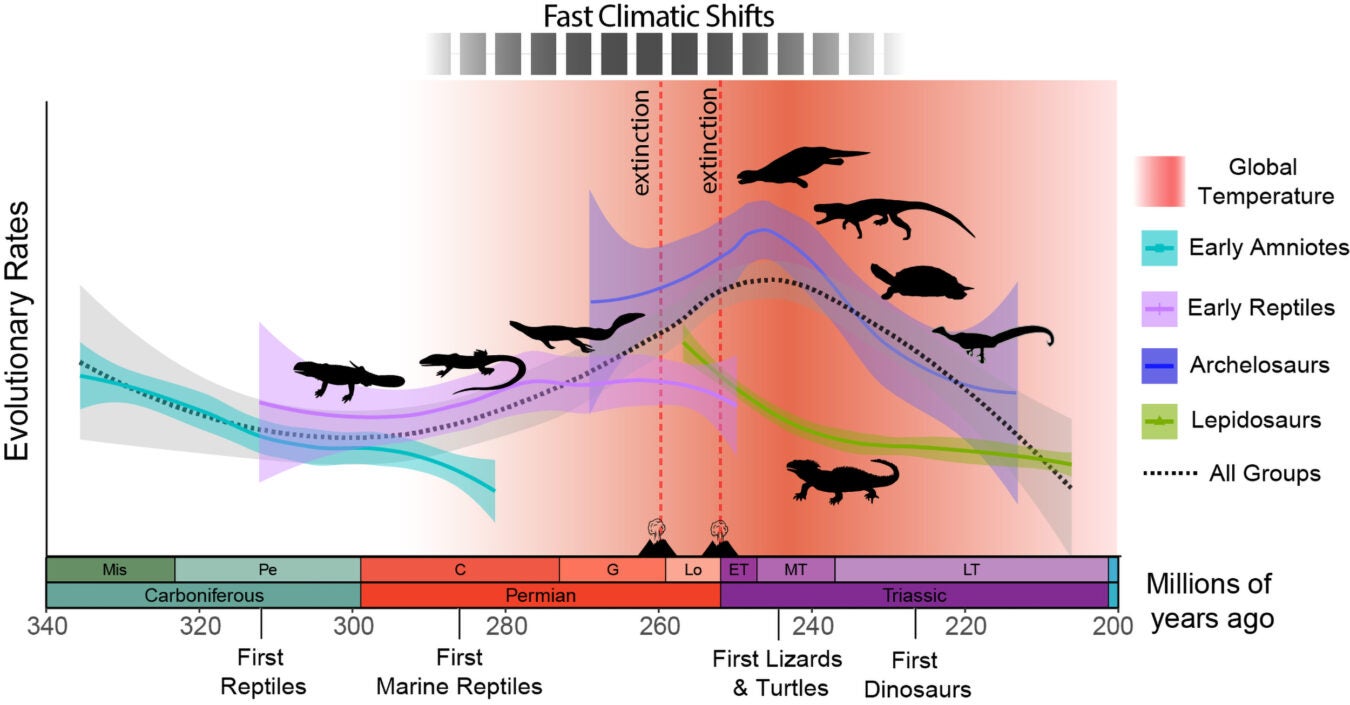
Chart shows rates of evolution (adaptive anatomical changes) in reptiles start increasing early in the Permian (at about 294 million years ago), which also marks the onset of the longest period of successive fast climatic shifts in the geological record. From 261 until 235 million years ago, increased global warming from massive volcanic eruption contributed to further climate change and led to the hottest period in Earth’s history. This resulted in two mass extinctions and the demise of reptile competitors on land (mammalian ancestors). The most intensive period of global warming coincided with the fastest rates of evolution in reptiles, marking the diversification of reptile body plans and the origin of modern reptile groups.

Evolutionary response from reptiles to global warming and fast climate changes.

Tiago Simoes

In the paper, published Friday in Science Advances, the researchers lay out the anatomical changes that took place in many reptile groups, including the forerunners of crocodiles and dinosaurs, concentrated between 260 to 230 million years ago.

The study provides a close look at how a large group of organisms evolved because of climate change, which is especially pertinent today amid rising global temperatures. In fact, the rate of carbon dioxide released into the atmosphere today is about nine times that seen in the period that culminated 252 million years ago in the biggest climate-change-driven mass extinction ever: the Permian-Triassic mass extinction.

“Major shifts in global temperature can have dramatic and varying impacts on biodiversity,” said Pierce, Thomas D. Cabot Associate Professor of Organismic and Evolutionary Biology and curator of vertebrate paleontology in the Museum of Comparative Zoology. “Here we show that rising temperatures during the Permian-Triassic led to the extinction of many animals, including many of the ancestors of mammals, but also sparked the explosive evolution of others, especially the reptiles that went on to dominate the Triassic period.”

The study involved nearly eight years of data collection along with loads of camerawork, CT scanning, and passport stamps as Simões traveled to more than 20 countries and 50 different museums to take scans and snapshots of more than 1,000 reptilian fossils.

The researchers created an expansive data set that was analyzed with state-of-the-art statistical methods to produce a diagram called an evolutionary time tree. That helped researchers see how early reptiles were related to each other, when their lineages first originated, and how fast they were evolving. They then overlaid it with global temperature data from millions of years ago.

Diversification of reptile body plans started about 30 million years before the Permian-Triassic extinction, making it clear these changes weren’t triggered by the event, as previously thought. The extinction events did help put them in gear though.

The data set also showed that rises in global temperatures, which started about 270 million years ago and lasted until at least 240 million years ago, were followed by rapid body changes in most reptile lineages. For instance, some of the larger cold-blooded animals evolved to become smaller, allowing them to cool down easier; others evolved to life in water. The latter group included some ill-fated reptiles that would eventually become extinct, such as a giant, long-necked marine reptile (like the modern conception of a Loch Ness monster); a tiny, chameleon-like creature with a bird-like skull and beak; and a gliding reptile resembling a gecko with wings. It also includes the ancestors of reptiles that still exist today, such as turtles and crocodiles.

Smaller reptiles, which gave rise to the first lizards and tuataras, traveled a different path than their larger reptile brethren. Their evolutionary rates slowed down and stabilized in response to the rising temperatures. The researchers believe it was because the small-bodied reptiles were already better adapted to rapidly rising temperatures.

The researchers say they are planning to expand on this work investigating the impact of environmental catastrophes on evolution of organisms with abundant modern diversity, such as the major groups of lizards and snakes.
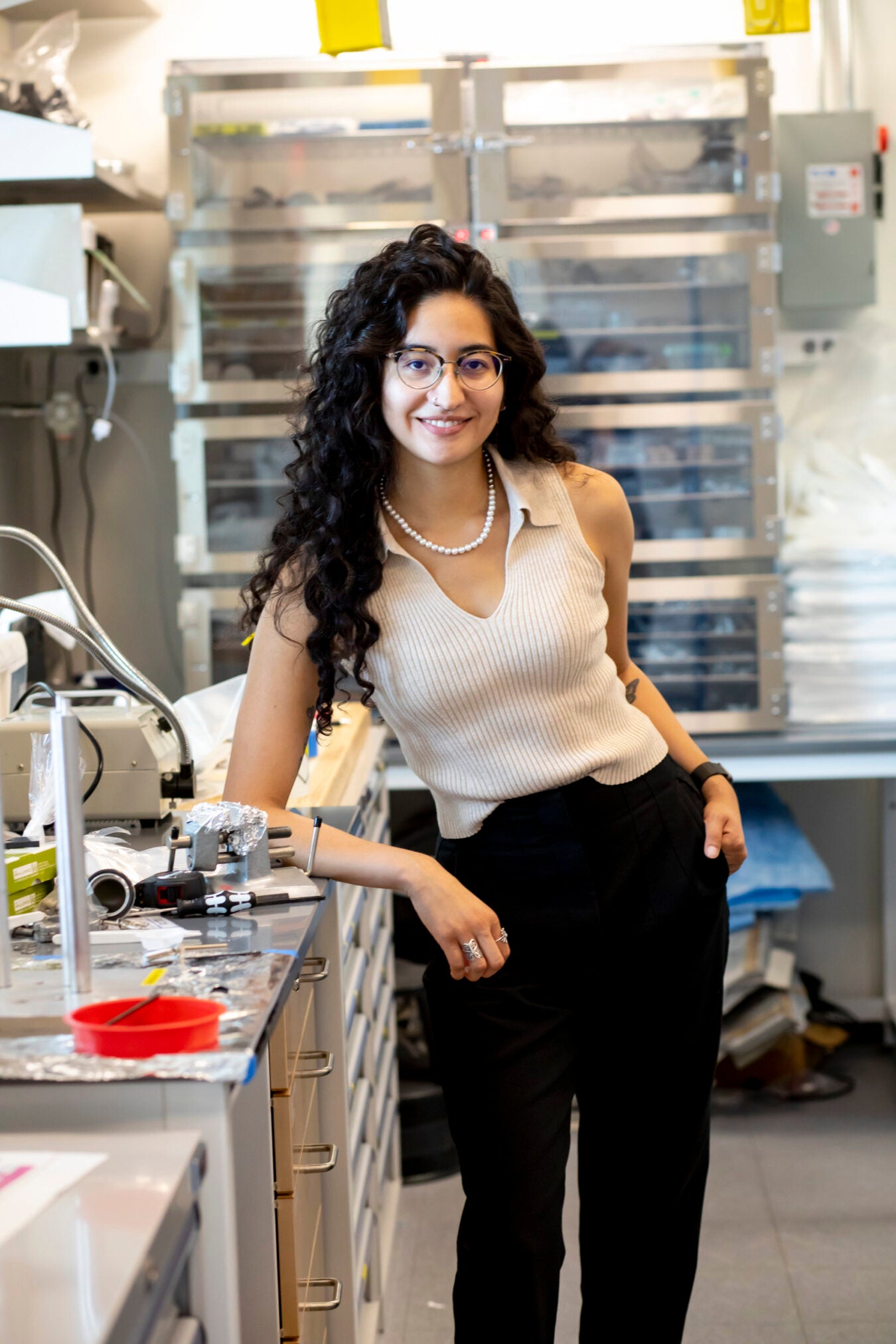

Denisse Córdova Carrizales spent her summer, quite literally, bringing the heat.

On a typical day Córdova Carrizales, who begins her senior year this fall, would arrive at the lab of condensed-matter physicist Julia Mundy at about 9 a.m. and don a white protective suit. The physics concentrator’s research involved working with chemical compounds heated in an oven to temperatures as high as 1,200 degrees Fahrenheit. Her job was to X-ray samples and perform electrical tests in a sealed container. If the material showed potential as a superconductor, she’d do further testing.

Córdova Carrizales was part of the first group of fellows in the Harvard Quantum Initiative’s Summer Research Program. The program, which is in its inaugural year, supported 10 undergraduate researchers from June to mid-August as they worked full-time in labs belonging to members of HQI.

The fellowship is designed for students with any level of prior research experience and provides advising and stipends to help them spend the summer in the Cambridge area. It also provides opportunities for the students to present their work and network with colleagues and peers. They work with supervising faculty and members of labs to design and pursue research projects in quantum science, including quantum information, systems, materials, and engineering.

Denisse Cordova Carrizales in the Mundy Lab.

“It helped me feel more confident about doing research,” rising senior Denisse Córdova Carrizales said of the summer program.

Rose Lincoln/Harvard Staff Photograher

The program offers the fellows a glimpse at the real-world lives of research scientists — and it’s not always as exciting as some might think. Córdova Carrizales says her process is repetitive and often nothing comes from the experiments, but it forces her to continually rethink and tweak what she’s doing. Fascinated, challenged, and “borderline addicted” to the work, she described the summer experience as giving her some technical expertise and a confidence boost as a scientist.

“This summer in general has made me realize that I really do enjoy research and do want to go on,” Córdova Carrizales said. “It helped me feel more confident about doing research. I’ve gotten to lead my own project. It has all made me feel very capable.”

“The program is about students getting the opportunity to work in a quantum lab just as a regular member of the lab, as if they were a graduate student or a postdoc,” said John Doyle, Henry B. Silsbee Professor of Physics, who co-directs HQI. “Having undergraduate students do actual work in a lab is crucial to their education and their professional development. What we’ve been able to do is provide a very easy on-ramp for our students to have this experience.”

HQI launched in 2018 with the aim of expanding research, development, and education in a rapidly expanding field that is key to future innovations and major technological advancement.

Creation of the undergraduate research program was largely spearheaded by Mundy, an HQI member and assistant professor of physics and applied physics. A Harvard College alumna, she knows firsthand the power of such experiences for undergraduates, especially in areas that build on prior lab work. Those experiences, she said, were critical in shaping her career as a researcher in quantum materials.

“The summer between junior and senior year was completely pivotal for me,” Mundy said. “It wasn’t the first research experience I had, but it was a really special one because it’s right when you’re thinking about going to grad school and what [line of research to focus on]. It’s really exciting to see a new generation of undergraduates have the same experiences.”

Students in this year’s program are working on a range of projects, from optimizing quantum technology to decoding errors in quantum computers to building lasers that can more easily cut materials such as graphene. Córdova Carrizales, for example, designed a project looking for a new family of materials that could lead to superconductors that can operate at higher temperatures. It’s a Holy Grail in condensed-matter physics because of the door they would open to long-term, sustainable electric energy.

Andrew Winnicki, a rising senior from Quincy House studying physics and math, is part of the Doyle lab. He is using a laser array to control a molecule that one day could be used as a qubit in quantum computers.

“It’s unpredictable and exciting, because sometimes the experiment will throw something at us that we need to figure out how to deal with,” Winnicki said. “I’ve added many new techniques to my experimental tool kit, like different laser and optics setups, or skills such as designing electronics and machining hardware that will go inside of the vacuum chambers. It’s all been a big part of my growth as a scientist.”

Mincheol Park — an international student from South Korea who has a joint concentration in chemistry, physics, and math — is working on the theoretical side of quantum science. The rising junior is trying to produce a protocol to implement error-correcting codes for quantum processors that exist today. He’s valued the mentorship working full-time in the lab of physicist Mikhail Lukin. Park said he’s learned a lot from graduate students in the lab about how to prioritize work and what to do when something isn’t working. It also helps to hear about their career paths.

“It’s really good that I am able to learn this kind of lifestyle this early after my second year of college,” Park said.

The HQI undergraduate fellowship hosts a series of lunches for the fellows to network with other fellows and learn about each other’s work, as well as unwind and bond over their shared summer experience. There is also a poster session where the students present their work to the larger HQI community.

“It was an unexpected community this summer,” said Cassia Lee, a rising junior in Eliot House concentrating in chemistry and physics. “It’s easy to focus on your work and be in your own bubble, but it was really good to take a step back and see what everyone is doing.”

Standing at the poster session amid the different projects and diverse group of students, Doyle reflected on another of the key points of the fellowship: students pushing themselves to their limits and beyond.

“Generally, students are able to rise to whatever level of capabilities they have,” Doyle said. “In the lab, there is no upper limit. They can go as far as they want.”


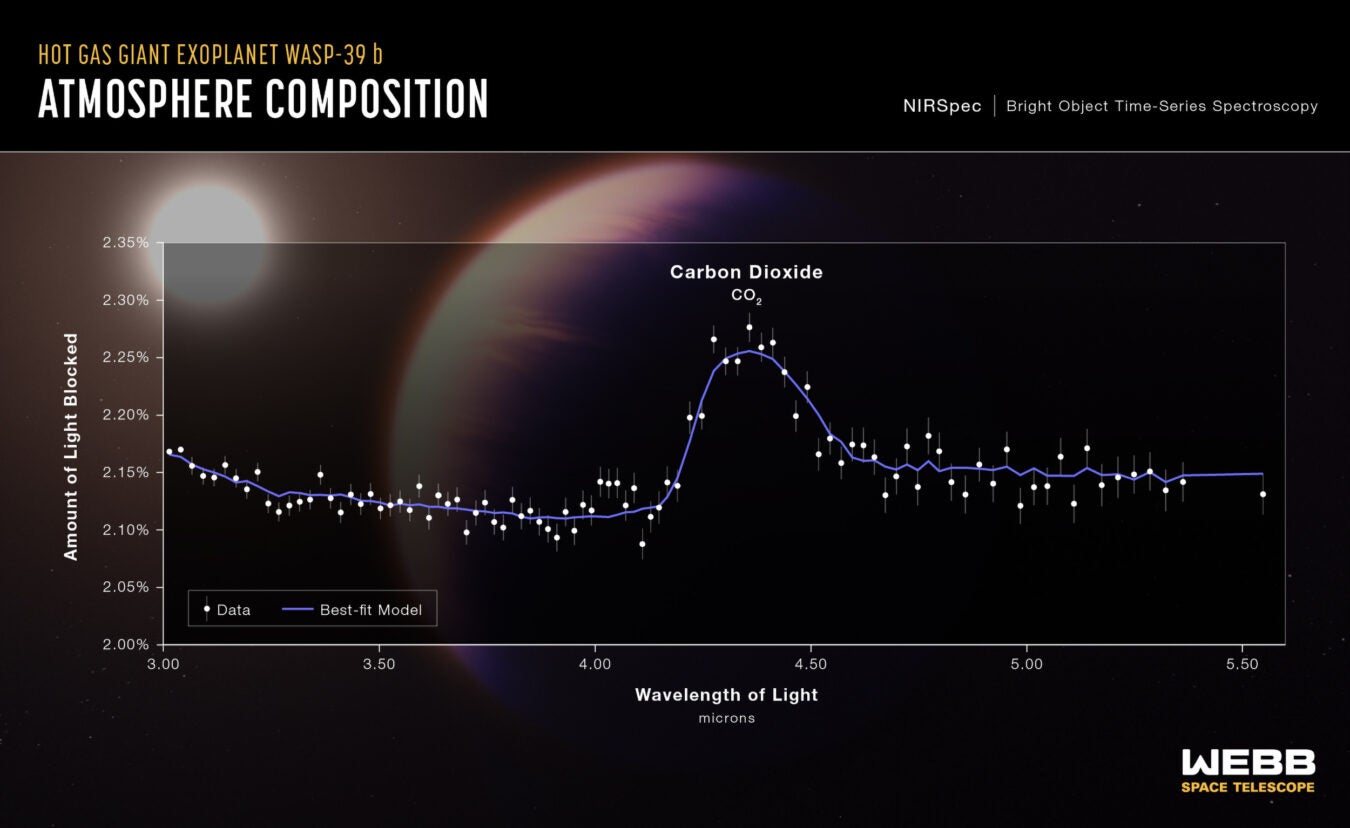
Scientists using NASA’s James Webb Space Telescope have captured definitive evidence of carbon dioxide in the atmosphere of a planet beyond our solar system.

The discovery, published in the journal Nature, gives scientists hope the powerful telescope, also known as JWST, will provide new insights on the composition and formation of exoplanets.

“Such a clear detection of carbon dioxide in this planet is exciting because it indicates that we will also be able to detect CO2 in the atmospheres of smaller, terrestrial planets,” said Mercedes López-Morales of the Center for Astrophysics | Harvard & Smithsonian.

López-Morales is one of two Harvard astrophysicists who worked on the study as part of a team of some 100 scientists. The other, James Kirk, single-handedly performed one of the four analyses the researchers ran on data from the telescope.

“This is the first time we have seen CO2 in an exoplanet atmosphere, which has incredibly exciting implications for studying carbon and oxygen chemistry in these planets, and in turn on how they form and evolve,” Kirk said.

The carbon dioxide molecules were detected in the atmosphere of “WASP-39 b,” a gas giant orbiting a sun-like star 700 light-years away. Scientists observed the exoplanet on July 10 using the telescope’s Near-Infrared Spectrograph.

Transmission spectrum captured by James Webb Telescope's Near-Infrared Spectrograph on July 10.

Data captured by James Webb Space Telescope's Near-Infrared Spectrograph on July 10.

NASA, ESA, CSA, Leah Hustak (STScI), Joseph Olmsted (STScI)

WASP-39 b was already on scientists’ radar. In 2018 NASA’s Spitzer Space Telescope revealed hints of carbon dioxide in its atmosphere. Previous observations from other telescopes had revealed water vapor, sodium, and potassium.

Thus the exoplanet was the ideal candidate for a follow-up using the new and improved JWST, said López-Morales.

Another factor: WASP-39 b is a transiting planet. During a transit, some of the starlight is eclipsed by the planet completely, causing overall dimming, and some is transmitted through the atmosphere. The atmosphere filters out some colors more than others depending on what it is made of, how thick it is, and whether there are clouds. Because different gases absorb different combinations of colors, researchers can analyze small differences in brightness of the transmitted light across a spectrum of wavelengths to determine the exact make-up of an atmosphere.

In this case, the resulting spectrum scientists obtained was significant: the first clear, detailed, indisputable evidence for carbon dioxide ever detected in a planet outside our solar system.

“The remarkably strong signal is a testament to [JWST’s] exquisite precision and revolutionary wavelength range, and demonstrates how much we stand to learn from this awesome observatory,” Kirk said.


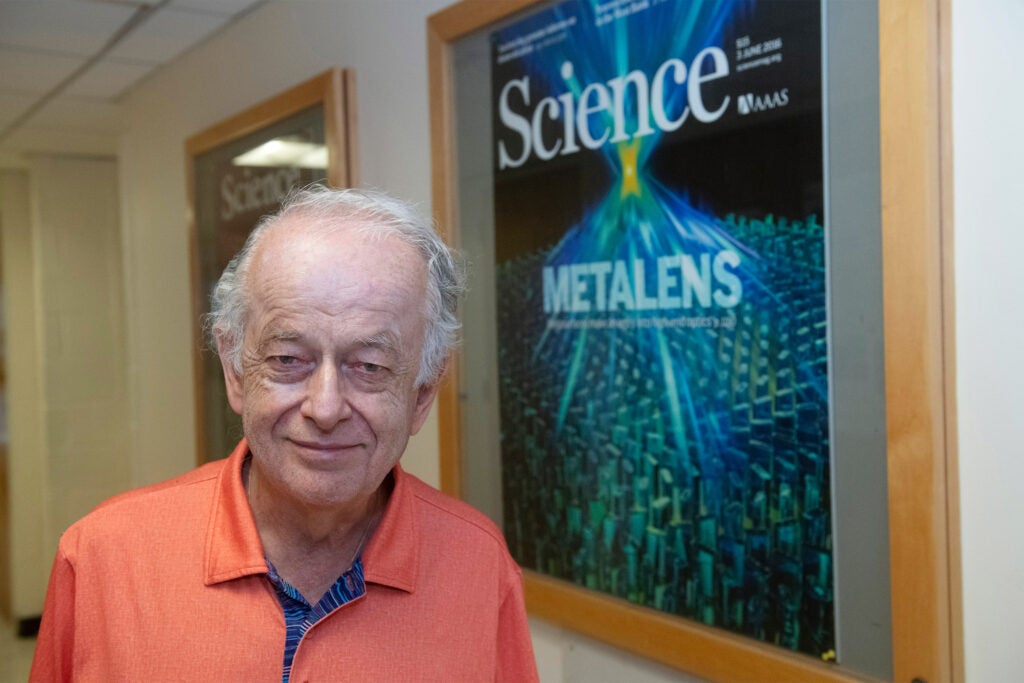
In June 2016, Alan Gordon’s phone was ringing off the hook. On the cover of the prominent journal Science was a striking image of a newly developed “metalens,” an array of tiny rectangular nanostructures that looked like skyscrapers in a vanishingly small city and focused light to a single point.

It was an invention that for years had been followed by doubt. Early results proved the concept, but the models were able to focus so little light it was thought a metalens might never be improved enough to be useful, one expert said. Later, better findings were questioned as inaccurate, and requests came in from incredulous reviewers for actual design details.

“They say it’s impossible, or you’re cheating somewhere in the system,” said Reza Khorasaninejad, a former postdoctoral fellow who was first author on several metalens papers before leaving Harvard in 2017.

But the promise for the esoteric innovation beckoned, too. Federico Capasso, the Robert L. Wallace Professor of Applied Physics in whose lab the devices were developed, had long recognized that they had the potential to do everything conventional lenses could do and more, enabling new functionality in a smaller package for all kinds of advanced devices like those for handheld facial recognition that need to “see” and do so cheaply enough that they might disrupt an industry still making lenses as they long had been, out of curved elements of glass or plastic. But it would be a long road, one that illustrates the roadblocks scientists and entrepreneurs face between the light-bulb moment and actual products.

“That’s what I liked about Federico. He doesn’t listen to these guys,” said Khorasaninejad, who worked in Capasso’s lab for three years. “He told us, ‘Let’s focus on this.’ He gave us the resources; he gave us the guidance.”

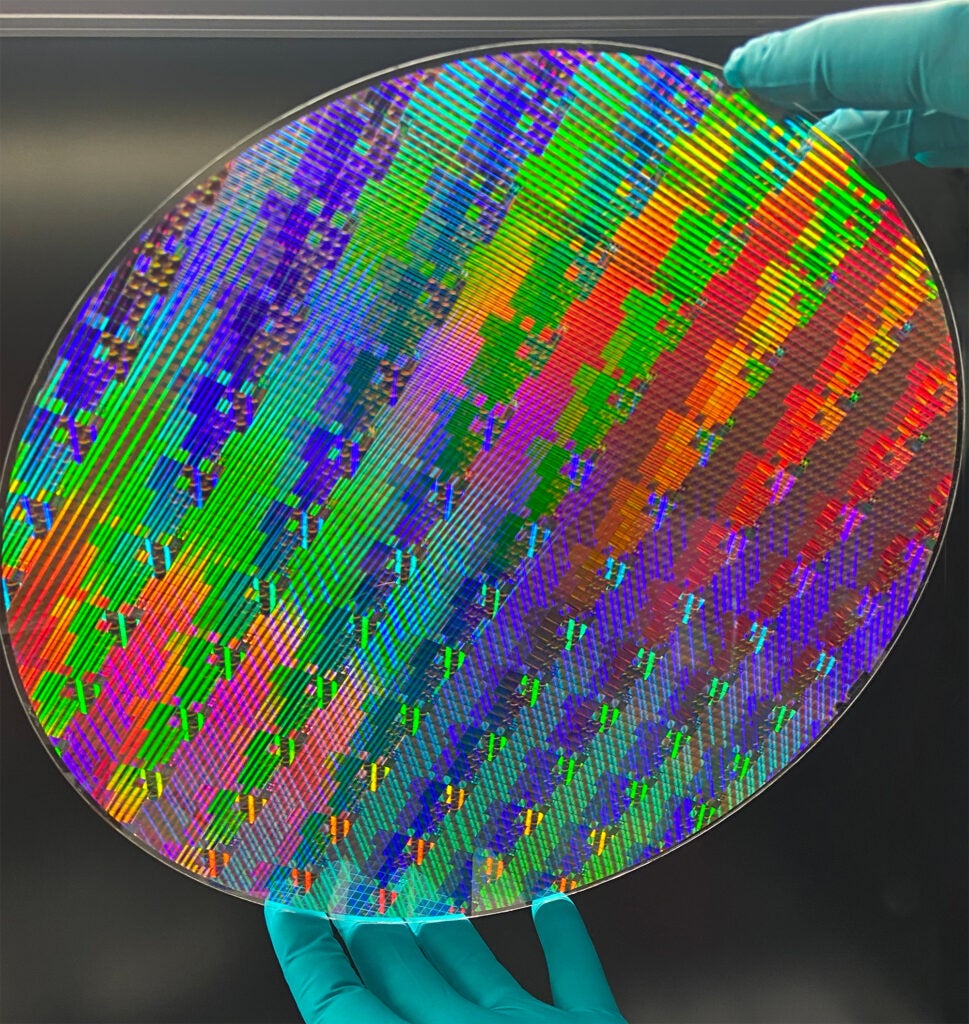
Metalens.

While traditional lenses use curved glass or plastic to bend light and focus an image, a metalens uses a series of tiny pillars on a millimeter-thin wafer.

Metalenz

In early 2016, a team led by Capasso, with key contributions by Khorasaninejad, graduate student Rob Devlin, and postdoc Wei Ting Chen, showed that it indeed could be done and done well enough that commercial devices were possible. Capasso filed a report of invention with the Harvard Office of Technology Development and, soon after, the discovery made Science’s cover. Gordon, OTD’s director of business development for physical sciences, stepped in to manage the avalanche of interest.

“I’ve been doing this for far longer than I like to admit but that paper, the invention, and the patent we filed generated far more commercial interest — from companies, entrepreneurs, investors — than any other hard-tech invention I can remember,” said Gordon. “It was exciting and a bit shocking. We met and talked with a lot of people about this work.”

Those people understood then what Capasso had seen more than a decade earlier. Lenses are essential components in a host of devices, focusing and detecting light — both visible and invisible — for applications well beyond imaging, including facial recognition in smartphones and laptops, proximity and gesture detection to enhance responsive functions in automated devices, depth-sensing cameras, environmental awareness in drones and robots, and collision avoidance in self-driving cars.

In many of those devices, space is tight. The stacked elements of plastic or glass in traditional lenses have resisted the true miniaturization that most other components have undergone. They remain among the bulkier components, and a bottleneck in device design.

“I hold up my cellphone and pull out a credit card,” Gordon said, describing how he introduces the technology to potential investors. “There are only two reasons the phone is not as slim as the credit card. One is the camera and the other is the battery. The metalens will help enable the phone to be as slim as a credit card.”

While traditional lenses use curved glass or plastic to bend light and focus an image, a metalens uses a series of tiny pillars on a millimeter-thin wafer. The pillars are smaller than the wavelength of light and transparent to the desired wavelength. The pillars’ shape, the distances between them, and their arrangement on the wafer are varied to bend light as desired.

Not long after that Science cover, OTD licensed the technology to a startup, Boston-based Metalenz, founded by Capasso, Devlin, and Bart Riley, a tech entrepreneur with whom that office had previously worked. Now Metalenz’s chief executive, Devlin made a key materials advance in the Capasso lab that greatly improved the lenses’ efficiency. Earlier this year, Metalenz logged its first major sale, with manufacturer STMicroelectronics. STMicro will use metalenses in the company’s “time of flight” modules, which provide 3D sensing in an array of devices and which have previously sold 1.7 billion units. Those units appear in everything from drones to robots to smartphones. Metalenz said in June that it expects its optical components to be in millions of consumer devices this year.

Khorasaninejad, who today is CEO and cofounder of San Francisco-based Leadoptik, called the deal “a very, very strong endorsement from industry,” while Capasso said that the metalens can be made in the same factories as computer chips is potentially “game-changing,” as it unifies two industries: semiconductor manufacturing and lens-making.

“The same planar technology, known as deep ultraviolet lithography, to mass-produce integrated circuits — chips — can be used by the same foundry to make flat optics such as metalenses,” Capasso said. “It means that the entire camera module of a cellphone or laptop will eventually be manufactured in one sweep, including the metalens and the sensor.”

‘Can you get rid of the lens?’

Capasso came to Harvard in 2003 after a career at Bell Labs, where, in 1994, he and colleagues invented and developed the quantum cascade laser, currently being commercialized in devices for chemical sensing and spectroscopy.

Capasso traced the development of the metalens to a conversation he had more than a decade ago with Jim Anderson, the Philip S. Weld Professor of Atmospheric Chemistry. The two had been discussing putting a quantum cascade laser on a drone that Anderson wanted to use to detect certain chemicals in the atmosphere, but there wasn’t enough room. That was in part because of the bulky optical elements needed for focusing. Anderson got to the heart of the problem.

“He said, ‘Can you get rid of the lens?’” Capasso recalled. “My first reaction was, ‘What the hell is he talking about?’ But then I said, ‘No, wait a moment.’”

Capasso started to brainstorm the idea with a couple of students in his group. Starting in 2007 or 2008, they began to focus on the scientific question of whether it was possible to bend light in an entirely flat device.

Rob Devlin.

Rob Devlin, now Metalenz CEO, made a key materials advance in Capasso's lab as a graduate student that greatly improved the lenses’ efficiency.

Metalenz

Early work used what they termed “plasmonic antennas” that eventually evolved into metasurfaces — millimeter-thick, two-dimensional surfaces studded with tiny nanostructures smaller than the wavelength of light. Those arrays, Capasso said, can alter the path of light flowing through it in a kind of “artificial refraction.”

That work progressed incrementally, producing several scientific papers that led to a 2011 breakthrough, published in Science and now cited more than 5,400 times. Capasso and members of his lab demonstrated they could tune the nanostructures and bend light to a roughly focused “hotspot.”

While the results were of scientific interest, the efficiency was so low that most of the light was lost, a result that skeptics said meant it would never become useful.

Bringing fresh eyes, new skills

In 2012, Devlin joined the lab. With no optics background, Devlin instead worked in an area Capasso thought would be key: materials science and nanofabrication. Devlin himself believed that the lab had mostly figured out the science, and that choosing the right materials and fabrication processes would be critical to improved results.

“The metasurface was a great proof of concept, but the devices themselves were really inefficient,” Devlin said. “There were problems in how it was fabricated, in materials, and design.”

Devlin set about considering materials and processes that not only worked in the lab, but that would also work, if a successful device needed to be scaled up. Ultimately, he settled on titanium dioxide, a compound widely used in paint pigment, sunscreen, food coloring, and as a reflective surface in dielectric mirrors. More importantly to Devlin, it had low light-absorption properties.

Federico Capasso.

Capasso and his postdocs are working on new discoveries, including an ambitious “universal camera” that can see all properties of light at the same time.

Jon Chase/Harvard Staff Photographer

By late 2015, there were eight to 10 people in the lab working on different aspects of metasurfaces. As each turned their focus to lens performance, they brought perspectives and insights gleaned from their diverse prior efforts.

Devlin knew they had things right when the efficiency — the amount of the available light the device could focus — abruptly began to climb, rising from 10 percent to 85 percent in a few weeks. The rapid improvement and clarity of the resulting images stunned Devlin, Khorasaninejad, and Chen.

Those results spurred the 2016 Science paper, which not only generated a buzz in the lens industry, but also became a runner-up for Science’s breakthrough of the year. Despite the accolades and new belief in the promise of a metalens, it still focused just single wavelengths of light. And, while there were certainly uses for single-wavelength light — facial recognition, for example, is done by bouncing a single wavelength outside the visible spectrum off a person’s face and analyzing the light that returns — the next challenge was to produce the first “achromatic” metalens, one that focuses light across the visible spectrum.

“I locked myself in my office with Wei Ting Chen for the weekend, and I said, ‘Now we need to understand what we have done,’” Capasso said. “Our design ensured that all the colors, irrespective of where they take off, arrive at the same time in the same spot.”

It took two years, but in 2018, they became the first to report success, with high resolution.

In the meantime, though, Gordon was fielding calls from industry and advising Capasso and Devlin as to the next step of the metalenses’ commercial development. He counseled them that founding a startup around a new technology tends to be more successful than licensing it to a large corporation, where it can get lost. They listened and founded Metalenz to commercialize the invention and look for additional applications.

Devlin, meanwhile, had a decision to make. He had entered his graduate studies thinking he would pursue an academic track when he left Capasso’s lab. But he had the opportunity to be among the founders of Metalenz and shepherd the device’s development himself.

To Capasso, though, Devlin’s first priority was finishing the degree. He didn’t let up on the younger scientist, requiring he continue research and complete another scientific paper. Then Capasso ran interference with investors and companies wanting a piece of Devlin’s time.

“Federico made sure I was not abandoning the completion of my Ph.D.,” Devlin said. “He said, ‘No one is to contact Rob until he completes his dissertation.’”

Devlin defended his dissertation in 2017 and graduated in June 2018. When OTD and Metalenz announced the startup to the world in 2021, Devlin was its chief executive.

“The Ph.D. student is not always a CEO type, but some are, and Rob has shown he has the personality for it,” Gordon said.

The last several years have seen Devlin taking the company through several startup milestones, securing funds, developing relationships with manufacturers, and the recent announcement that the company’s metalenses will go into mass production.

Though Metalenz has licensed more than 20 Capasso lab patents from Harvard, Capasso and his students and postdocs are busily working on new discoveries. A current focus is on ultracompact, polarization-sensitive cameras — based on flat optics — that can detect the direction in which light vibrates after it’s transmitted or reflected, revealing otherwise invisible details of a scene. His group is involved with two collaborations with NASA on these cameras, related to Earth sciences and solar physics. He and his students are also toying with the idea of a “universal camera” that can see all properties of light at the same time, including ones that can’t be seen by existing cameras. Capasso described that challenge as “very ambitious.”

“We are here to learn, starting with me,” Capasso said. “I always tell students, ‘If you have something good, you have to give it away. Don’t keep it to yourself.’”


To accomplish feats of athletic or academic excellence and even everyday actions like walking and talking, the brain must acquire and seamlessly process a ton of information. That requires a whole orchestra of cells to “listen” and move, interact, and coordinate with one another. One of the most enduring, fundamental questions in neuroscience involves precisely how this happens.

Scientists know that this cellular symphony includes not only neurons, but cells that normally play a role in defending the body against pathogens. One group is tiny immune cells called microglia, which researchers are increasingly learning play oversized roles in brain function, health, and disease. The cells are also gaining increased attention for their roles in assembling and maintaining neural circuits and their ability to change their molecular identity to match their environment. A key to solving one of neuroscience’s great mysteries involves finding out how they make this change.

In a new report in Nature, researchers from the lab of Paola Arlotta, Golub Family Professor of Stem Cell and Regenerative Biology and the Stanley Center for Psychiatric Research at the Broad Institute, move a step closer to answering this question. The paper, published Wednesday, shows that microglia cells “listen in” to neighboring neurons and change their molecular state to match them.

“When they were first discovered, microglia were assumed to be simply scavengers, cleaning up cell debris and helping to fight off pathogens,” said Jeffrey Stogsdill, who led the study as a postdoctoral researcher in the Arlotta lab. “Now we know that microglia can interact with neurons in very sophisticated ways that can affect neuron function.”

This discovery could one day open the door for lines of research that can target communications between microglia and their neuron partners with pinpoint accuracy, offering insight into disorders such as autism and schizophrenia, which arise when these communications between cells go awry.

“You would no longer have to treat, for instance, microglia as one blanket cell type when trying to affect the brain,” Stogsdill continues. “We can target very specific states, or we can target very specific subtypes of neurons with the ability to change specific states of microglia. It allows us to have high-level granularity.”

The study provides unique insight into how different cell types work together in harmony.

“What we’re discovering here are the rules by which different cell types in the brain talk to each other and influence each other to ultimately be able to do more together,” said senior author Arlotta, an institute member at the Broad.

In the paper, the scientists describe how neurons train microglia to work with them when they first meet, early in the life of the brain. The group found that during the formation of the cerebral cortex — a part of the brain responsible for skilled motor function, sensory perception, and cognition — different types of neurons influence the number and molecular state of nearby microglia in their own unique ways.

“These different types of cortical neurons recruit different numbers of microglia,” Stogsdill said. “They then pattern those microglia to tell them exactly what type they need to be.”

The cerebral cortex is organized into layers, with different neuron types residing in each. The researchers used genetic profiling methods to examine the microglia in the different layers and discovered that they varied in number and molecular state depending on the layer in which they were found. The team then changed the composition of neuron types in these layers and found that they could influence the distribution of the different microglial states. The microglia matched the types of neurons in the new locations, confirming that the neurons were influencing them.

The research team then built a molecular atlas that outlined the communication between neurons and microglia. The team analyzed their profiling data to find pairs of interacting proteins expressed by the different microglial states and their neuron partners. Such a molecular atlas could enable future research into the functional roles of these interactions and possible targets for therapeutic intervention. The researchers plan to start by explaining exactly what differences and functional distinctions exist among microglia in the different layers.

“We know that microglia can affect the function of the neural circuit, and now we know that neurons can recruit specific types of microglia to their neighborhood,” Arlotta said. “It’s a fascinating idea that neurons can reshape their environment to help fine-tune their own circuit function.”

This work was supported by grants from the Broad Institute of MIT and Harvard, the U.S. National Institute of Health, the Klarman Cell Observatory, and the Howard Hughes Medical Institute.


Do spiders dream? A new study looking at infrared footage of 34 juvenile jumping spiders suggests that perhaps they do. The team of former Harvard researchers analyzed videos of the sleeping arachnids and found they exhibited a rapid-eye movement (REM) dream-like state, which they could directly observe because juvenile spiders have translucent exoskeletons. The researchers also documented limb movements characteristic of dreaming, including leg twitching and curling. The study is believed to be the first time REM sleep-like behavior has been documented in a terrestrial invertebrate. Two of the study’s authors, Paul Shamble, a former John Harvard Distinguished Science Fellow who performed the work while he was still at the University, and Daniela C. Rößler, a former postdoctoral researcher in Shamble’s Harvard lab, spoke to the Gazette about key findings of the study, which was published Monday in PNAS. The interview was edited for clarity and length.

Q&A

Paul Shamble and Daniela C. Rößler

GAZETTE: When REM happens in humans or even in dogs, research shows that they’re dreaming. Are jumping spiders dreaming, and what is the significance behind that?

RÖẞLER: Let’s get to the biggest question right at the front. Well, I personally think they are dreaming — just like any person watching a dog or cat sleep and kick their leg will think that they’re dreaming — but being able to scientifically prove that is a whole different story. I don’t think we can say they are, and I’m not even sure we will ever be able to say it, but the fact alone that we’re thinking about it is already quite amazing.

SHAMBLE: In terms of significance behind that, that possibility makes you wonder what dreaming is for and what it’s doing. Because the brains of these animals are so different from ours and their evolutionary history is so different from ours, it makes you start to wonder about if this kind of visual dreaming is just what visual brains do. And that would be a very different way to think about REM than the way that we typically think about it now.

GAZETTE: Can you explain what you mean by that? 

SHAMBLE: So much of what we think about REM is about vision. It makes me wonder if creatures that aren’t visual also dream. Jumping spiders are really visual, but there are lots of spiders that aren’t visual but have very similar brains. It makes me wonder if dreaming happens in a lot of different ways.

GAZETTE: How did you decide to look at this and how did the experiment work?

RÖẞLER: We accidentally stumbled across these jumping spiders hanging throughout the night. They would suspend themselves on the silk thread, and it looked like a very neat strategy to avoid predation at night. After a study looking at that, we thought if they hang all night, what are they actually doing? We recorded the adults as they hung there. We saw these regularly occurring bursts of activity that just looked or reminded us a lot about when you watch cats and dogs sleep or dream where you just see these quite uncontrolled twitches. Just everything about it looked like sleeping or dreaming to us. That’s when we began even asking that question. Could this be something like REM sleep?

We knew that the babies were translucent right after emergence, so we waited for a few to emerge. We then tried filming those babies so we could see the retinal tubes. We saw the exact same twitching behaviors and leg-curling behaviors and always when these types of activity happened the retinas were moving. That was quite mind-blowing.

GAZETTE: In the paper, you describe limb movements as one of the biggest signs of REM sleep. Why is that so important?

RÖẞLER: What is characteristic for REM sleep is not only the eye movements but also the muscle atonia during that time, which is basically motor function being greatly diminished so someone doesn’t run off while they dream. It shuts down, basically. In spiders, the whole system is based on hydraulics. They do not use muscles to extend their legs, but they use muscles just in the head to basically push fluid into the legs to extend them. When muscle atonia happens, what we think is happening is that the muscles in the head relax and that leads the legs to decrease in pressure, and so they curl up, basically like a dead spider. (All dead spiders have their legs curled up.) For us, this muscle atonia proves they are not awake and suggests the body is trying to suppress motion.

GAZETTE: Big question: If these jumping spiders are, in fact, dreaming, what do you think they’re dreaming about?

SHAMBLE: I think this is a really big question. It’s actually a question about the nature of dreams, which is sort of astonishing. You, sort of, just have to base it on your own experience. I assume that they’re dreaming about their own lives, like what happens to them during the day, the same way that we do — some strange visual version of their own experience. That’s pretty profound.


Senate Democrats reached a sudden agreement on climate, inflation reduction, and other issues recently, with Senate Majority Leader Chuck Schumer and West Virginia Sen. Joe Manchin agreeing to a package that would spend billions to boost climate change responses and make other tax and revenue changes that would more than pay for the spending over time. The proposal’s supporters say it would spend $369 billion on climate change and energy security while the nonprofit Committee for a Responsible Federal Budget puts the number at $385 billion. The Gazette spoke with John Holdren, who served as President Obama’s top adviser on science and technology policy and today is the Teresa and John Heinz Research Professor of Environmental Policy at the Harvard Kennedy School, about the legislation and its potential impact, should it survive Senate and House scrutiny and be signed by President Biden. Interview was edited for clarity and length.

Q&A

John Holdren

GAZETTE:  This proposed legislation seemed to surprise a lot of people when it was announced late last month. Did it surprise you?

HOLDREN: Yes. Like most people, I thought when Manchin declared it dead only a few days earlier, it really was dead. I was very gloomy about it, and everybody I know was very gloomy about it. But somehow Schumer and Manchin figured out a way to rescue it, and they rescued a lot of important stuff. They didn’t get agreement on everything that matters, but what we got — assuming this is actually passed and signed into law — would be a whole lot better than nothing.

Apparently, the key with Manchin was a combination of measures to avoid an inflationary hit from expenditures on clean energy and climate change and some agreements mandating a certain amount of leasing on federal lands for oil and gas. While it’s disappointing to some of the environmental groups and many environmentalists that that was the price, a lot of us believe it will be much less impactful than the investments in clean and efficient energy. Not a bad deal, is my conclusion.

GAZETTE: I’ve seen some saying this would be the strongest climate legislation ever passed at the federal level. Do you agree?

HOLDREN: I think that’s right. There have been a number of assessments published — not just by the bill’s authors — suggesting that this could be enough to get us to 40 percent below 2005 emissions by 2030. That’s not quite as far as the 50 percent Biden promised, but it’s also not 2030 yet, and this could be more than a good start on additional measures that might get us the rest of the way. I say that without believing that any particular numerical target is the key to salvation. We are already experiencing, at about 1.2 degrees Celsius above preindustrial temperatures, devastating droughts, wildfires, torrential downpours and floods, more powerful storms, expanding ranges of tropical diseases, and more. The climate change problem is already upon us, and there’s no silver bullet that’s going to make it all go away. We have to aim for increasingly effective measures to reduce emissions by a very large margin. And 40 percent below 2005 emissions levels by 2030 would not be bad — not good enough, but this measure may stimulate some follow-ons, particularly once some of its provisions are seen to be succeeding.

John Holdren

“The single most important thing that’s left out — under current political circumstances, there was just no way it was going to get done — is putting a price on carbon emissions across the board,” said John Holdren.

File photo by Stephanie Mitchell/Harvard Staff Photographer

GAZETTE: There are a lot of incentives aimed at consumers in the legislation, with tax credits for energy efficiency and electric cars. Does it take largely a bottom-up approach or is it more balanced than that?

HOLDREN: I think it’s more balanced. It’s both bottom-up and top-down. I’ve always thought that comprehensive programs on almost anything significant — and difficult — need to be a combination of bottom-up and top-down. This looks to me like a pretty good balance. There are important things missing that were in the other measures the Biden administration was trying to get through, but there were also some not-so-good elements in there that have been dropped. I don’t argue that this is an ideal piece of legislation, but it is so much more than we thought we were going to get.

GAZETTE: Are there specifics in there that you like in particular? That may have multiplier effects?

HOLDREN: The energy and climate total, $385 billion, is terrific. The clean-manufacturing tax credits represent a very productive approach. The tax credits to consumers for buying electric vehicles and energy-efficiency improvements, too. We know that those work. The real name of the game in getting emissions under control is making the clean options more attractive economically than the dirty options. It’s that simple. So any measure that can contribute to creating or expanding the economic advantage of going with clean and efficient technologies is a smart thing to do, and there’s a lot of that in here.

There are also some specifics, like very substantial incentives to companies for reducing methane emissions, that are a big deal. Some of the measures focused on offsetting the economic costs are also very good. There is always an emphasis on how much it’s going to cost to have cleaner options faster, but there is almost never a discussion of how much money those measures will ultimately save the economy through reduced damages from climate change. I wish there was more attention paid to the economic benefits of taking these steps. Our late, great economics Professor Dale Jorgenson, who died recently, was a great exponent of the proposition that doing what we need to do to address climate change would ultimately be an economic benefit, not a cost.

GAZETTE: Looking at cost, will we eventually reach a tipping point after which renewables will be cheap enough that they’ll spread on their own, like natural gas did when it undercut coal? Is it possible that this legislation can get us to that tipping point?

HOLDREN: In some respects, we’ve gotten to that point already. Electricity generation from solar photovoltaics and from wind power in many places is now cheaper than electricity generation with coal. And in some places, it’s cheaper than electricity generation with natural gas. That’s a very important driver. One of the challenges is that some technologies that we need to embrace if we’re going to get emissions reductions down as much as we need to are more obstinate economically. I’m thinking of carbon capture, sequestration, and utilization, for example.

Some environmentalists hate those options, saying it’s just a further lease on life for fossil fuels. But in a world that is still almost 80 percent dependent for its primary energy on coal, oil, and natural gas, we have to recognize that there is going to be quite a lot of fossil fuel burned in the years ahead. What we need to do, given the urgency of the climate change challenge, is make it possible to burn some of that fossil fuel in ways that do not release the resulting carbon dioxide into the atmosphere. But carbon capture and sequestration of that carbon in geologic formations is intrinsically expensive, and we will do it only if it is made more economical with subsidies from the government or regulations. So that is another good characteristic of this new legislation: It would provide a boost to the subsidies for carbon capture and sequestration.

GAZETTE: Might supporting carbon capture and sequestration tell oil companies that they have a place in a future carbon-free economy and bring them on board, or is there little chance of them doing anything other than fighting this tooth and nail?

HOLDREN: The situation with the big oil and gas companies has been changing. Some of them are now very progressive in their approach to this problem. BP, for example, has completely restructured its business plan and is aiming for major reductions in the emissions of their operations, and ultimately the emissions for which they’re responsible. I’m quite sure they’re serious about it. A number of the other big oil and gas companies are moving in that direction. I’ve been saying for decades that we’re not going to solve climate change over the dead bodies of private sector companies. We’re going to solve the problem by finding ways to bring those companies on board in a pathway toward a much more sustainable energy system. Those folks can also do arithmetic — in fact they’re very good at it. They can read the data, and the data on climate change make clear that it’s real, it’s deadly, it’s here. And if we are to at least minimize the worst consequences of climate change, there’s going to have to be a much bigger transition than oil and gas companies until recently were willing to acknowledge. They’re acknowledging it now and trying to figure out how to do it. We should push them along.

GAZETTE: There are tax credits to encourage energy production, including large plants of solar and wind power. Does the legislation do anything to encourage the transmission lines needed to get the power from the places where the wind blows and the sun shines to the big cities?

HOLDREN: The biggest problem with transmission is the permitting. It’s incredibly complex to build a transmission line anywhere because of the number of permits required and the ability of any one of those permit grantors to refuse and to block the project. There is language in this legislation about accelerating and streamlining the permitting processes, and that’s going to be important if it can succeed. But this is a very difficult nut to crack because of people’s affection for due process and for review at various levels. That makes it very difficult to solve the transmission problem. It’s clear that a key to a higher proportion of renewable energy in our national mix is being able to build expanded transmission networks to get the energy from where it’s most economically generated to the places where the largest consumption is taking place. We really do have to master the transmission siting challenges in this country, or we’re cooked.

GAZETTE: What’s left out? How do we get the extra 10 percent emissions reduction that Biden wants?

HOLDREN:  The single most important thing that’s left out — under current political circumstances, there was just no way it was going to get done — is putting a price on carbon emissions across the board. That could be done either with a carbon tax or with a cap-and-trade approach, as was tried initially in the Waxman-Markey bill that failed in the beginning of the Obama administration. Economists of every political stripe, conservatives as well as progressives, will tell you that the single most important and efficient thing we could do to reduce greenhouse gas emissions is to put a price on carbon emissions and let the market figure out the cheapest way to get it done.

In the Obama administration, we did calculations that said if we could have imposed a mere $30 a ton tax on carbon dioxide emissions in 2015, that the reductions by 2025 could have been 32 to 34 percent instead of the 26 to 28 percent target we embraced based on measures that didn’t include a carbon tax or its equivalent. That’s a big difference from a very low carbon tax. If we had a carbon tax of a $75 a ton or $100 a ton, it would be transformative. You could rebate the money to poor and middle-class families. You could spend some of the money to reduce other taxes. The late Dale Jorgenson showed that if you had a carbon tax and if you offset its economic impact by reducing capital gains taxes and income taxes, the economy would be better off after 20 years of having a carbon tax than without it. It’s a very old economic principle that it is more efficient in the societal sense to tax “bads” than to tax “goods.” Capital gains and income are goods and emissions are bad. If we taxed emissions instead of income and made it revenue-neutral overall, as Jorgensen pointed out a couple of decades ago or more, the economy comes out better.

GAZETTE: It seems that the power of that versus the targeted approach is that the tax is economy-wide, so it’s gaining efficiencies in every nook and cranny.

HOLDREN:  And it brings out ingenuity in every nook and cranny. That’s the beauty of it.


MKRdezign

Contact Form

Name

Email *

Message *

Powered by Blogger.
Javascript DisablePlease Enable Javascript To See All Widget