Articles by "Science and Technology"

Map shows a network of ancient Roman roads.

Map shows a network of ancient Roman roads.

Credit: MAPS

Science & Tech

Putting human past on the MAPS

Harvard digital atlas plots patterns from history ancient and modern

6 min read

A network of ancient Roman roads converges neatly with satellite images of the Earth at night. A heat map of 15th-century bubonic plague outbreaks bears an eerie resemblance to Europe’s early COVID-19 hot spots. Mapping Past Societies, a free digital atlas hosted by the Initiative for the Science of the Human Past at Harvard, illuminates just a few of these patterns.

“It has a rich dataset of historic, economic, archaeological, environmental, and health information as well as climate data going back much further,” said Santiago Pardo Sánchez ’16, the project’s co-managing editor. “Someone who’s interested in modern transportation could look at how it worked in the past. Someone who’s looking at the plague in Central Asia could also get data from the Middle East.”

Mapping Past Societies, or MAPS, is powered by vast spreadsheets that geo-locate everything from historic rat populations to medieval marketplaces and Roman military structures. Its user-friendly interface, which runs on ArcGIS software, invites discovery by layering multiple phenomena across a single map — or by animating how one dataset plays out over time.

“The shipwreck data have been important to me and other economic historians,” said MAPS founder and general editor Michael McCormick, the Francis Goelet Professor of Medieval History and chair of the Science of the Human Past initiative. “They offer a rather crude but nevertheless rich indicator of economic activity for the period between about 500 B.C.E. and 1500 C.E.”

For much of his career, McCormick focused on the history and archaeology of the fall of the Roman Empire. He was once in the habit of hand-drawing maps for his classes. Then a thought occurred one evening in the 1990s while he was outlining the Roman Empire for an exam: “At this very moment, around the globe, there are probably 100 other professors drawing exactly the same map,” he recalled. “I said, ‘Wait! This is not a good use of our time. There should be one map!’”

Soon he was experimenting with geographic information systems to design his own digital maps, with several appearing in “Origins of the European Economy: Communications and Commerce, A.D. 300-900” (2002). That led to partnering with the Center for Geographic Analysis to launch the free Digital Atlas of Roman Empire and Medieval Civilizations in the mid ’00s. Over the years, DARMC was slowly expanded to incorporate new datasets. Information on the ancient and medieval worlds remains most robust, but more recent additions cover Colonial Latin America, 18th-century France, and more.

Michael McCormick, Pardo Sánchez ’16, Alexander More.

Michael McCormick (from left), Santiago Pardo Sánchez, and Alexander More.

Kris Snibbe/Harvard Staff Photographer

The pandemic inspired the team to refresh the project’s branding and interface, relaunching DARMC earlier this year as MAPS. The site’s new dashboard will be familiar to anybody who recalls tracking COVID cases on the Johns Hopkins website. At the same time, recent software updates enabled the addition of that showstopping layering feature.

“Before you could just turn on and off one layer,” Pardo Sánchez noted. “But now, you can do much more. You can change the visualizations with overlays and transparencies. You can share it more easily. You can switch the basemap, or background, to satellite imagery of the Earth at night.”

From the start, students have been key to the project’s success. Undergraduates bring a natural fascination with Roman and medieval history, McCormick said, but many struggle to make meaningful early academic contributions in the field, given the need for proficiency in multiple languages including Greek, Latin, Arabic, and Syriac — not to mention all the must-read secondary literatures in German, Italian, French, and Spanish.

To work on MAPS, however, all they need is curiosity, attention to detail, and facility with spreadsheets. “This is a real intellectual contribution to our understanding of the human past which they can, should, and do cite among their publications,” McCormick said.

“My litmus test has been: Could a nerdy 12-year-old use it? Because if a nerdy 12-year-old can use it, then anybody can.”

Anika Liv Christensen, MAPS research assistant

“The undergrads working on the project now are younger than the project,” quipped Pardo Sánchez, who made his first MAPS contributions as an undergraduate, cataloguing findings from McCormick’s “Origins of the European Economy.” As an undergraduate concentrating in history, Pardo Sánchez later contributed to one of the site’s biggest datasets, nearly 60,000 records of climate events over the past 2,000 years.

Today, Anika Liv Christensen ’26, a research assistant currently working on MAPS, says, “It was the perfect job for a 19-year-old with no experience. Originally, my job was to check databases for errors. With so many entries, there are bound to be misspellings and formatting problems.”

Christensen, a joint concentrator in music and human evolutionary biology, recently worked on inventorying atypical burial sites in medieval France, currently with about 300 entries (each with up to five individuals per site).

“My litmus test has been: Could a nerdy 12-year-old use it?” Christensen said. “Because if a nerdy 12-year-old can use it, then anybody can.”

The enormous spreadsheets that populate the site’s map are freely available for download to anybody with an internet connection. The information on Roman roads has proved especially popular, McCormick shared. “There was a whole series of economic studies on 21st-century Europe showing that proximity to Roman roads helped predict economic vibrancy today.”

At a recent MAPS kickoff event, co-managing editor Alexander More, M.A ’07, Ph.D. ’14, an associate professor of environmental health at the University of Massachusetts, demonstrated what it looks like to plot the Roman roads alongside information on bubonic plague outbreaks from the 14th century.

“You can really see the data come alive,” he marveled. “For the first time, you can see the progression of this pandemic throughout Europe, with these hotspots emerging at nexuses of Roman roads.”

As bursts of yellow covered Italy and France, yet another historic intersection came into view. “These nexuses are in fact also the same places where COVID emerged in full force in 2020,” More said.


Photo of Bence Ölveczky with mouse models.

Bence Ölveczky.

Niles Singer/Harvard Staff Photographer

Science & Tech

Want to make robots more agile? Take a lesson from a rat.

Scientists create realistic virtual rodent with digital neural network to study how brain controls complex, coordinated movement  

4 min read

The effortless agility with which humans and animals move is an evolutionary marvel that no robot has yet been able to closely emulate. To help probe the mystery of how brains control and coordinate it all, Harvard neuroscientists have created a virtual rat with an artificial brain that can move around just like a real rodent.

Bence Ölveczky, professor in the Department of Organismic and Evolutionary Biology, led a group of researchers who collaborated with scientists at Google’s DeepMind AI lab to build a biomechanically realistic digital model of a rat. Using high-resolution data recorded from real rats, they trained an artificial neural network — the virtual rat’s “brain” — to control the virtual body in a physics simulator called MuJoco, where gravity and other forces are present. And the results are promising.

Illustration panels showing a virtual rat using movement data recorded from real rats.

Harvard and Google researchers created a virtual rat using movement data recorded from real rats.

Credit: Google DeepMind

Published in Nature, the researchers found that activations in the virtual control network accurately predicted neural activity measured from the brains of real rats producing the same behaviors, said Ölveczky, who is an expert at training (real) rats to learn complex behaviors in order to study their neural circuitry. The feat represents a new approach to studying how the brain controls movement, Ölveczky said, by leveraging advances in deep reinforcement learning and AI, as well as 3D movement-tracking in freely behaving animals.

The collaboration was “fantastic,” Ölveczky said. “DeepMind had developed a pipeline to train biomechanical agents to move around complex environments. We simply didn’t have the resources to run simulations like those, to train these networks.”

Working with the Harvard researchers was, likewise, “a really exciting opportunity for us,” said co-author and Google DeepMind Senior Director of Research Matthew Botvinick. “We’ve learned a huge amount from the challenge of building embodied agents: AI systems that not only have to think intelligently, but also have to translate that thinking into physical action in a complex environment. It seemed plausible that taking this same approach in a neuroscience context might be useful for providing insights in both behavior and brain function.”

Graduate student Diego Aldarondo worked closely with DeepMind researchers to train the artificial neural network to implement what are called inverse dynamics models, which scientists believe our brains use to guide movement. When we reach for a cup of coffee, for example, our brain quickly calculates the trajectory our arm should follow and translates this into motor commands. Similarly, based on data from actual rats, the network was fed a reference trajectory of the desired movement and learned to produce the forces to generate it. This allowed the virtual rat to imitate a diverse range of behaviors, even ones it hadn’t been explicitly trained on.

These simulations may launch an untapped area of virtual neuroscience in which AI-simulated animals, trained to behave like real ones, provide convenient and fully transparent models for studying neural circuits, and even how such circuits are compromised in disease. While Ölveczky’s lab is interested in fundamental questions about how the brain works, the platform could be used, as one example, to engineer better robotic control systems.

A next step might be to give the virtual animal autonomy to solve tasks akin to those encountered by real rats. “From our experiments, we have a lot of ideas about how such tasks are solved, and how the learning algorithms that underlie the acquisition of skilled behaviors are implemented,” Ölveczky continued. “We want to start using the virtual rats to test these ideas and help advance our understanding of how real brains generate complex behavior.”

This research received financial support from the National Institutes of Health.


Scott Edwards standing against a bookcase.

“We’re pulling away the veil across the mystery of this species,” said senior author Scott Edwards.

File photo by Kris Snibbe/Harvard Staff Photographer

Science & Tech

Bringing back a long extinct bird

Scientists sequence complete genome of bush moa, offering insights into its natural history, possible clues to evolution of flightless birds

4 min read

Using ancient DNA extracted from the toe bone of a museum specimen, Harvard biologists have sequenced the genome of an extinct, flightless bird called the little bush moa, shedding light on an unknown corner of avian genetic history.

Published in Science Advances, the work is the first complete genetic map of the turkey-sized bird whose distant living cousins include the ostrich, emu, and kiwi. It is one of nine known species of moa, all extinct for the last 700 years, which inhabited New Zealand before the late 1200s and the arrival of Polynesian human settlers.

“We’re pulling away the veil across the mystery of this species,” said senior author Scott V. Edwards, professor in the Department of Organismic and Evolutionary Biology and curator of ornithology at the Museum of Comparative Zoology. “We can study modern birds by looking at them and their behavior. With extinct species, we have very little information except what their bones looked like and in some cases what they ate. DNA provides a really exciting window into the natural history of extinct species like the little bush moa.”  

Bush moa were the smallest species of moa, weighing about 60 pounds and distributed in lowland forests across the north and south islands of New Zealand. Genomic analysis has revealed their closest living relatives aren’t kiwis, as was originally speculated, but rather tinamous, a Neotropical bird group from which they diverged genetically about 53 million years ago.

The research offers new genetic evidence for various aspects of bush moa sensory biology. Like many birds, they had four types of cone photoreceptors in their retinas, which gave them not only color but also ultraviolet vision. They had a full set of taste receptors, including bitter and umami.

Perhaps the most remarkable trait of these flightless birds is their complete absence of forelimb skeletal elements that typically comprise birds’ wings, the researchers wrote. Studying the moa genome could offer new clues into how and why some birds evolved to become flightless.

Illustration of related birds.

Little bush moa (third from left) are related to the ostrich, rhea, and tinamou. Wing bones are greatly reduced in ostrich and rhea and completely absent in moa. Ostrich, rhea, and moa also have sternums with no keel, a hallmark of flightless birds.

Credit: Wren Lu ’19

The scientists used high-throughput DNA sequencing, which allows rapid sequencing of short DNA fragments. To produce the bush moa genome, the team sequenced the equivalent of 140 bird genomes, or about 140 billion base pairs of DNA, only about 12 percent of which was actual moa DNA (the rest was bacterial).

They then pieced together the genome, taking each snippet of DNA and mapping it to its correct position. Assembly of extinct species is painstaking work, which has gotten a big boost from technologies like high-throughput sequencing. Other species that have been mapped similarly are the passenger pigeon, the woolly mammoth, and our close relative, the Neanderthal. Using an existing emu genome as a guide, researchers strung together the bush moa’s genetic sequence by finding overlaps between each genetic snippet, essentially reconstructing a long puzzle of 140 billion pieces.

The project originated more than 15 years ago in the lab of the late Allan J. Baker. An expert in ancient bird DNA at the Royal Ontario Museum, Baker was the first to extract and sequence the bird’s DNA from a fossil recovered on the South Island of New Zealand.

Also involved in the initial DNA processing and sequencing was Alison Cloutier, a co-author of the new paper, who formerly worked with Baker and later became a postdoctoral researcher in Edwards’ lab at Harvard, which inherited the data/research.

Reconstructing the genome of a long-extinct bird fills in a new branch of the avian family tree, opening doors to study avian evolution, or even someday, to possibly resurrect these species through de-extinction technologies.

“To me, this work is all about fleshing out the natural history of this amazing species,” Edwards said.


Science & Tech

Getting ahead of dyslexia

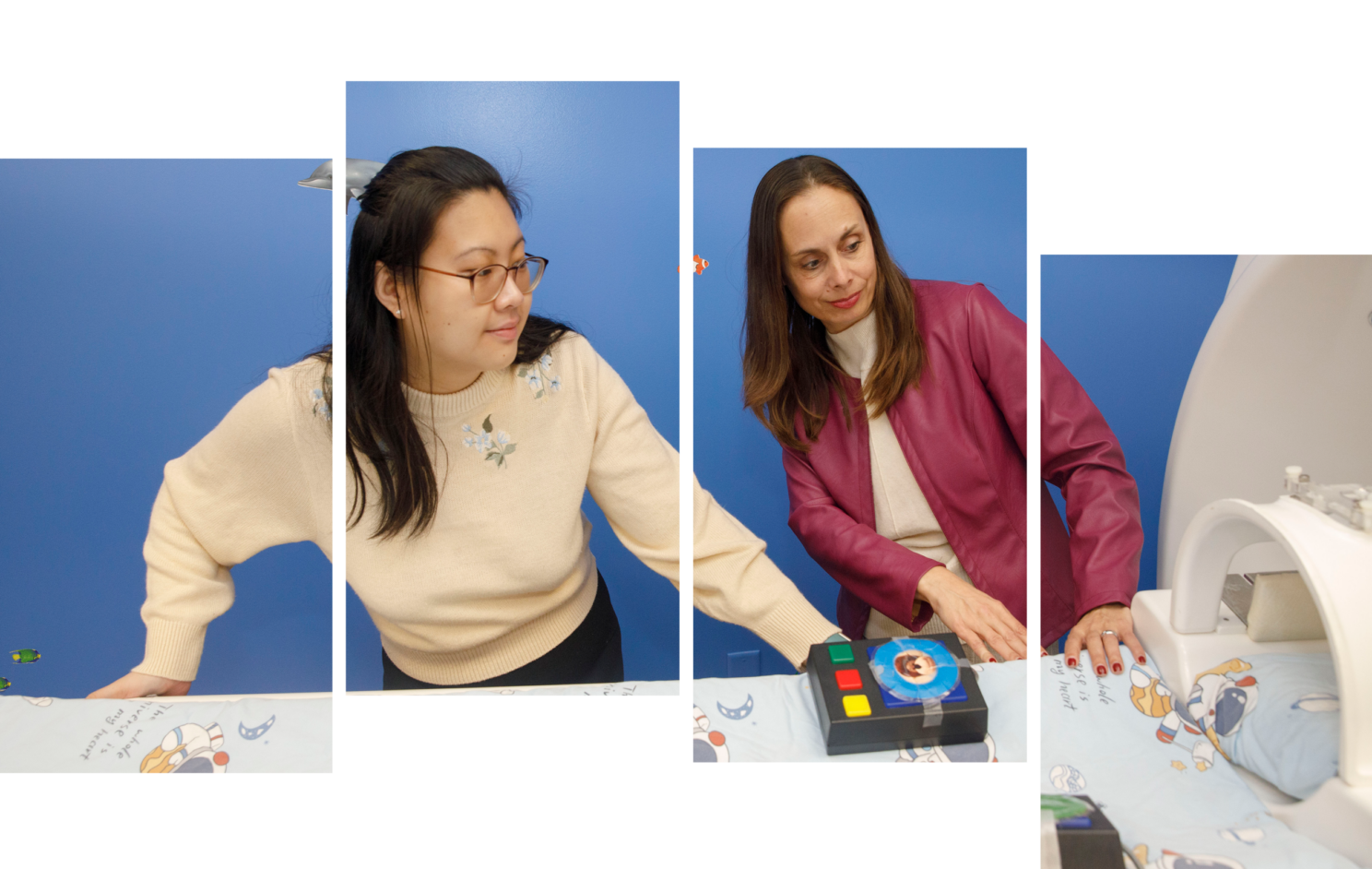
Megan Loh and Nadine Gaab show a model of an MRI machine they use to acclimate young study participants.

Nadine Gaab and research assistant Megan Loh (left) demonstrate a mock MRI machine they use to prepare children for the real thing.

Photo by Kris Snibbe/Harvard Staff Photographer; photo illustration by Judy Blomquist/Harvard Staff

5 min read

Harvard lab’s research suggests at-risk kids can be identified before they ever struggle in school

Final installment in a four-part series on non-apparent disabilities.

For more than 15 years, Nadine Gaab’s lab has been unlocking secrets of how young brains develop, with an emphasis on non-apparent disabilities, or physical or mental conditions that are not immediately obvious to others. 

“It is very challenging and rewarding at the same time,” said Gaab, associate professor of education. “The best way to examine how a child learns is to follow them closely while they are learning and to look at all aspects of their learning, including brain development, behavior, genetics, and environment.”

The Gaab Lab, based at the Graduate School of Education since 2021, focuses on atypical learning trajectories, particularly those of children with dyslexia, a language-based learning disability. A key question the lab is tackling is pinpointing when brain characteristics associated with dyslexia manifest.

Scientists have long known that people who struggle with reading often show atypical brain structure and function. “The question was, ‘Is that development in response to struggling every day in school, or is it something that develops before their first day of kindergarten?’ That’s a really important question for policy,” she said.

“If everyone comes to kindergarten with a ‘clean slate’ brain and then changes in response to instruction, then you have to monitor them after they start school and try to catch kids who fall off the bandwagon. But if you can show that some of these atypical brain developments happen before the first day of kindergarten, you should find them before they start and intervene in response so that they will never struggle.”

In its Boston Longitudinal Dyslexia Study (BOLD), started in 2007, the lab found that some of the brain characteristics reported in the third or fourth grade were already present in preschoolers. The findings piqued Gaab’s curiosity and pushed her team to launch a follow-up study in 2011 to see how early these markers could be seen.

In its ongoing BabyBOLD study, Gaab’s team enrolls infants between 3 and 8 months old who have a familial risk for reading disabilities — perhaps a parent or sibling has dyslexia — and monitor them until elementary or middle school. They’ve found that some atypical brain characteristics involving white matter (where information and communication is exchanged), connectivity patterns, and other measurements found in older children are already present as early as infancy.

“If you can show that some of these atypical brain developments happen before the first day of kindergarten, you should find them before they start.”

Nadine Gaab

“A lot of the importance in the work from the Gaab Lab has to do with seeing that there are some developmental differences in children prior to the start of formal reading instruction,” said Ted Turesky, a researcher at the lab. “It shows policymakers that there are these differences and that we need to address them before reading instruction starts so interventions can be more effective.”

This is key, Gaab said, because until recently, elementary schools across the country have relied on a “wait to fail model” for students with reading disabilities. Gaab said this reactive model often leaves children with low self-esteem, negative experiences with learning, and even shame. Her lab’s research instead promotes a proactive model that aims for earlier interventions.

“Every child has the right to read well. Every child has the right to access their full potential,” Gaab said. “This society is driven by perfectionism and has been very narrow-minded when it comes to children who learn differently, including learning disabilities.”

Until recently, Gaab said, many elementary schools have relied on a “wait to fail model” that often leaves students with low self-esteem, negative experiences with learning, and shame.

Workdays in the lab sometimes stretch from 9 a.m. to 9 p.m. Three-hour sessions with young learners include behavioral monitoring, psychometric testing, brain scans, and speech assessments.

Ahead of the brain scans, Gaab’s researchers have their young subjects experiment with a mock MRI while watching a movie like “Kung Fu Panda.” “Going into the MRI can be a lot for the kids,” research assistant Megan Loh explained. “What we have found to be the most effective strategy is just to treat it like a really fun game where they have to stay super still.”

Gaab works closely with the learning disability community and grassroots parents’ organizations, as well as state and federal agencies. The lab recently collaborated with Decoding Dyslexia Massachusetts, a parent-led group that advocates for systems-level changes in education and dyslexia prevention legislation, on research dedicated to early identification of children at risk of developing reading difficulties and the need for screenings at school.

The organization was among nearly a dozen groups that supported former state Secretary of Education James Peyser’s June 2022 measure to require early literacy universal screenings in schools and districts. That mandate officially took effect in July 2023.

“There is a large number of kids globally who have disabilities and one big subgroup of this is invisible disabilities, and often invisible disabilities are completely ignored,” Gaab said. “These are brilliant individuals and it’s really important that we bring invisible disabilities to the forefront and make sure that we provide interventions and accommodations to them.”


Resources


Superconductors have intrigued physicists for decades. But these materials, which allow the perfect, lossless flow of electrons, usually only exhibit this quantum-mechanical peculiarity at temperatures so low — a few degrees above absolute zero — as to render them impractical.

A research team led by Professor of Physics and Applied Physics Philip Kim has demonstrated a new strategy for making and manipulating a widely studied class of higher-temperature superconductors, called cuprates, clearing a path to engineering new, unusual forms of superconductivity in previously unattainable materials.

Using a uniquely low-temperature device fabrication method, Kim and his team report in the journal Science a promising candidate for the world’s first high-temperature, superconducting diode — essentially, a switch that makes current flow in one direction — made out of thin cuprate crystals. Such a device could theoretically fuel fledging industries like quantum computing, which rely on fleeting mechanical phenomena that are difficult to sustain.

“High-temperature superconducting diodes are, in fact, possible, without application of magnetic fields, and opens new doors of inquiry toward exotic materials study,” Kim said.

Cuprates are copper oxides that, decades ago, upended the physics world by showing they become superconducting at much higher temperatures than theorists had thought possible, “higher” being a relative term (the current record for a cuprate superconductor is minus 225 Fahrenheit). But handling these materials without destroying their superconducting phases is extremely complex due to their intricate electronic and structural features.

The team’s experiments were led by S.Y. Frank Zhao, a former student in the Griffin Graduate School of Arts and Sciences and now a postdoctoral researcher at MIT. Using an air-free, cryogenic crystal manipulation method in ultrapure argon, Zhao engineered a clean interface between two extremely thin layers of the cuprate bismuth strontium calcium copper oxide, nicknamed BSCCO (“bisco”). BSCCO is considered a “high-temperature” superconductor because it starts superconducting at about minus 288 Fahrenheit — very cold by practical standards, but astonishingly high among superconductors, which typically must be cooled to about minus 400.

Zhao first split the BSCCO into two layers, each one-thousandth the width of a human hair. Then, at minus 130, he stacked the two layers at a 45-degree twist, like an ice cream sandwich with askew wafers, retaining superconductivity at the fragile interface.

The team discovered that the maximum supercurrent that can pass without resistance through the interface is different depending on the current’s direction. Crucially, the team also demonstrated electronic control over the interfacial quantum state by reversing this polarity. This control was what effectively allowed them to make a switchable, high-temperature superconducting diode — a demonstration of foundational physics that could one day be incorporated into a piece of computing technology, such as a quantum bit.

“This is a starting point in investigating topological phases, featuring quantum states protected from imperfections,” Zhao said.

The Harvard team worked with colleagues Marcel Franz at University of British Columbia and Jed Pixley at Rutgers University, whose teams previously performed theoretical calculations that accurately predicted the behavior of the cuprate superconductor in a wide range of twist angles. Reconciling the experimental observations also required new theory developments, performed by University of Connecticut’s Pavel A. Volkov.

The research was supported, in part, by the National Science Foundation, the Department of Defense, and the Department of Energy.


Freezing is one of the most common and debilitating symptoms of Parkinson’s disease, a neurodegenerative disorder that affects more than 9 million people worldwide. When individuals with Parkinson’s disease freeze, they suddenly lose the ability to move their feet, often mid-stride, resulting in a series of staccato stutter steps that get shorter until the person stops altogether. These episodes are one of the biggest contributors to falls among people living with Parkinson’s disease.

Today, freezing is treated with a range of pharmacological, surgical, or behavioral therapies, none of which are particularly effective.

What if there was a way to stop freezing altogether?

Researchers from the Harvard John A. Paulson School of Engineering and Applied Sciences (SEAS) and the Boston University Sargent College of Health & Rehabilitation Sciences have used a soft, wearable robot to help a person living with Parkinson’s walk without freezing. The robotic garment, worn around the hips and thighs, gives a gentle push to the hips as the leg swings, helping the patient achieve a longer stride.

The device completely eliminated the participant’s freezing while walking indoors, allowing them to walk faster and further than they could without the garment’s help.

“We found that just a small amount of mechanical assistance from our soft robotic apparel delivered instantaneous effects and consistently improved walking across a range of conditions for the individual in our study,” said Conor Walsh, the Paul A. Maeder Professor of Engineering and Applied Sciences at SEAS and co-corresponding author of the study.

The research demonstrates the potential of soft robotics to treat this frustrating and potentially dangerous symptom of Parkinson’s disease and could allow people living with the disease to regain not only their mobility but their independence.

The research is published in Nature Medicine.

For over a decade, Walsh’s Biodesign Lab at SEAS has been developing assistive and rehabilitative robotic technologies to improve mobility for individuals’ post-stroke and those living with ALS or other diseases that impact mobility. Some of that technology, specifically an exosuit for post-stroke gait retraining, received support from the Wyss Institute for Biologically Inspired Engineering, and was licensed and commercialized by ReWalk Robotics.

In 2022, SEAS and Sargent College received a grant from the Massachusetts Technology Collaborative to support the development and translation of next-generation robotics and wearable technologies. The research is centered at the Move Lab, whose mission is to support advances in human performance enhancement with the collaborative space, funding, R&D infrastructure, and experience necessary to turn promising research into mature technologies that can be translated through collaboration with industry partners.

This research emerged from that partnership.

“Leveraging soft wearable robots to prevent freezing of gait in patients with Parkinson’s required a collaboration between engineers, rehabilitation scientists, physical therapists, biomechanists, and apparel designers,” said Walsh, whose team collaborated closely with that of Terry Ellis,  professor and Physical Therapy Department chair and director of the Center for Neurorehabilitation at Boston University.

The team spent six months working with a 73-year-old man with Parkinson’s disease, who — despite using both surgical and pharmacologic treatments — endured substantial and incapacitating freezing episodes more than 10 times a day, causing him to fall frequently. These episodes prevented him from walking around his community and forced him to rely on a scooter to get around outside.

In previous research, Walsh and his team leveraged human-in-the-loop optimization to demonstrate that a soft, wearable device could be used to augment hip flexion and assist in swinging the leg forward to provide an efficient approach to reduce energy expenditure during walking in healthy individuals.

Here, the researchers used the same approach but to address freezing. The wearable device uses cable-driven actuators and sensors worn around the waist and thighs. Using motion data collected by the sensors, algorithms estimate the phase of the gait and generate assistive forces in tandem with muscle movement.

The effect was instantaneous. Without any special training, the patient was able to walk without any freezing indoors and with only occasional episodes outdoors. He was also able to walk and talk without freezing, a rarity without the device.

“Our team was really excited to see the impact of the technology on the participant’s walking,” said Jinsoo Kim, former Ph.D. student at SEAS and co-lead author on the study.

During the study visits, the participant told researchers: “The suit helps me take longer steps and when it is not active, I notice I drag my feet much more. It has really helped me, and I feel it is a positive step forward. It could help me to walk longer and maintain the quality of my life.”

“Our study participants who volunteer their time are real partners,” said Walsh. “Because mobility is difficult, it was a real challenge for this individual to even come into the lab, but we benefited so much from his perspective and feedback.”

The device could also be used to better understand the mechanisms of gait freezing, which is poorly understood.

“Because we don’t really understand freezing, we don’t really know why this approach works so well,” said Ellis. “But this work suggests the potential benefits of a ‘bottom-up’ rather than ‘top-down’ solution to treating gait freezing. We see that restoring almost-normal biomechanics alters the peripheral dynamics of gait and may influence the central processing of gait control.”

The research was co-authored by Jinsoo Kim, Franchino Porciuncula, Hee Doo Yang, Nicholas Wendel, Teresa Baker, and Andrew Chin. Asa Eckert-Erdheim and Dorothy Orzel also contributed to the design of the technology, as well as Ada Huang, and Sarah Sullivan managed the clinical research.

It was supported by the National Science Foundation under grant CMMI-1925085; the National Institutes of Health under grant NIH U01 TR002775; and the Massachusetts Technology Collaborative, Collaborative Research and Development Matching Grant.


A group of scientists, including several at Harvard, have dived deeper into the mammalian brain than ever before by categorizing and mapping at the molecular level all of its thousands of different cell types.

The researchers reported their work in Nature, through a series of 10 papers — six with Harvard affiliations. It’s part of the National Institutes of Health’s Brain Research Through Advancing Innovative Neurotechnologies initiative, which so far has focused on mice; future phases will shift to humans and other primates.

Mammal brains house billions of cells, each defined by the genes they express. This complexity is why true understanding of many brain functions, including molecular mechanisms that underlie neurological diseases, remains so elusive.

To create the first molecularly defined cell atlas of the whole mouse brain, a team led by Harvard’s Xiaowei Zhuang identified and spatially mapped thousands of unique cell types, most of which had never previously been characterized.

“We identified 5,000 transcriptionally distinct cell populations,” said Zhuang, the David B. Arnold Professor of Science and a Howard Hughes medical investigator. “Suffice it to say that the level of diversity we identified is really extraordinary.”

The brain-wide atlas of cell types cataloging cells, their distribution, and interactions could serve as a starting point for scientists studying certain brain functions or diseases. Someday the basic outlines of the atlas could be applied to the human brain, 1,000 times larger than the mouse brain.

“It gives me real excitement to see things that were not visible before. I am also thrilled when our technology is used by so many labs,” said Zhuang, referring to Multiplexed Error-Robust Fluorescence in situ Hybridization (MERFISH), a genome-scale imaging technology developed in her lab.

Xiaowei Zhuang (center) in the lab with team Aaron Halpern (from left), Won Jung, Meng Zhang, and Xingjie Pan.

Niles Singer/Harvard Staff Photographer

In collaboration with scientists at the Allen Institute for Brain Science, Zhuang and her team used MERFISH together with single-cell RNA sequencing data to not only identify each cell type, but to image them in situ. Their work provides new information about the molecular signatures of these cell types, as well as where they are located in the brain. The result is a stunningly detailed picture of the mouse brain’s full complement of cells, their gene-expression activity, and their spatial relationships.

In their Nature paper, the researchers used MERFISH to determine gene-expression profiles of approximately 10 million cells by imaging a panel of 1,100 genes, selected using single-cell RNA sequencing data provided by Allen Institute collaborators.

Retina findings could boost glaucoma research

In a separate paper in the Nature series, Joshua Sanes, the Jeff C. Tarr Professor of Molecular and Cellular Biology, co-led a team that captured new insights into the evolutionary history of the vertebrate retina.

Joshua Sanes.

Joshua Sanes.

Photo by Rick Friedman

A part of the brain encased in the eye, the retina boasts complex neural circuits that receive visual information, which they then transmit to the rest of the brain for further processing. The retina is functionally very different from species to species — for example, human hunter-gatherers evolved sharp daytime vision, whereas mice possess better night vision than humans do; some animals see in color, while others see predominantly in black and white.

But at molecular levels, how different are retinas, really? Sanes, in collaboration with researchers at the University of California, Berkeley, and the Broad Institute, performed a new comparative analysis of retinal cell types across 17 species, including humans, fish, mice, and opossums. Using single-cell RNA sequencing, which allowed them to differentiate types of retinal cells by their genetic expression profiles, the researchers’ findings upended some long-held views about how certain species’ visual systems evolved.

One striking discovery involved so-called “midget retinal ganglion cells,” which, in humans, carry 90 percent of the information from the eye to the brain. These cells give humans their fine-detail vision, and changes to them are associated with eye diseases such as glaucoma. No related cells had ever been found in mice, so they had been assumed to be unique to primates.

In their analysis, Sanes and team identified for the first time clear relatives of midget retinal ganglion cells in many other species, including mice, albeit in much smaller proportions. Since mice are a common model animal to study glaucoma, being able to pinpoint these cells is a potentially crucial insight.

“I think we can make a very compelling case that if you want to study these important human retinal ganglion cells in a mouse, these are the cells you want to be studying,” Sanes said.

Other Harvard-affiliated researchers, at Harvard Medical School, Boston Children’s Hospital, and the Broad, also contributed findings to the NIH’s cell census network, including a molecular cytoarchitecture of the adult mouse brain, and a transcriptomic taxonomy of mouse brain-wide spinal projecting neurons.


Harvard researchers have realized a key milestone in the quest for stable, scalable quantum computing, an ultra-high-speed technology that will enable game-changing advances in a variety of fields, including medicine, science, and finance.

The team, led by Mikhail Lukin, the Joshua and Beth Friedman University Professor in physics and co-director of the Harvard Quantum Initiative, has created the first programmable, logical quantum processor, capable of encoding up to 48 logical qubits, and executing hundreds of logical gate operations, a vast improvement over prior efforts.

Published in Nature, the work was performed in collaboration with Markus Greiner, the George Vasmer Leverett Professor of Physics; colleagues from MIT; and QuEra Computing, a Boston company founded on technology from Harvard labs.

The system is the first demonstration of large-scale algorithm execution on an error-corrected quantum computer, heralding the advent of early fault-tolerant, or reliably uninterrupted, quantum computation.

Lukin described the achievement as a possible inflection point akin to the early days in the field of artificial intelligence: the ideas of quantum error correction and fault tolerance, long theorized, are starting to bear fruit.

“I think this is one of the moments in which it is clear that something very special is coming,” Lukin said. “Although there are still challenges ahead, we expect that this new advance will greatly accelerate the progress toward large-scale, useful quantum computers.”

Denise Caldwell of the National Science Foundation agrees.

“This breakthrough is a tour de force of quantum engineering and design,” said Caldwell, acting assistant director of the Mathematical and Physical Sciences Directorate, which supported the research through NSF’s Physics Frontiers Centers and Quantum Leap Challenge Institutes programs. “The team has not only accelerated the development of quantum information processing by using neutral atoms, but opened a new door to explorations of large-scale logical qubit devices, which could enable transformative benefits for science and society as a whole.”

It’s been a long, complex path.

In quantum computing, a quantum bit or “qubit” is one unit of information, just like a binary bit in classical computing. For more than two decades, physicists and engineers have shown the world that quantum computing is, in principle, possible by manipulating quantum particles — be they atoms, ions, or photons — to create physical qubits.

But successfully exploiting the weirdness of quantum mechanics for computation is more complicated than simply amassing a large-enough number of qubits, which are inherently unstable and prone to collapse out of their quantum states.

The real coins of the realm are so-called logical qubits: bundles of redundant, error-corrected physical qubits, which can store information for use in a quantum algorithm. Creating logical qubits as controllable units — like classical bits — has been a fundamental obstacle for the field, and it’s generally accepted that until quantum computers can run reliably on logical qubits, the technology can’t really take off.

To date, the best computing systems have demonstrated one or two logical qubits, and one quantum gate operation — akin to just one unit of code — between them.

The Harvard team’s breakthrough builds on several years of work on a quantum computing architecture known as a neutral atom array, pioneered in Lukin’s lab. It is now being commercialized by QuEra, which recently entered into a licensing agreement with Harvard’s Office of Technology Development for a patent portfolio based on innovations developed by Lukin’s group.

The key component of the system is a block of ultra-cold, suspended rubidium atoms, in which the atoms — the system’s physical qubits — can move about and be connected into pairs — or “entangled” — mid-computation.

Entangled pairs of atoms form gates, which are units of computing power. Previously, the team had demonstrated low error rates in their entangling operations, proving the reliability of their neutral atom array system.

With their logical quantum processor, the researchers now demonstrate parallel, multiplexed control of an entire patch of logical qubits, using lasers. This result is more efficient and scalable than having to control individual physical qubits.

“We are trying to mark a transition in the field, toward starting to test algorithms with error-corrected qubits instead of physical ones, and enabling a path toward larger devices,” said paper first author Dolev Bluvstein, a Griffin School of Arts and Sciences Ph.D. student in Lukin’s lab.

The team will continue to work toward demonstrating more types of operations on their 48 logical qubits and to configure their system to run continuously, as opposed to manual cycling as it does now.

The work was supported by the Defense Advanced Research Projects Agency through the Optimization with Noisy Intermediate-Scale Quantum devices program; the Center for Ultracold Atoms, a National Science Foundation Physics Frontiers Center; the Army Research Office; and QuEra Computing.


Some dogs love to play fetch, while others watch the tennis ball roll by with little interest. Some run circles around their owners, herding them, during walks, while others stop to sniff everything in their path.

It begs the question — why do dogs behave so differently, even within their own breeds?

Erin Hecht, assistant professor of human evolutionary biology at Harvard, is seeking answers through The Canine Brains Project, part of the University’s Brain Science Initiative. She recently gave a talk on the emerging field of canine neuroscience, and what we know so far about our furry friends.

Dogs, according to Hecht, have the potential to teach us a lot about brain development, having been domesticated roughly 20,000 to 40,000 years ago — a blip on the evolutionary timeline. For context, modern humans emerged roughly 300,000 years ago. Because domestication was relatively recent, modern dog breeds live alongside ancient breeds, making comparison possible.

“Darwin saw dogs as a window on mechanisms of evolution,” Hecht said. “When we’re looking at dogs, as a natural experiment and brain behavior evolution all we have to do is look at their brains and see what evolution did in order to satisfy those selection requirements.”

Hecht’s lab performs MRI scans on nearly 100 canine brains a year and conducts owner surveys looking at dogs’ working skills, like hunting, herding, and guarding, compared to skull shape, body size, and breed.

The lab looks at domesticated breeds like Great Danes or other hunting dogs or designer dogs — a practice that took really took hold during the Victorian era — as well as ancient dogs like huskies and “village dogs.”

“About 80 percent of the dogs living on the planet today are what’s known as village dogs. These are free-ranging animals that live as human commensals. So they’re living within human society, but they’re not pets,” Hecht said.

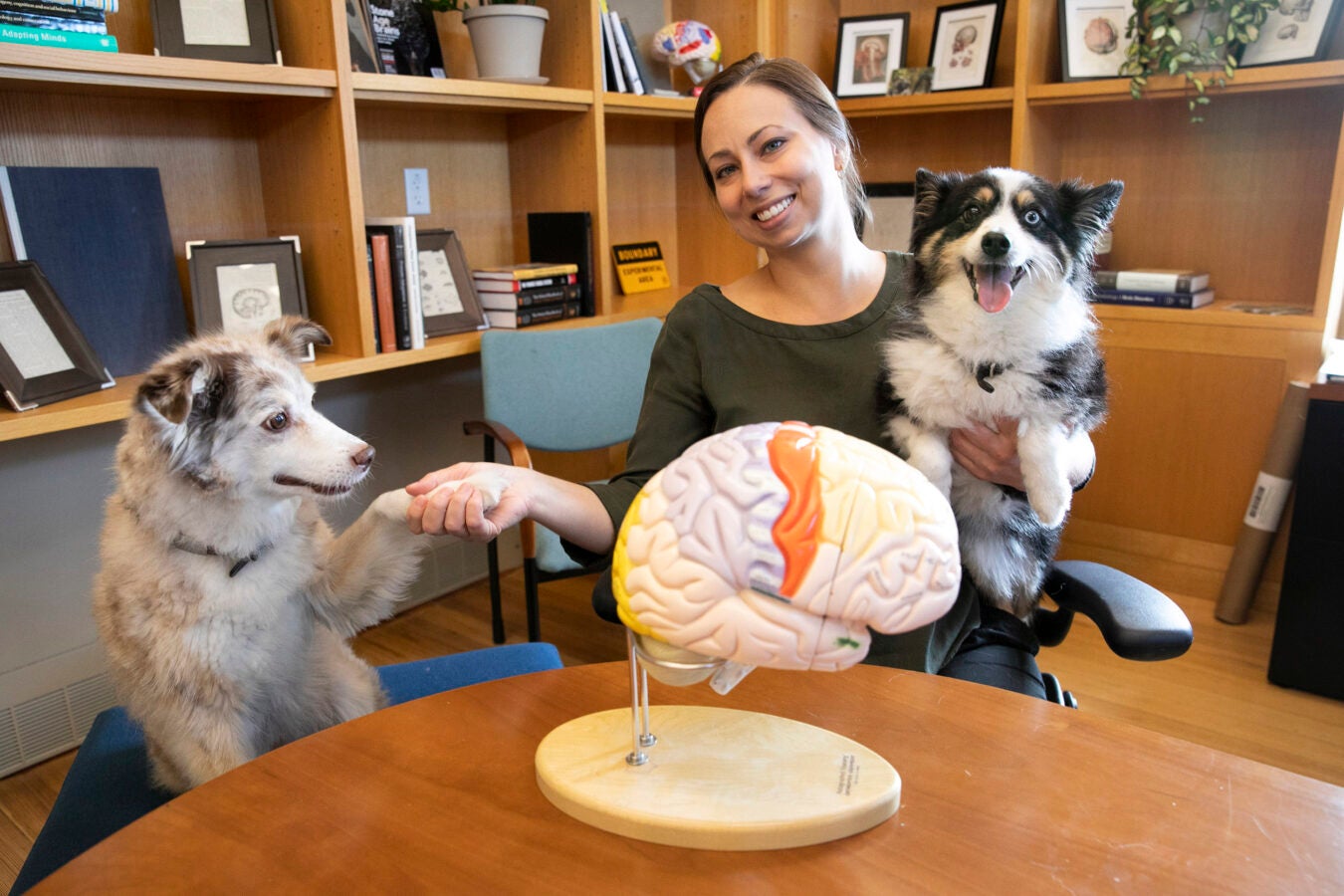
Erin Hecht with her Australian Shepherds in her office in front of a brain model.

Erin Hecht with Australian shepherds Lefty and Izzy.

File photo by Jon Chase/Harvard Staff Photographer

Some initial findings from the lab include the discovery of neurological differences in dog breeds, including that premodern dogs on a whole have larger amygdala — the part of the brain that controls emotional processing and memory. Such heightened environmental-monitoring skills would come in handy for dogs deciding which humans to steal scraps from and which to avoid.

Modern dogs have a bigger neocortex — the part of the brain that controls motor function, perception, and reasoning. It may play a part in modern dogs’ increased behavioral flexibility, or ability to adapt to new environments.

Hecht’s lab connects personality and skill differences in dogs to six different parts of the brain: the regions controlling drive and reward; olfaction and taste; spatial navigation; social communication and coordination; fight or flight; and olfaction and vision. While breeds we see in our homes today share similarities in these pathways, Hecht’s research suggests the traits can be attributed more to selective breeding than ancestral DNA.

“There has been very strong recent specific selection in individual breeds rather than founding effects in ancestral founding populations,” Hecht said. “So then we can look at behavior and ask whether the types of behaviors that different lineages have been selected for historically … [explain] each dog’s anatomy and these six brain networks. And it seems like there are some interesting relationships here.”

More than breed itself, pathways are impacted by a dog’s head shape and size. For example, Hecht’s lab has found that bigger dogs have larger neocortices than their smaller counterparts, and therefore generally are more trainable and less anxious. Dogs bred for their narrow skulls may see that impact their behavior.

“It stands to reason that if you’re manipulating the shape of a skull, you’re going to be manipulating the shape of the brain,” Hecht said. “But this confirms that dogs with these extreme skull morphotypes have impacts on their brain anatomy that likely affects behavior.”

In conjunction with the MRI scanning, Hecht’s lab measures dogs’ behavior with an assessment called C-BARQ, the Canine Behavioral Assessment and Research Questionnaire. The survey, which is filled out by the dog’s owner, assesses behaviors such as aggression, trainability, and rivalry, to name a few.

“There was one study that collected C-BARQ data on 32,000 dogs from 82 different breeds and then performed clustering on the survey responses. And the data clustered more on the body height of the dogs than on breed relatedness. So size was a better predictor than breed in predicting temperament scores on this C-BARQ assessment,” Hecht said.

She added that just because certain dogs have brain makeups that suggest a certain disposition, it doesn’t lock them into those behaviors. That goes especially for working skills.

“Training is almost always necessary. I have yet to hear of any particular breed of working dog, where it’s just born knowing how to do its job,” Hecht said.

But whether you have a pit bull that acts like a chihuahua or a Yorkie that likes to run with the big dogs, a look inside their brain might help explain why they are the way they are.

Find out more about the work happening in the Hecht lab or see if your dog is a study candidate.


Humans have been considered unique for their ability to form relationships for mutual benefit not just within immediate kin groups but across and between them, even with total strangers.

It turns out that one of our closest living relatives, bonobos, are also able to think outside the group.

These were the findings of a Harvard study that involved two years of data collection in the deep forests of the Democratic Republic of Congo, where up to 20,000 of the endangered apes make their only home. The ability to engage in such “out-group” cooperation is the foundation on which humans have created societies and cultures through trade and knowledge-sharing.

“Our work with bonobos is showing that cooperation beyond social borders, without immediate payoff between unrelated individuals, is not uniquely human,” said senior author Martin Surbeck, assistant professor in the Department of Human Evolutionary Biology, who has researched bonobos for 20 years. The study was published in Science with lead author Liran Samuni, a former Harvard research associate who works at the German Primate Center in Göttingen.

A previous study, based on the same bonobo communities, found that the primates maintained distinct, stable social borders, so called “communities.” In their latest analysis, Samuni and Surbeck found evidence of cooperation between members of different communities, facilitated by an assortment of key individuals. These certain few consistently engaged in behaviors such as grooming and food-sharing and acted as links between groups — think ape ambassadors. Within each behavior, individuals cooperated with specific counterparts who were also good cooperators in that domain.

Members of the local community and bonobo data collection team.

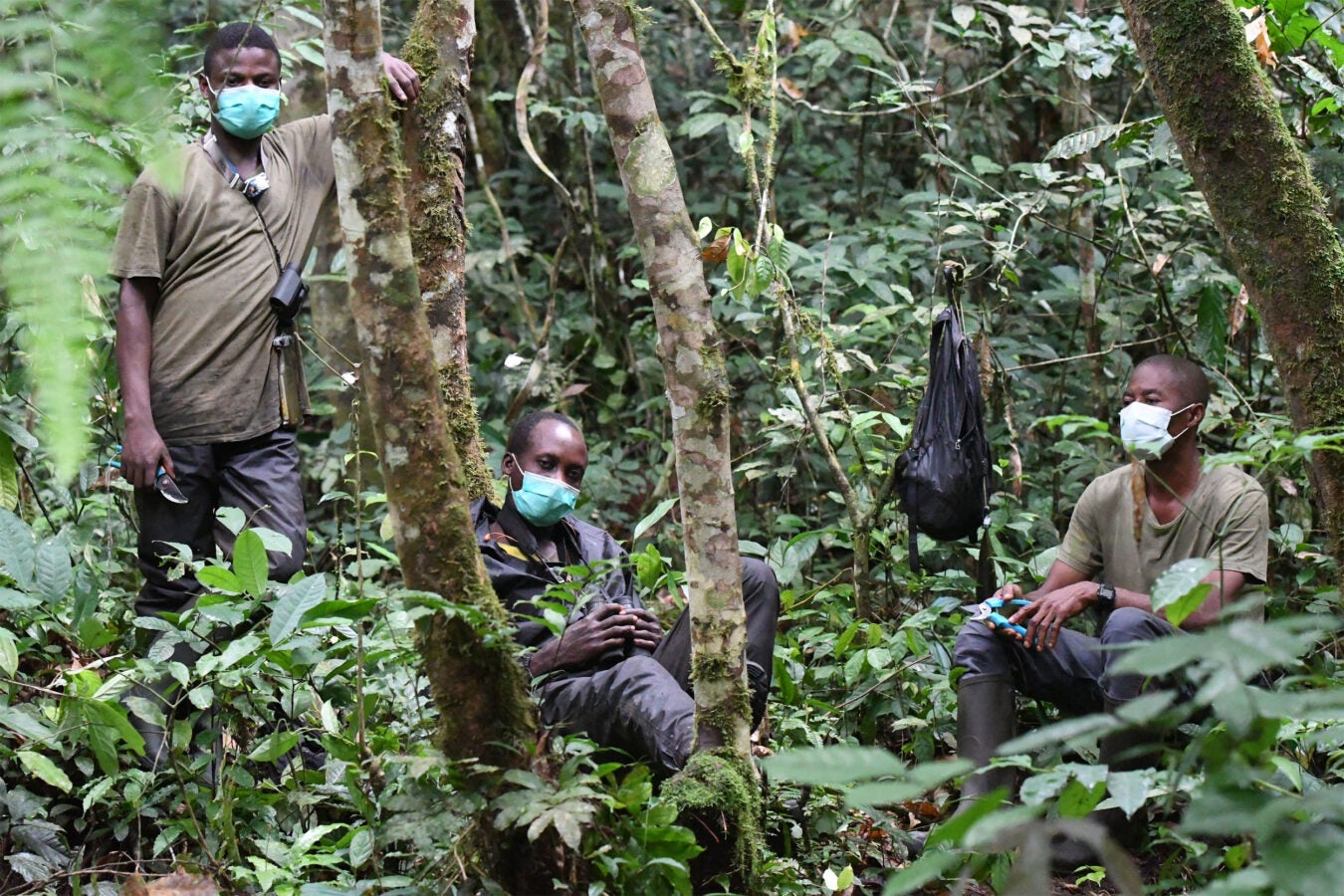
Members of the local community and bonobo data collection team at the Kokolopori Bonobo Reserve: Medard Bangela (from left), Vincent Moscova, and Leonard Lolima Nkanga.

The conclusions arose from daily observations of within- and between-group interactions of 31 adult bonobos, living in two communities called Ekalakala and Kokoalongo, all within the Kokolopori Bonobo Reserve in the Congo. Surbeck initiated the project in 2016 and, together with Samuni, has been working with Congolese partners and local villagers to collect data.

For the study, Surbeck, Samuni, and a team of local trackers focused on three cooperative behaviors: food-sharing; grooming; and forming alliances, which consists of joint action against a common opponent.

They found that certain individuals exhibited these acts outside their social bounds with others who would be likely to return the favors. Although bonobos are known for being a peaceful species, compared with their more warring chimpanzee cousins, the researchers found that the bonobos were not random in their benevolence.

“They’re not similarly nice to everybody,” Samuni said, noting they formed preferences for some and not others.

“The extreme tolerance we observed between members of different bonobo groups paves the way for pro-social cooperative behaviors between them, a stark contrast to their sister species, the chimpanzees,” she added.

Humans and bonobos share 99 percent of their DNA. Observing the animals in their natural environment can offer a window into our evolutionary past, the researchers say. Work at the preserve takes years of remote coexistence with the bonobos; habituation of the animals to a human presence has been key to making the studies successful, Surbeck said.

Surbeck’s team works closely with local partners, including the conservation organization Vie Sauvage, the Congolese Conservation authorities (ICCN), and the Bonobo Conservation Initiative, to gain support and permission to work in the country and on the community reserve.

“Long-term research sites don’t always quite get the recognition they deserve, in terms of what they contribute to both basic data collection and serving as a platform for other scientists, as well as for the conservation of the species,” Surbeck said.

Bonobos are a critically endangered species, with only a few thousand left in the wild, yet they represent a key comparative model to human social systems, “a rare opportunity to reconstruct the ancestral conditions of human large-scale cooperation,” according to the paper.


When animals of two different species mate, their hybrid offspring can be unhealthy or sterile. Often, only one sex is affected.

Sexual differences in fertility follow a pattern known as Haldane’s Rule, which states that hybrids are afflicted more when they inherit two different sex chromosomes. In mammals, males have XY sex chromosomes, so male “ligers” and “tigons” (offspring between tigers and lions) are sterile, while females, which have two X chromosomes, tend to be more fertile. But in butterflies as well as birds, females have ZW sex chromosomes while males have ZZ, so according to Haldane’s Rule, it is females that are sterile.

What insights could this natural phenomenon hold for speciation, the process in which different biological lineages split? James Mallet, professor of organismic and evolutionary biology in residence and associate of population genetics in the Museum of Comparative Zoology, and senior author of a new study in Proceedings of the National Academy of Sciences, takes a stab at the “why” behind Haldane’s Rule, using butterfly genetics as a guide.

Designed and led by former graduate student Tianzhu Xiong, the study investigated hybrid sterility in butterflies, creating hybrid crosses of different species to determine which particular genes were responsible for the phenotype.

According to analysis by Xiong, now a postdoctoral researcher at Cornell, the sterility trait in hybrid butterflies is probably tied to many genes scattered across the Z chromosome. Thus understanding all the genetic mechanisms behind it will require further study.

For the research, Xiong and colleagues created hybrids of Papilio swallowtail butterflies. They found that problems associated with hybrids, such as low pupal weight and ovary malformation in the females, happened because of uneven mixing, or “introgression,” between the Z sex chromosome and all the other chromosomes. This observation points to many genes working together to produce a balance within each species.

The balance between the Z chromosome and the rest of the chromosomes is disturbed when the former is inherited from only one species, as in female ZW hybrids. The W chromosome characteristic of female butterflies carries very few genes and is not involved. Furthermore, Xiong showed that female hybrids of another butterfly, Heliconius, studied by Neil Rosser and colleagues, also followed the same multigene pattern on the Z chromosome.

“Initially, I was in a mindset of hoping to find a major gene that causes the phenotype,” Xiong said. “But it turns out that the answer is more mathematical than expected, and that a very large number of genes actually explain the pattern better.”

The analysis shows that hybrid sterility may be like height in humans — polygenic, or involving multiple genes. “Tianzhu has shown it is the fraction of the Z chromosome that matters, not whether you’ve got a particular problem on one region of the chromosome,” Mallet said.

The work was supported in part by the National Science Foundation.


The warming climate is having ripple effects across ecosystems, including plants, which have evolved clever mechanisms to conserve water when stressed by drought.

But are plants likelier to defend themselves against dry air or dry soil? This question is hotly debated among climate scientists, and the distinction matters: While there’s consensus on the trajectory of temperature rise over coming decades, less is known about how global warming will affect soil moisture. Understanding this dynamic may help decide the most effective ways to ensure the survival of robust plant life.

A team led by Kaighin McColl, assistant professor in the Department of Earth and Planetary Sciences and the John A. Paulson School of Engineering and Applied Sciences, have new research in Nature Water indicating that plant drought-defense mechanisms, which involve closing tiny pores on leaves called stomata to limit photosynthesis and conserve water, are more likely triggered by dry soil than by dry air.

Their results challenge recently held views and were derived from a place with no plants at all — the barren salt flats of Utah and Nevada.

Previous research had found that plants are likelier to have closed stomata in the presence of dry air, rather than dry soils, so it was assumed that aridity triggered the drought response. But McColl and colleagues suspected these results did not tell the whole story about plant vulnerability to drier environments.

Kaighin McColl.

Kaighin McColl went to the salt flats in the Western U.S. desert to conduct his research.

Alex Griswold/Harvard University Center for the Environment

“The problem with this argument is that correlation does not imply causation; when plants close their stomata, that could actually be causing the air to get drier, rather than the other way around,” McColl said.

To investigate their opposing hypothesis, McColl and lead author Lucas Vargas Zeppetello, a Harvard postdoctoral researcher who starts at the University of California, Berkeley, in January, used as their natural laboratory one of the only places on Earth that has a vigorous water cycle but doesn’t grow any plants — salt flats in the Western U.S. desert.

Using salt flats data provided by collaborators in Nevada and Utah, the researchers reproduced other researchers’ studies that had calculated the relationship between air dryness and moisture flux, or movement (in this case through evaporation), from the land surface and had attributed those values to plants closing their stomata to conserve water. The Harvard team found their calculations lined up almost perfectly with those previous studies, but with no plants in the salt flats, they knew there had to be another explanation.

In that plant-free environment, evaporation responds only to soil dryness. McColl and Vargas Zeppetello concluded that plant responses to lack of humidity may have been exaggerated in previous studies. They think instead that plants respond most acutely to dry soil, an environmental stressor that is known to reduce transpiration and photosynthesis.

What does this mean? Soil dryness matters more than air dryness when it comes to global plant ecosystems.

“Our findings put emphasis on projections for water in the future,” Vargas Zeppetello said. “People talk about consensus on climate change, but that really has to do with global temperatures. There’s much less of a consensus on what regional changes to the water cycle are going to look like.”

The research was supported in part by the National Science Foundation.


MKRdezign

Contact Form

Name

Email *

Message *

Powered by Blogger.
Javascript DisablePlease Enable Javascript To See All Widget