April 2023

Most of what is known about the Xiongnu people comes from their enemies.

“If you do an online image search, most of what you find are brutal battle scenes,” said Christina Warinner, associate professor of anthropology and an expert in biomolecular archaeology. “It’s all very masculine, very violent.”

In research published earlier this month in Science Advances, Warinner worked with a team of archaeologists and geneticists to paint a fuller picture of the world’s first nomadic empire. What they found was a multiethnic society, reflecting nearly all the diversity that existed in Eurasia 2,000 years ago. The researchers also confirmed contemporaneous reports regarding the high status and political power of Xiongnu women.

Illustration of reconstructing how the Xiongnu people lived.

The co-authors commissioned an artist to depict their findings about the Xiongnu.

Illustration courtesy of Christina Warinner

“We set out to integrate genetics and archaeology in a new way,” noted Warinner, who is also the Sally Starling Seaver Associate Professor at Harvard Radcliffe Institute. “One of the most exciting things about the study is offering a fresh perspective on this much-maligned population.”

The Xiongnu, contemporaries of the peoples of ancient Egypt and Rome, dominated the Mongolian steppe from about 200 B.C. to 100 A.D. These horseback nomads proved innovative in warfare, but historians know little about the inner workings of their culture because the Xiongnu never developed a formal writing system. “Most of what we know comes from the Han Dynasty of Imperial China,” Warinner said. “They were major rivals of the Xiongnu, and they wrote about their wars and skirmishes along the border.”

In fact, the Great Wall was built as a barrier to mounted Xiongnu warriors.

Also detailed in historic documents are the Xiongnu’s powerful women. “That was another reason Imperial China didn’t like them,” Warinner quipped.

Physical evidence of these claims has been hard to come by. “In most places in the world, the archaeological record abounds in residential domestic debris,” Warinner said. “The problem with mobile societies is they don’t stay anywhere long enough to build up that kind of archaeological record.”

What the Xiongnu did leave behind are vast mortuary complexes, elaborately built from stone and visible from miles away — they even show up on satellite imagery. It’s been well over 10 years since archaeologists Jamsranjav Bayarsaikhan and Bryan K. Miller excavated two such burial sites, located at the western edge of the Xiongnu empire (in Mongolia’s present-day Khovd Province, not far from the border with China). Artifacts recovered there include fine silk, glass beads, and lacquered vessels. “The Xiongnu valued far-flung trade goods,” Warinner said. “They were an early globalizing society.”

Miller subsequently worked with Warinner on an enormous study, published in 2020, that reconstructed the genetic history of Mongolia over a span of 6,000 years. That meant sequencing the DNA of human remains recovered from archaeological sites across the windswept country. “At the time, we only analyzed one or two individuals per site,” said Warinner. “From that, we could tell the Xiongnu were genetically diverse and multiethnic. But we weren’t able to say anything about their gender or social roles or about whether there was a relationship between their genetics and social status.”

Understanding the “internal dynamics” of Xiongnu communities would require a new line of inquiry. As Bayarsaikhan and Miller saw it, this could be accomplished via cross-disciplinary research at the burial sites. With the archaeological work complete, Warinner signed on to lead the genetic lab work while analysis was done by Juhyeon Lee, a Ph.D. candidate with the Department of Biological Sciences at Seoul National University and lead author on the new paper.
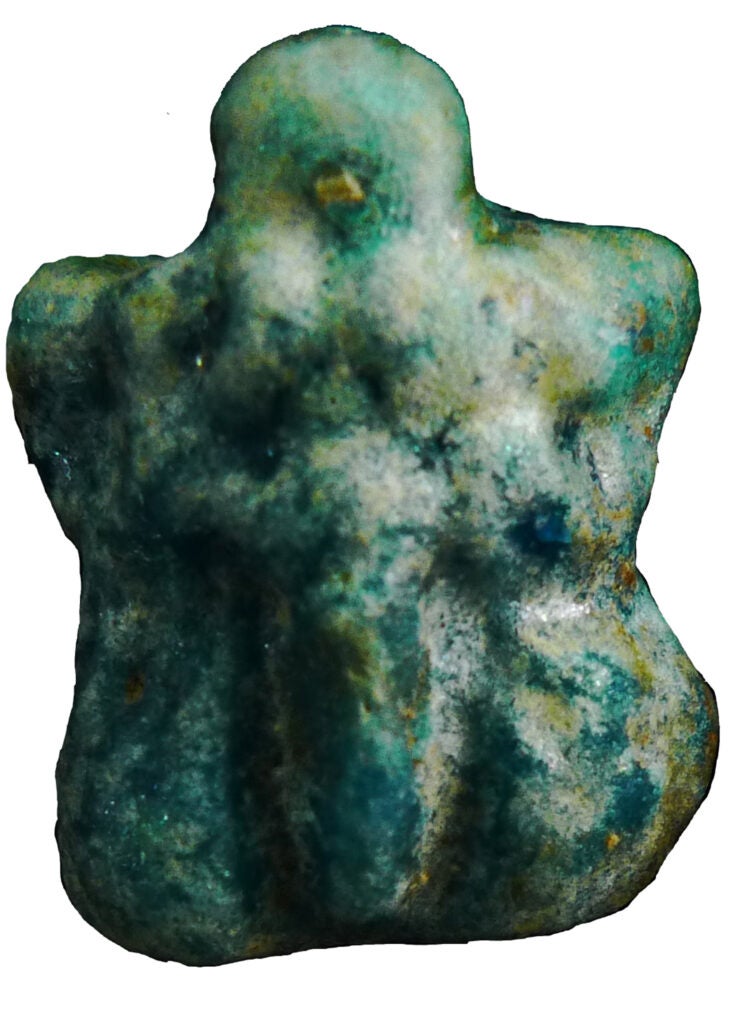
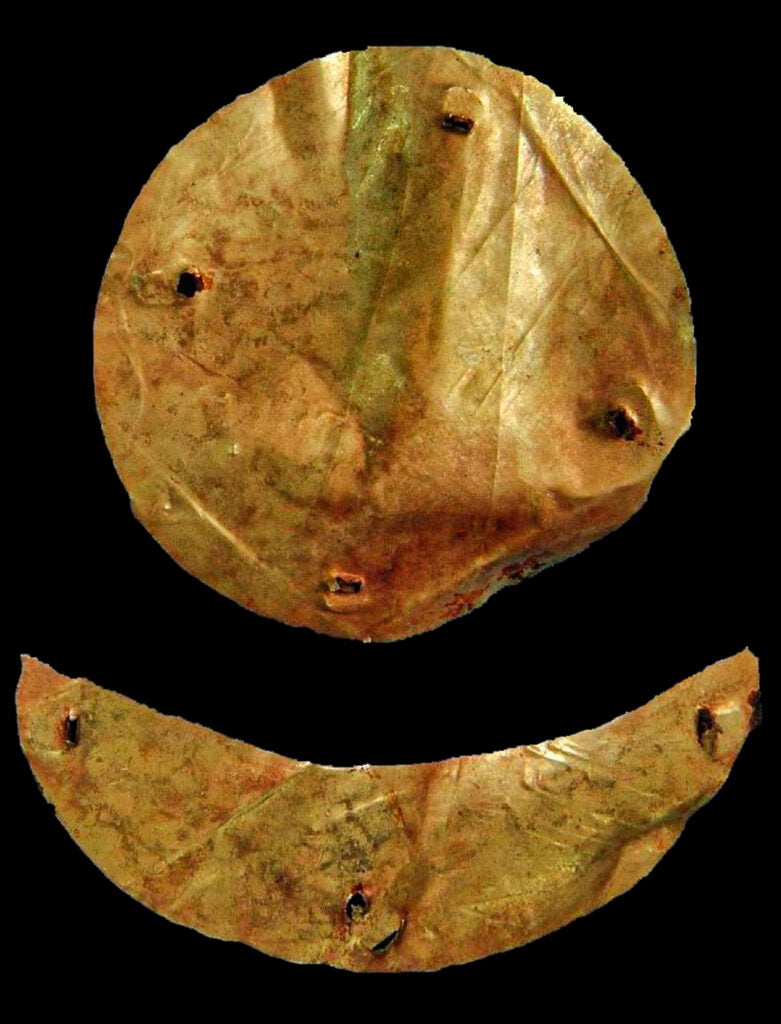
Single bead.
An ornamental sun and moon.

Items found at the burial sites: A faience bead depicting the Egyptian god Bes, protector of children; ornamental sun and moon.

In the end, the scientists harvested genome-wide data for 19 individuals, with 17 yielding sufficient human DNA for analysis. “We found that the aristocratic elite tombs were occupied by women,” said Warinner, who went on to list some of the symbolic goods buried with them — a gilded iron belt buckle, horse tack, a wagon, an ornamental sun and moon. “I think what we’re seeing is that as armies of Xiongnu warriors were going out and expanding the empire, elite women were governing the borders,” she said.

As a group, these aristocratic women exhibited the lowest genetic diversity, Warinner added, suggesting that power was concentrated within particular lineages. As for the servants buried around them, they turned out to be a highly diverse group of males, incorporating populations from the empire’s farthest reaches and beyond.

A different pattern was observed with burials of lower-level elites. There, strategic marriages appear to have been used to cement ties to newly incorporated groups. Taken together, the patterns of genetic ancestry and kinship along frontier communities point to the different means by which the Xiongnu grew their multiethnic empire. “Some have proposed that the Xiongnu Empire was made up of a multitude of clans who themselves were fairly homogenous,” Warinner said. “We found that’s not true. They’re genetically diverse even within a single community.”

DNA evidence also complemented archaeological discovery in touching ways. Tween boys were buried with toy-like bows and arrows. A woman was buried with her perinatal infant, both apparently the casualties of childbirth. Around the mother’s neck was a faience bead depicting the Egyptian god Bes, protector of children.

Warinner and her co-authors were so moved by these “intimate snapshots” that they commissioned an artist to capture the project’s findings. The result is a colorful social scene filled with strong women, ethnic diversity, and finery from all over the continent. “For the first time,” Warinner said, “we get to see the Xiongnu as they presented themselves.”

Researchers from Harvard’s Stem Cell and Regenerative Biology (HSCRB)’s Zon lab have discovered a new mechanism that influences melanoma development, a finding that could have wide implications for patients across a variety of cancers.

The discovery, as described this week in Science, involves a protein known as CDK13. “Before this paper, no one knew the role of CDK13 in cancer,” said Megan Insco, a former postdoctoral fellow and first author of the paper.

Insco and her team found that the CDK13 protein acts as a tumor suppressor in melanoma and that mutation or loss of it can lead to the development of tumors. Working with melanoma patient data and the Zon zebrafish model, the team has learned what causes loss or mutation of the protein and how it can lead to cancer, including the underlying gene expression.

Cells routinely make gene expression mistakes. Insco found that cells produce shortened RNAs that then go on to make abnormal proteins leading to cancer.  Fortunately, cells also have an active cleanup mechanism to take care of those transcriptional mistakes. “But if the cells can’t take out the trash, those RNAs accumulate and can become cancer-causing,” she said. In this paper, the team discovered that mutant CDK13 is the reason those abnormal RNAs aren’t mopped up.

Normally, CDK13 roams the cells performing RNA surveillance. If it encounters an abnormal RNA, it recruits a collection of proteins working together (known as a complex) that degrades short RNAs in the cell’s nucleus — in essence, vacuuming the mistakes and ridding the cell of this precancerous material.

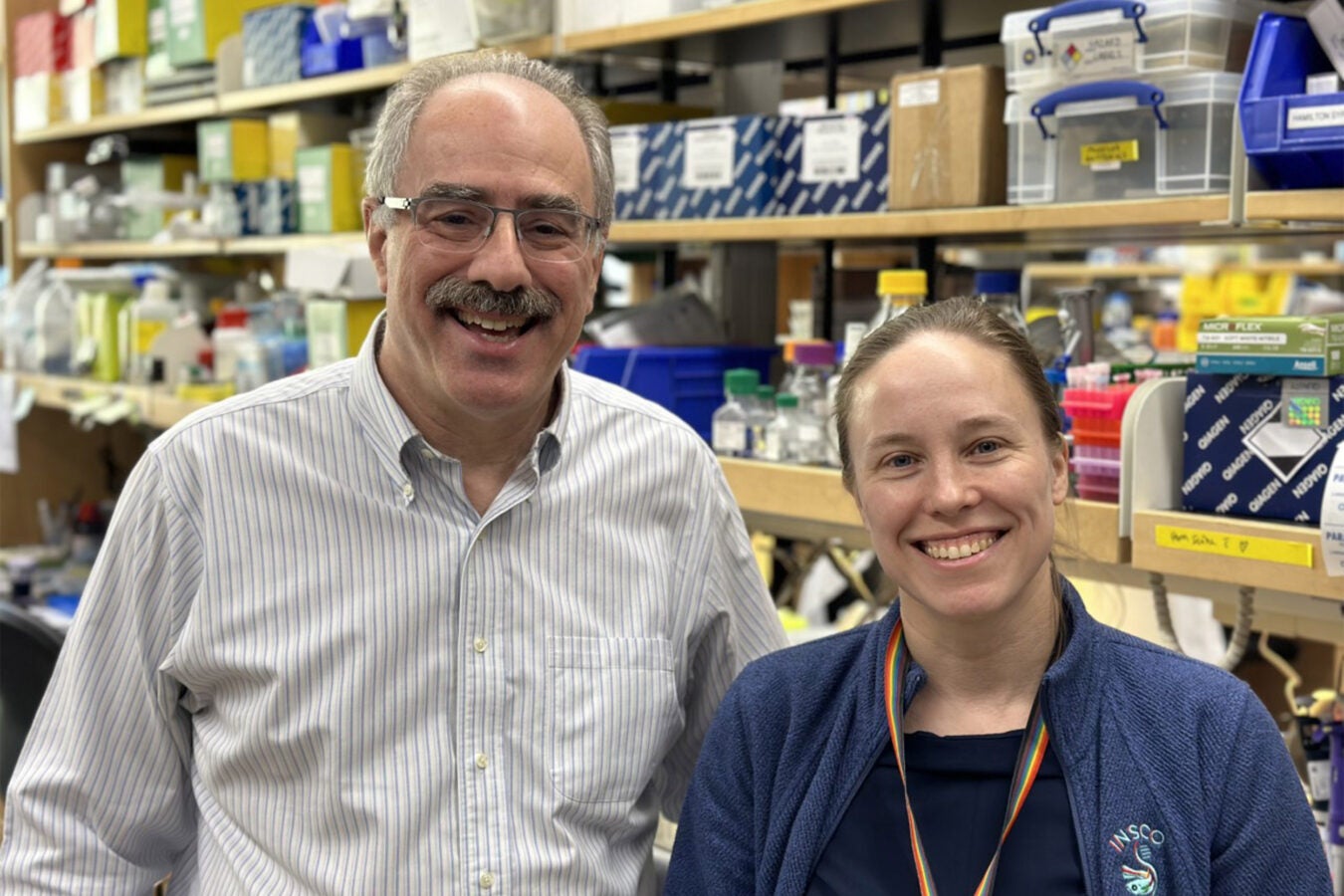
Leonard Zon and Megan Insco.

Professor Leonard Zon with Megan Insco, who used the Zon zebrafish model to learn what causes the loss or mutation of a protein and how it can lead to cancer.

But if mutated, CDK13 fails to perform its RNA surveillance duties and essentially stops taking out the trash. “We know those trash RNAs are causative in cancer because when we put them back into the zebrafish, it mirrored this whole process all over again,” said Insco.

CDK13 mutations are found in many human cancers and function the same in zebrafish, mouse, and human cells. The team observed mutated CDK13 in patient melanoma tissue and accelerated melanoma growth in their zebrafish studies.

The researchers also uncovered another implication for CDK13 mutations involving the PAXT complex, which is the first step of nuclear RNA degradation.

“It serves as a tagging mechanism,” Insco explained. But if CDK13 is mutated, the PAXT complex doesn’t get activated, “It’s like a switch to turn the vacuum cleaner on or not,” she added.

This new paper reveals that damaged RNAs are actively regulated, foreshadowing implications for the mechanism of cancer development for many patients. In melanoma alone, more than 20 percent of patients have this broken nuclear RNA surveillance mechanism involving CDK13.

“The finding that CDK13 is mutated in human cancers suggests a broader involvement of this mechanism in cancer,” said Leonard Zon, professor and executive committee chair for the Harvard Stem Cell Institute.

Along with CDK13, at least two other members of the PAXT complex are recurrently mutated in several cancer types, not just melanoma. “We believe it’s not just a CDK13 thing, but there are multiple other complex members that are going to be involved in breaking that vacuum cleaner,” said Insco.

Based on this work, Insco recently started her own lab at Dana-Farber Cancer Institute to better understand nuclear RNA surveillance and provide novel therapeutic approaches for melanoma patients who don’t respond to existing therapies. The Zon lab will continue to study RNA biology as it relates to tumor initiation.


The strongest earthquake in Japan’s recorded history triggered a massive tsunami in 2011. Waves taller than houses slammed against hundreds of miles of the country’s northern coastline; one wave measured 33 feet high. Together, the two natural disasters claimed close to 20,000 lives, making the event one of the deadliest in Japan’s history.

But the crisis didn’t end there. The tsunami knocked out power to the Fukushima Daiichi nuclear plant, launching a nuclear meltdown whose fallout still affects Japan’s citizens, international relations, and internal politics to this day, according to Martin Fackler. And he should know. Fackler, a writer, journalist, and Harvard research fellow, has spent two decades covering Asia. He reported on the Fukushima accident for The New York Times, arriving in Japan just one day after the quake struck. His team’s coverage earned them a spot as a finalist for a Pulitzer Prize.

Last Thursday, Fackler joined Arnold “Arn” Howitt, co-director of the Program on Crisis Leadership at the Harvard Kennedy School, to discuss how the nuclear accident — the second-worst in history, after Chernobyl — irrevocably altered Japan. The event, called “Dry Run for War: How Fukushima Changed Japan and Its Place in the World,” was hosted by the Rajawali Foundation Institute for Asia, the Program on U.S.-Japan Relations at the Weatherhead Center for International Affairs, and Edwin O. Reischauer Institute of Japanese Studies.

“When this accident began — and I say began because it’s not over,” Fackler said at the start of his presentation on Japan’s day-to-day response to the crisis. More than a decade later, about 30,000 Japanese citizens who lived near the Fukushima plant are still under evacuation orders (the government lifted a few in early April).

When the tsunami hit, Fackler said, three of the plant’s six reactors sustained severe core damage and melted down, releasing hydrogen and radioactive materials. Cooling systems failed. Then, the leaking hydrogen detonated, damaging the other three reactor buildings.

In the HBO TV series “Chernobyl,” local leaders send in firefighters to try to cool the reactors and prevent an even more catastrophic disaster. (If a meltdown burns hot enough, it can blaze through steel and other barriers and release huge amounts of radioactivity.) “Many of them paid the ultimate price,” Fackler said of the first responders.

But Japan, which has avoided armed conflict and been ambivalent about its military since World War II, was not accustomed to sending its citizens into harm’s way — but it would have to. Both first responders and military personnel would need to risk their lives to secure the facility. “This was an existential crisis,” said Fackler.

To this day, a lot of details about Japan’s response remain hidden, Fackler said. But, based on interviews he’s had with key characters, the journalist has pieced together the story of the aftermath — a story of paralysis and disorganization but also heroics.

Plant manager Masao Yoshida was the first to risk people’s lives, Fackler said, sending in a “suicide squad” to vent and cool the reactors. But that wasn’t enough. “At the plant, things started to spin out of control,” he said. “Something similar happened in Tokyo, a meltdown of a sort.”

At the time, Japan’s Prime Minister was Naoto Kan, known as “Kan, the Irritable.” Kan, who had been in office for less than one year when the earthquake hit, was skeptical of both the military and the country’s traditionally cozy relationship with the U.S. But when the rest of the government, including Japan’s nuclear regulatory agency, failed to act, Fackler said, Kan was forced to improvise. At one point, he even flew up to the plant to confront the manager.

“Imagine if President Biden got into Air Force One, flew up to Three Mile Island and started berating the plant owner,” Fackler said, referring to the Pennsylvania plant’s partial nuclear meltdown in 1979.

Most countries anticipate and prepare for emergencies, said Howitt, who studies crisis management and gave a quick presentation on Japan’s response to Fukushima. But Japan’s 2011 crisis was too novel, deadly, and multilayered for it to be easy to predict. Three disasters struck at the same time, killing thousands, and the earthquake and nuclear accident were far larger than any Japan had ever seen.

“I’m not sure a whole lot of prime ministers would have done better,” Fackler said. “But at a crucial moment, he does act.”

Kan forced about 69 workers to stay at the plant and pump water onto the reactors (these workers are the inspiration for the movie “Fukushima 50”). Eventually and reluctantly, he did ask the U.S. for help. (Others might argue the Americans forced their way in after detecting a radioactive plume 100 nautical miles offshore of Fukushima.) The Americans pushed Japan to take “heroic measures” and risk more lives to get the meltdown under control.

And they did — with enduring consequences.

Today in Japan, the military forces Kan hoped to disband are now widely accepted by Japanese citizens after they risked their lives to secure the Fukushima plant, Fackler said. That same military, called Japan Self-Defense Forces, also performs more joint maneuvers with their American counterparts. And, after the crisis, Japan started preparing for future emergencies, including potential war. “It really needed to get its act together in order to handle itself in a dangerous neighborhood,” said Fackler.

The Fukushima accident also motivated other countries, including the U.S., to practice for out-of-the-box scenarios (“Even if they’re farfetched,” Howitt said), and crises like famine, drought, pandemics, and superstorms, such as Hurricane Sandy.

A lot of people had believed this kind of disaster couldn’t happen in Japan, Fackler said. “Fukushima was a wake-up call.”


In a new study, Harvard researchers took a granular approach to measuring the duration and frequency of suicidal thinking. With the help of a smartphone app, they were able to monitor participants multiple times a day over several weeks. These assessments revealed that suicidal thinking changes rapidly — with far shorter timescales than previously thought. And they offered a firmer sense of when suicidal desire is most predictive of future intent.

According to lead author Daniel Coppersmith, a Ph.D. student who works in a lab with the influential suicide researcher Matthew Nock, academic interest in suicide has increased in recent decades. But most of that research has focused on quantifying deaths or identifying risk. Few have sought to understand the fundamental contours of self-injurious thinking and behavior, information that can help better guide more effective prevention.

“A foundational aspect of other areas of science is observing natural phenomena as they unfold in the wild,” Coppersmith said. “Because we haven’t necessarily done that with suicide, we don’t have answers to basic questions like: How often do suicidal thoughts occur? How long do they last?”

The results were published this week in the Proceedings of the National Academy of Sciences of the United States of America (PNAS).

With the new study, Coppersmith, Nock, and their co-authors wanted to capture suicidal thinking as it occurred. Over 42 days, 105 adults with histories of suicidal thought received high-frequency pop-ups via the app with questions about their thoughts and feelings. One prompt asked about their level of suicidal desire at that very moment. Another concerned their current state of suicidal intent. Answers could be given on a scale from zero to 10, with 10 signaling a “very strong” desire or intent to kill oneself.

Crunching the data yielded several fresh insights. First, suicidal thinking tends toward brevity. Less frequent assessments put the average duration of elevated suicidal desire at 9½ hours. High-frequency testing put that average at 1.4 hours. “If we didn’t have this higher-frequency sample of data, we might infer that these types of thoughts last much longer,” Coppersmith said.

High-frequency sampling also confirmed previous studies that found suicidal thinking comes and goes. “Even among people who were recently suicidal, or have a history of suicidal behavior, they’re not thinking of suicide most of the time,” Coppersmith said. “Zero” was the most common answer given when ranking suicidal desire and suicidal intent.

Finally, different types of suicidal thinking operate according to different timescales. Current suicidal desire tends to predict future suicidal desire for about 20 hours, whereas suicidal intent is less common and can be predicted in timescales of only one to three hours. “We also have a better understanding of how these different constructs interact,” Coppersmith noted. “We were able to zoom in on the window in which desire is most predictive of future intent, which also seems to last around two to three hours.”

Nock, the Edgar Pierce Professor of Psychology and chair of Harvard’s Psychology Department, led a similar study 15 years ago. Back then Nock and his team relied on PalmPilots, which limited polling to a few times per day. Still, end-of-the-day self-assessments revealed that suicidal thinking had passed in an hour or less for the majority of study volunteers. “People were describing these short intervals,” Coppersmith said, “but [the researchers] weren’t collecting data within those time windows.”

Sometimes volunteers in the new study received a ping every few hours. At other times, an hourlong burst brought alerts every 10 minutes. Nock, who earned a MacArthur award in 2011 for his work in suicide research and prevention, likened this approach to technological advances in microscopes, which allow scientists to zoom in ever closer on their subjects.

The researchers emphasized that it’s safe to ask study participants about suicide, with no increased risk according to multiple meta-analyses. Throughout the process, Coppersmith added, volunteers were reminded via the app about the 988 Suicide & Crisis Lifeline and other resources.

While the findings are illuminating, suggesting that suicidal risk appears and recedes over extremely short periods of time, Coppersmith cautioned that more research is needed before concrete prescriptions can be offered. “But if we have a better understanding of the timescale,” he said, “we may eventually have a better understanding of when to deploy interventions.”


Vikings occupied Greenland from about 985 to 1450 A.D., farming and building communities before they abruptly abandoned their settlements. Why they disappeared has long been a puzzle, but a new paper from the Department of Earth and Planetary Sciences determines that one factor — rising sea level — likely played a major role.

“There are many theories as to what exactly happened” to drive the Vikings out, said Marisa J. Borreggine, lead author of “Sea-Level Rise in Southwest Greenland as a Contributor to Viking Abandonment,” published April 17 in the Proceedings of the National Academy of Sciences.

“There’s been a shift in the narrative away from the idea that the Vikings completely failed to adapt to the environment and toward arguments that they were faced with myriad challenges, ranging from social unrest, economic turmoil, political issues, and environmental change,” said Borreggine, a doctoral candidate in the Harvard Kenneth C. Griffin Graduate School of Arts and Sciences.

Amid those pressures, “the changing landscape would’ve proven to be yet another factor that challenged the Viking way of life,” said Borreggine, who works in the Mitrovica Group led by Frank B. Baird Jr. Professor of Science Jerry X. Mitrovica. This likely led “to a tipping point before they abandoned the settlement.”

The departure of these Viking settlers coincided with the beginning of the period known as the Little Ice Age, which had a particular impact on the North Atlantic. But while cooling and freezing might seem likely to lower sea levels, a variety of factors combined to have the opposite effect in Greenland.

With the waters of the North Atlantic “contributing to that new ice volume, intuition might suggest that sea level should go down,” Borreggine said. However, a closer look at previously published geomorphological and paleoclimate data and the researchers’ modeling of ice-sheet growth instead suggested glacial isostatic adjustment, “a process that leads to changes in the gravitational field, the rotation axis, and crustal deformation as the ice grows or melts,” said Borreggine.

In a first for this kind of research, “We were able to apply that analysis of nonuniform sea-level change and more accurate sea-level physics to this longstanding archeological question of, ‘Why exactly did Vikings abandon the eastern settlement?’”

The researchers’ striking answer: Not only were sea levels drawn up by gravity, other factors — including the subsidence of Greenland’s land mass — made the settlement more prone to flooding.

Focusing on the period of Viking habitation from 1000 to 1450, “there’s already a background trend of sea-level rise upon Viking arrival in the eastern settlement,” Borreggine said. “It’s been rising for a few thousand years.” But there’s also a local effect: “crustal subsidence, or the sinking of land and the gravitational pull of water toward the growing ice sheet.”

“Not only do you have the ground being pushed down, you also have the sea surface going up,” Borreggine said. “It’s a double whammy.”

During this period, researchers found that the settlers experienced “up to 3.3 meters of sea-level rise throughout their occupation.” For comparison’s sake, “that’s two to six times the rate of 20th-century sea-level rise. So it was pretty intense.”

Archaeological research into the life of the Vikings who settled in Greenland together with this novel application of sea-level science fleshed out this compelling story. Noting the partially drowned ruins of a Viking warehouse, Borreggine pointed out that one of the group’s analyses found that 75 percent of Viking sites are within 1,000 meters of an area of flooding. “This flooding was pervasive.”

The impact of rising seas can also be seen in the changing diet of the Vikings, as they shifted from their own agricultural products to more marine-based foods, perhaps as their fields became saturated with salt or flooded. Such a shift, said Borreggine, reveals “they were attempting to adapt to the rising sea level.”

This paper “shows the advantages of interdisciplinary research, bringing ideas from one field to another and contributing powerful new insights,” said Mitrovica.

If the lasting impact of sea-level rise sounds familiar in understanding current efforts to mitigate climate change, Borreggine noted the parallels — and one major difference.

“The Vikings didn’t really have a choice. They couldn’t stop the Little Ice Age. We can do work to mitigate climate change. The Vikings were locked into it.”


Director Oliver Stone — on campus earlier this month to promote his new film — argued nuclear power has been stigmatized and overlooked as a solution for meeting the world’s energy needs amid climate change.

Joining Stone at the “Nuclear Now” prescreening and panel at the Science Center was co-writer Joshua S. Goldstein; Richard Lester, associate provost at MIT; and moderator Daniel Schrag, director of Harvard’s Center for the Environment. The screening was introduced by psycholinguist Steven Pinker.

“Since Hollywood and mass media and the entertainment industry may have played some role in turning off an entire generation to nuclear power, it seems quite fitting that an icon of Hollywood is taking an active role in changing public consensus about nuclear power,” said Pinker, Harvard’s Johnstone Family Professor of Psychology.

“Nuclear Now” paints a picture of urgent need: global fossil fuel consumption rapidly increasing as developing countries modernize and populations grow. Nuclear power, it argues, is a clean, safe, reliable alternative to fossil fuels. The film covers the history of nuclear power, from key scientific discoveries to world powers harnessing it for mass destruction. It makes a point of separating nuclear power from nuclear bombs.

Addressing other safety fears tied to nuclear — the film posits that past accidents, caused by poor design, can be prevented with new reactors, and that despite Hollywood portrayals, meltdowns in Chernobyl, Three Mile Island, and Fukushima have led to far fewer casualties than the fatal levels of air pollution produced annually by coal and other fossil fuels. It argues small amounts of radiation have not been proven to cause health issues — imagery of dental offices and X-ray machines cross the screen.

Steven Pinker.

Steven Pinker kicks off the event.

Along with safety, cost was a major topic of the panel. Stone and Goldstein said the industry will right-size itself through repetition of production, while others expressed doubts.

“In South Korea, they’re building the same thing over and over, and cost comes down,” said Goldstein, who co-authored “A Bright Future: How Some Countries Have Solved Climate Change and the Rest Can” with Swedish engineer Staffan Qvist.

Schrag, who said he supports nuclear, relayed skepticism of the cost argument, adding that despite success abroad, estimates for production of U.S. reactors would still be in the tens of billions of dollars.

“To make even a significant fraction of a dent in the climate problem requires somehow a big change in the economics,” he said.

Stone proposed opening up production across borders. “The idea has to be expanded to China and Russia and above all we have to get away from this world animosity that I think the United States has played a large role in creating.”

Lester said innovation, along with repetition, can bring down nuclear costs, but bureaucracy is a barrier.

Several of his former students are innovators in the nuclear sector, including Jacob DeWitte and Caroline Cochran, co-founders of startup Oklo, which is featured in the film. “When you look at what it takes for these entrepreneurs to get their new designs through the regulatory game, it’s taken 10 years for one of the reactor types that was mentioned in the movie to be reviewed by regulators, and they’re still not through.”

From the audience, William Hogan, research director of Harvard Electricity Policy Group, said he sees a challenge for poorer countries. “What we do in the United States is important, but that’s not the problem. The problem is what’s going to happen to all these other places when they look at our story about how cheap it is in order to get to zero emissions and they say that looks pretty expensive.”

John Marshall, CEO of the Potential Energy Coalition, also speaking from the audience, said public opinion on nuclear may be shifting — only one in seven people are opposed, according to a survey his organization conducted in 2021.

Lester said he believes nuclear, despite its challenges, is unmatched in its potential to meet the world’s energy needs.

“We are not able to come close to addressing the climate change and decarbonization goals that have been set for the world without a lot more nuclear power. I just don’t think it can happen any other way.”

“Nuclear Now” opens to the public with a limited theatrical release on April 28.


The last thing Carolyn Elya expected to find in her backyard were zombies.

Elya was studying microbes carried by wild fruit flies while a graduate student at the University of California, Berkeley. The discovery of some dead ones that had been infected by Entomophthora muscae, a mind-controlling fungal parasite, proved a turning point.

It allowed Elya to closely study how the parasite turns the insects into zombies — and potentially glean more clues into how microbes can affect behavior, a topic that has garnered more popular interest recently with the rise in literature on the human gut biome. (Zombies of various stripes, on the other hand, have been of interest for centuries.)

Elya, who is now a postdoctoral researcher in the Department of Organismic and Evolutionary Biology, recently published some findings from her research in a preprint in bioRχiv.

When she made her discovery, Elya was trying to capture wild fruit flies in her yard for experiments, using rotting fruit as bait. One day, she found some dead flies in a striking pose, with their wings up. Looking more closely, she noticed they also had some material with a banding pattern on their abdomens.

Carolyn Elya,.

Postdoc Carolyn Elya’s backyard discovery allowed her to set up the first “zombie fly” system so the process could be studied.

Kris Snibbe/Harvard Staff Photographer

“I ran over to the lab and put them under the microscope. They didn’t look like much, just looked like crusty old flies, but I could see the spores. That got me really excited, and I confirmed that it was Entomophthora by extracting and sequencing some DNA,” she said.

The fungal parasite, whose deadly methods could rival any cinematic horror creature, infects flies, feeds on their bodies slowly from the inside, and then eerily manipulates them into performing a series of specific behaviors at a fixed time of day that will end with them assuming a useful pose (at least for the fungus) before dying.

At sunset, the infected flies climb to an elevated location, called summiting, and extend their proboscises to whatever surface they are on. Sticky droplets that emerge from the proboscis cause the fly to stick to this surface before it lifts its wings and dies. That leaves the fly positioned at an optimal height, with wings out of the way, to allow fungal spores to escape and find a next victim.

Entomophthora muscae and their unfortunate fly victims have been recorded in scientific literature for more than 150 years. Most of the research had focused on house flies. There was no real evidence of the fungus infecting fruit flies — which is significant because so much is known about fruit flies, a laboratory staple.

Elya’s backyard discovery allowed her to set up the first Entomophthora muscae-Drosophila melanogaster “zombie fly” system so the process could be studied. She could now gain unprecedented access to the fly’s brain, helping her delve deep into the mechanistic basis of how the fungus could manipulate the fly’s behavior.

“I really wanted to find out how what circuits are they triggering,” she said. “Scientists have studied the fruit fly for such a long time and developed so many tools that the number of things we can do in flies is just astronomical. It was the ideal system to understand the mechanistic basis of how the fungus manipulates behavior.”

Specifically, Elya has focused on summiting. This effect is also called “summit disease.” In a 2018 study published in eLife, Elya first reported the behavior in zombie fruit flies and found that the fungus invades the flies’ nervous systems during the infection. This led to questions about how the fungus hijacks the nervous system and what neurons are involved.

At Harvard, Elya has robustly quantified “summit disease” for a more thorough understanding of how it is elicited. She also leveraged the fruit-fly system to target specific neurons and uncovered the possible circuit in the host that leads the fly to go to an elevated location at sunset.

She found that silencing a specific set of circadian neurons (DN1p) and the neurons from a region they were known to project to (PI-CA) diminishes summitting behavior. She also found that the fungus takes up residence in the brain very close to these neurons. She hypothesized that the fungus must be secreting something to affect these neurons.

After studying the flies’ hemolymph, or blood, she found certain differences between the infected and uninfected flies. And when she transfused the infected hemolymph into uninfected flies, lo and behold, they began to summit. It is likely that the fungus could be hijacking the fly’s neurosecretory system to manipulate its neurons, Elya theorized.

“There is a lot that we don’t know yet. We don’t yet know how the neurons are triggered to be active in the context of summitting.” Her experiments indicate that something circulating in the blood triggers summiting, but what that is remains unclear. “It could be that the fungus secretes [the summit-inducing factor], or the fungus causes the flies to secrete it themselves,” she said.

The timing of her work has been fortuitous in terms of popular culture. Zombies have been a mainstay for a while, but there is renewed interest owing to the recent hit TV show “The Last of Us,” a dystopic drama about a fungus infestation that turns humans into zombies. In fact, Elya has participated in a Reddit AMA (Ask Me Anything) as an expert on the science behind it.

Elya plans to continue her work. “Developing transgenics for the fungus would be very useful, because if we can modulate things from both the fly side and the fungus side, we can really demonstrate causality and test our understanding of how these processes work.”

Understanding how such a “villain” works can give us a glimpse into how these tiny microbes are capable of extraordinary and seemingly even impossible feats like mind control. “Personally, I never see the fungus as the villain,” she said. “It’s just doing what it needs to do to survive!”


Life | Work is a series focused on the personal side of Harvard research and teaching.

When Ju Chulakadabba was in elementary school in Thailand, she learned that industrial emissions are one important way that humans are changing the global climate. That’s when she realized that trying to make a difference wouldn’t necessarily be a far-off concern in her case, but a family matter.

Chulakadabba, a Ph.D. student in environmental science and engineering at the Harvard Kenneth C. Griffin Graduate School of Arts and Sciences and the John A. Paulson School of Engineering and Applied Sciences, grew up next door to a palm oil refinery on the outskirts of Bangkok. The factory, which employs more than 100 workers, was owned by her grandparents and remains a family business. Chulakadabba grew up surrounded by extended family — she’s the youngest of eight cousins — and remembers playing inside the factory in a large pile of clay used to transform the naturally reddish palm oil to the clear yellow liquid used in a dizzying array of prepared food, cosmetics, and consumer products throughout the world.

Chulakadabba never worked there — her mother became a psychiatrist instead of entering the family business — but she does plan to return and apply her education in environmental engineering to help make the facility more sustainable. In the meantime, she’s fostered her interest in the environment during undergraduate work at the Massachusetts Institute of Technology, and most recently in the lab of Steven Wofsy, Harvard’s Abbott Lawrence Rotch Professor of Atmospheric and Environmental Science.

“I feel like my family is a part of the issue,” Chulakadabba said. “I want to do something.”

That desire had her flying around the skies near Colorado last fall in a Gulfstream V jet mounted with methane-sensing instruments. The eight-hour flight acted as something of a proving ground for a project, called MethaneAIR, which will send the jet flying around the country later this year mapping sources of methane, a greenhouse gas much more potent than carbon dioxide. The flight also tested instruments and algorithms for a second, more ambitious project called MethaneSAT. MethaneSAT has a similar goal except, instead of a plane, the platform is a satellite — expected to launch in late 2023 or early 2024 — and the hunt for methane sources will be global rather than national.

Ju Chulakadabba.

Stephanie Mitchell/Harvard Staff Photographer

“My family benefited from the factory. I have a good education because of it, so I want to return and do something good.”

The projects are being conducted in collaboration with the Environmental Defense Fund, which is hoping to use data they generate to reduce methane emissions from oil and gas infrastructure by nearly half by 2025. Chulakadabba’s role is designing algorithms that quantify methane sources in the data.

Though carbon dioxide has received much of the attention as a climate-warming gas, methane makes a significant contribution — roughly 25 percent that of CO2 — to warming the planet, Wofsy said. Because it is a much more potent greenhouse gas than carbon dioxide, far less methane is emitted to get that effect, which is why Wofsy terms it something of a “low-hanging fruit” in climate remediation.

Chulakadabba has been looking for ways to help the environment for many years. In middle school, she created a project that used the industrial clay she once played with — called “bleaching earth” in the industry — to remove copper from wastewater.

“I felt like this issue directly affected me, and it was fascinating to me that I could do something about it,” Chulakadabba said of the project. “It was small-scale but had the possibility that I could convert it into something bigger.”

Environmentalists say processing palm oil creates pollutants that taint the air and water, but perhaps the biggest environmental threat posed by the industry involves the large-scale deforestation and habitat disruption that takes place to clear areas for growing, primarily in portions of Asia, Africa, and Latin America.

Chulakadabba moved to the U.S. and finished high school in New Jersey. While at MIT for her undergraduate studies, she did research on indoor air pollution, detecting methane emissions in a lake, doing models to examine climate impacts in China, and using satellite data to measure plant response to water availability.

“I didn’t really know what I wanted to do, though I knew I wanted to do something with the environment,” Chulakadabba said. “Eventually, I want to go back to the factory and make it greener, or at least make the quality of life of people in that area better. My family benefited from the factory. I have a good education because of it, so I want to return and do something good.”

Chulakadabba said her years at MIT convinced her that she was most interested in projects with broad effects.

“I enjoyed doing something that has a bigger impact,” Chulakadabba said. “I feel like the most important issue today is climate change, and if I can do something with that, I can help a larger group of people.”

As her MIT graduation neared, Chulakadabba looked at several environmental engineering graduate programs. She wanted one that blended computation and experimentation, but found that most programs focused more heavily on one or the other. Her adviser suggested she talk to Wofsy, and the more she learned about MethaneSAT, the more she thought it would be a good fit.

She had to talk her way onto the project, however, because Wofsy told her that it wasn’t ideal for a Ph.D. Rather than focusing on creating new knowledge, its ultimate goal was to affect policy around methane emissions. That might reduce the number of scientific papers that result, Wofsy warned. But Chulakadabba stuck to her guns, and Wofsy let her join the effort.

Wofsy said Chulakadabba is among a modern cohort of graduate students who embrace the idea — even insist on it — that their work go beyond the science to have practical impact. While graduate students — three others work on MethaneSat with Chulakadabba — have always wanted their work to be impactful, he said it seems more important today, perhaps stemming from frustration over government inaction on climate change, which is getting worse by the day and carries a real existential threat. 

“It turns out that in this generation of students are a sizable number strongly motivated to make the world a better place,” Wofsy said. “They embrace the idea that a Ph.D. in this area might be a little different than the normal Ph.D. Maybe they won’t get as many papers. That’s fine with them as long as they’re compensated by seeing impact.”


Cephalopods such as octopus and squid evolutionarily diverged from mollusks like slugs and snails. These animals have elaborate compact nervous systems located within specialized arm appendages, which can perform a surprisingly diverse group of behaviors.

So how did these animals evolve neurologically from the shelled mollusk to a behaviorally sophisticated creature?

In two separate studies published in Nature, researchers from the Bellono lab at Harvard and Ryan Hibbs’ lab at UC San Diego discovered some clues, focusing on how cephalopod nervous systems adapt to sense their marine environments. They describe how the animals evolved using a family of chemotactile receptors within their arms and offer a glimpse into how such functional changes likely took place as adaptations to environment over deep evolutionary time.

Squid are ambush predators that strike and capture unsuspecting prey with their eight arms and two long tentacles.

Video by Peter Kilian

In the first of the papers, the researchers describe how the octopus repurposes ancestral neurotransmitter receptors to sense its external environment. They discovered that octopus chemotactile receptors evolved from acetylcholine neurotransmitter receptors, the same kind that humans have at our neuromuscular junction. Instead of sensing neurotransmitters, however, octopus receptors contain important adaptations to sense relatively insoluble, greasy molecules that stick to surfaces.

“They use their arms for ‘taste by touch’ contact-dependent aquatic exploration of crevices in the sea floor,” said senior investigator Nicholas Bellono, associate professor in the Department of Molecular and Cellular Biology.

The team determined the 3D structure of the octopus chemotactile receptor and compared it with the acetylcholine receptor to examine how it transitioned from its ancestral role in neurotransmission. The overall architecture of the two receptors looked similar.

“But the binding pocket of the octopus receptor, although in a similar spot that the ancestral neurotransmitter sticks to, is very different,” Bellono said of the large, sticky surface. “And we discovered that the binding pocket is under evolutionary selective pressure.”

This explains how an animal like the octopus can transition from neurotransmission to environmental chemosensation, such as a sense of smell or taste, by subtly changing just part of the protein to create a new receptor and behavioral function.

Octopus arm.

Octopus use their arms for “taste by touch,” explained senior investigator Nicholas Bellono.

In contrast with their octopus cousins, squid are ambush predators that strike and capture unsuspecting prey with their eight arms and two long tentacles. Rather than using their arms to probe surfaces, they grab prey, reeling it in to eat.

“In the second paper, we found that the squid’s chemical receptors are more analogous to our sense of taste,” Bellono said. The team discovered that squid receptors have adapted to sense bitter molecules. If a squid senses bitterness, it may interpret it as toxic or undesirable and will release its prey. Again, the team found the major difference between the human neurotransmitter receptor and the squid receptor was in the binding pocket.

“In this case, there were fewer receptors than in the octopus, and they looked more like the neurotransmitter binding pocket in that it can bind more hydrophilic molecules,” said Bellono. “We see this difference between the octopus and squid as reflecting an evolutionary timeline and adaptation, where we see transition from neurotransmission in acetylcholine receptors to soluble bitter taste in the squid, to the most recent innovation of taste-by-touch sensing of insoluble molecules in octopus.”

In 2020, Bellono’s team first reported that octopus use chemotactile receptors in their arms to search and explore their environments. Together, these two new papers provide a basis for understanding how subtle structural adaptations, such as those in cephalopod receptors, can drive new behaviors suited to an animal’s specific ecological context.

“Cephalopods are excellent models for studying evolution. These studies present a nice and unexpected example of how to exploit these creatures to study biological innovation from atomic to organismal levels,” Bellono said.


MKRdezign

Contact Form

Name

Email *

Message *

Powered by Blogger.
Javascript DisablePlease Enable Javascript To See All Widget