Latest Post

As the mobility world awaits Harley Davidson’s EV debut, there’s plenty of motion in the e-moto startup space.

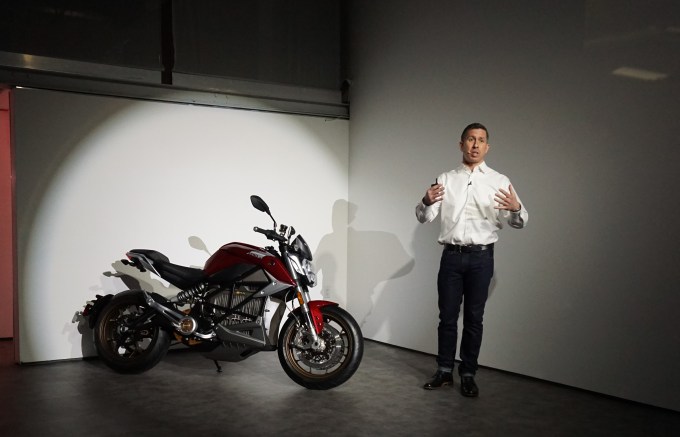
Zero Motorcycles unveiled its new 110 horsepower SR/F model in New York this week, offering a 200 mile range, one hour charge capability, and top speed of 124 mph.

The California based startup—whose investors include New York VC firm Invus—wired the SR/F with Zero’s new Cypher III operating system and Bosch’s Motorcycle Stability Control.

Both combine to offer remotely synced mobile connectivity to the motorcycle’s charge status and performance controls. The 485 pound SR/F is upgraded from Zero’s existing line-up to include cornering ABS, traction control, and a new app and dash interface.

Zero’s two-wheeler comes in at an entry price of $18,995. On the business side, the EV startup could produce as many as 10,000 SR/Fs and add members to its 200 dealer network, CEO Sam Paschel told TechCrunch in New York.
Zero’s SR/F enters the e-moto market in a year where EV startups will face more competition on specs and pricing, and big motorcycle manufacturers will feel more pressure to go electric.

From a business perspective, as TechCrunch has reported, the U.S. motorcycle industry has been in pretty bad shape since the recession. New sales dropped by roughly 50 percent since 2008, with sharp declines in ownership by everyone under 40. The exception is women, who have become the only growing motorcycle ownership segment.

E-moto upstarts have worked to attract new riders and close gaps with gas motorcycles in performance and cost—but most offerings have come with some compromise.

Italian company Energica’s models hit high marks in tech controls and performance—with 150 horsepower, 30 minute fast-charge times, and 125 mile range—but not without a hefty price of $20K and up.

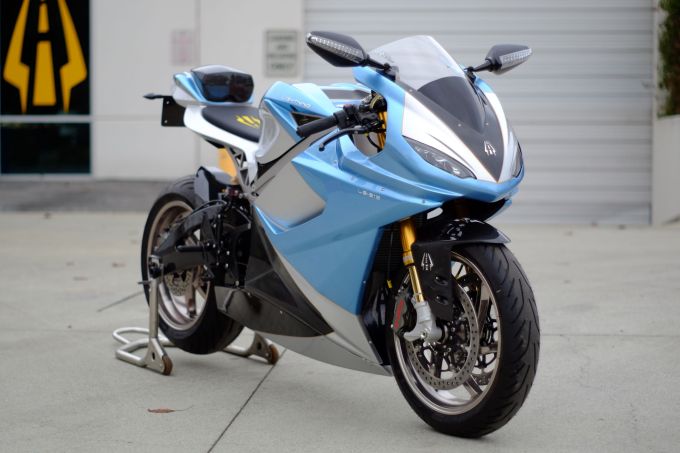
Lightning Motorcycles, another California based e-moto startup, offers ultra-high end of performance, claiming the world’s fastest production motorcycle in the world with its LS-218. But the $38K, 218 mph, track bred e-moto isn’t exactly average rider accessible.
Zero Motorcycles has found the widest market and model breadth, with prices starting at $8K on its FX model. Still, Zero’s e-motos (including the $16K SR) haven’t matched the performance control options, specs, or charge-times of the higher priced Energica Ego or Eva.

In 2019, Zero’s new machine—and a model being teased by Lightning—could bridge gaps in performance, range, charge-times, and price that have held many back from going e-motorcycle.

With its Bosch MSC system and upgraded operating system, the fully redesigned SR/F matches Energica in digital performance controls and comes close on power and speed at a more competitive price.

As TechCrunch reported, Lightning began taking reservations for a $12,998 Strike e-moto with some almost unbelievable stats at that price: 150 mph top speed, 35 minute charge-time, and 150 mile range. Lighting calls it their “first premium mass-market motorcycle,” with plans to unveil sometime in March.

Both Zero and Lightning’s 2019 models are positioned to compete with Harley Davidson’s EV entry, the $29K LiveWire expected to debut sometime this summer. HD revealed more product specs recently, such as 3 second 0-60 mph acceleration and 110 mile range. Harley Davidson has also indicated it plans a full pivot to electric, with additional e-motorcycles in the pipeline, as well as e-bicycles and scooters.

Harley’s electric moves, as well as Zero and Lightning’s more competitive offerings, could hasten major motorcycle manufacturers’ plans to sell e-motos. None of the big names producers—Honda, Kawasaki, Suzuki, BMW—have offered a production electric street motorcycle in the U.S. HD will be the first.

With momentum in the motorcycle world shifting electric, there are more than a few caveats as to whether there’s a viable U.S. market. In addition to the contracting sales environment, the e-moto startup space has racked up a series of failures. These include Brammo, Mission Motorcycles, and more recently,  Alta Motors—a California based EV venture backed by $45 million in VC that ceased operations in October. Alta had a partnership with Harley Davidson (now defunct) and there’s been little light shed on what forced them to shut off the lights.

Alta Motors resurfaced last week, when Canadian company BRP—the owner of such brands as snowmobile maker Ski-Doo and watercraft producer Sea-Doo—acquired select Assets of Alta. There had been hopes someone would purchase and revive the California e-moto startup, but that looks unlikely. “We don’t have any current plans for resuscitating Alta Motors in it’s old form,” BRP’s Vice President for Communications Leslie Quinton told TechCrunch. “We have no plans yet to announce how we’re going to use the technologies,” she said.

So as Harley Davidson, Zero, and Lightning move to mainstream electric motorcycles in 2019, it appears another e-moto startup has officially faded into history.
Twitter confirmed it has in development a new “Hide Tweet” option, but has yet to provide more detail about its plans for the feature. The new option, spotted in Twitter’s code, is available from a list of moderation choices that appear when you click the “Share” button on a tweet – a button whose icon has also been given a refresh, it seems. Like it sounds, “Hide Tweet” appears to function as an alternative to muting or blocking a user, while still offering some control over a conversation.

Related to this, an option to “View Hidden Tweets” was also found to be in the works. This appears to allow a user to unhide those tweets that were previously hidden.

The “Hide Tweet” feature was first discovered by Jane Manchun Wong, who tweeted about her findings on Thursday.

Wong says she found the feature within the code of the Twitter Android application. That means it’s not necessarily something Twitter will release publicly, but has at least thought about seriously enough to develop.

Reached for comment earlier today, Twitter told us some employees would soon tweet out more context about the feature. As of the time of writing, those explanations had not gone live.

Immediately, there were concerns an option like this would allow users to silence their critics – not just for themselves, as is possible today with muting and blocking – but for anyone reading through a stream of Twitter Replies. Imagine, for example, if a controversial politician began to hide tweets they didn’t like or those that contradicted an outrageous claim with a fact check, people said.

On the flip side, putting the original poster back in control of which Replies are visible may allow people to feel more comfortable with sharing on Twitter, which could impact user growth – a number Twitter struggles with today.

But as of now, it’s not clear that the “Hide Tweet” button is something that would hide the tweet from everyone’s view, or just the from the person who clicked the button.

It’s also unclear what stage of development the feature is in, or if it will be part of a larger change to moderation controls.

If Twitter chooses to comment, we’ll update with those answers.

The feature’s discovery comes at a time when Twitter has been under increased pressure to improve the conversational health on its platform.

In a recent interview, Twitter CEO Jack Dorsey admitted that it puts most of the burden on the victims of abuse, which has been “a huge fail.” He said Twitter was looking into new way to proactively enforce and promote health, so blocking and reporting were last resorts.

A “Hide Tweet” button doesn’t seem to fit into that plan, as it requires users’ direct involvement with the moderation process.

It’s worth also noting that Twitter already has a “hidden tweets” feature of sorts.

In 2018, the company introduced a new filtering strategy to hide disruptive tweets, which takes into consideration various behavioral signals – like whether the account had verified its email, is frequently blocked, or tweets often at accounts that don’t follow it back, for example. If Twitter determined the tweet should be downranked, it moved it to its own secluded part of the Reply thread, under a “Show more replies” button.

Twitter tests a number of things that never see the light of day in a public product. More recently, the company said it was weighing the idea of a “clarifying function” for explaining old tweets. It’s also launching a prototype app that will experiment with new ideas around conversation threads.


Customer experience management platform Medallia has filed to raise up to $70 million in Series F funding, according to regulatory documents obtained by the Prime Unicorn Index. The new shares were priced at $15 apiece, valuing the nearly two-decades-old business at $1.7 billion.

We’ve reached out to Medallia for comment.

Medallia is expected to finally transition to the public markets in 2019, a year chock-full of high-profile unicorn IPOs. The downsized round, which if raised at full is less than half of its Series E funding, is likely Medallia’s final infusion of private investment.

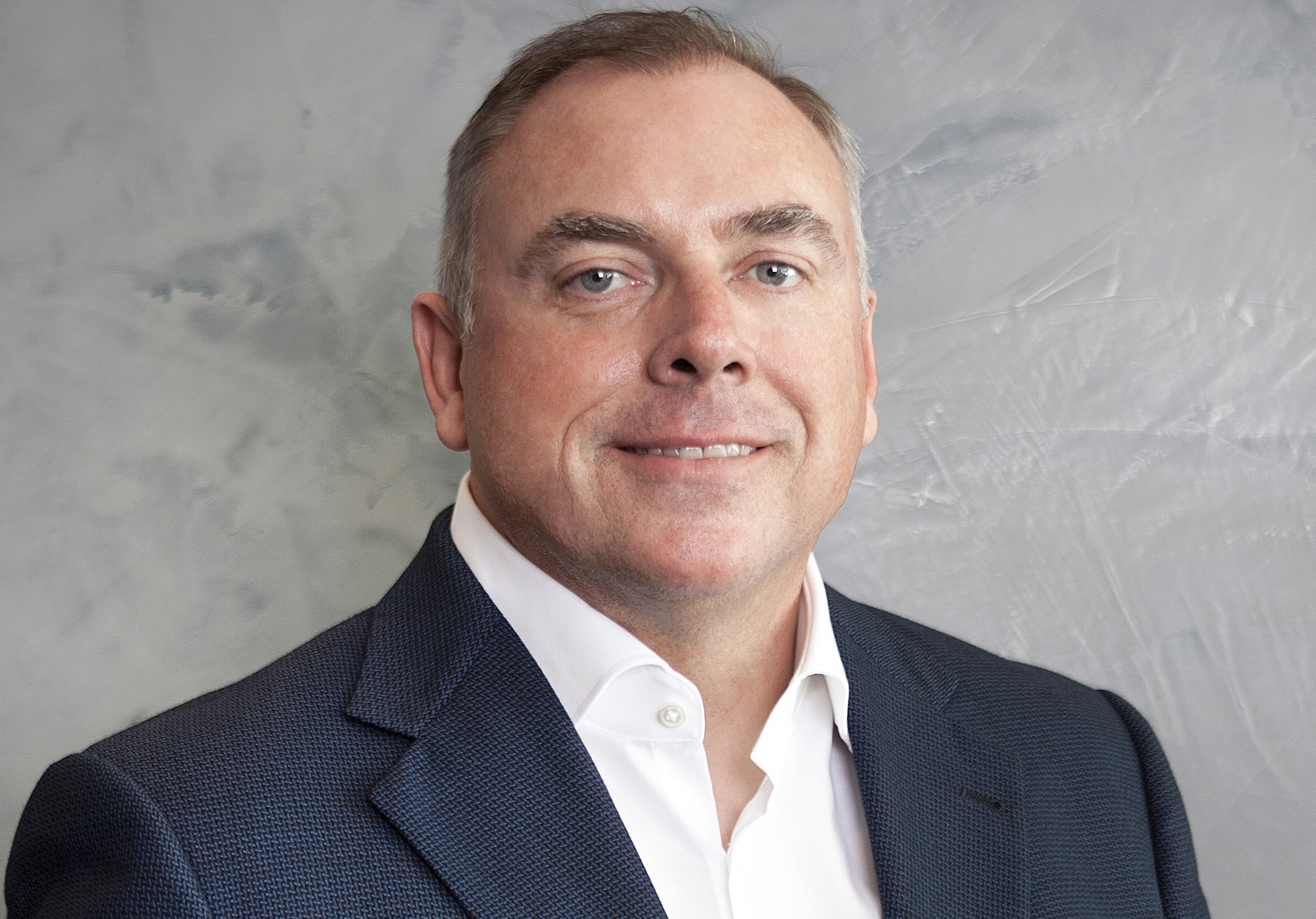
San Mateo-headquartered Medallia, led by newly-appointed chief executive officer Leslie Stretch, operates a platform meant to help businesses better provide for their customers. Its core product, the Medallia Experience Cloud, provides employees real-time data on customers collected from online review sites and social media. The service leverages that data to provide insights and tools to improve customer experiences.

Leslie Stretch, president and CEO of Medallia (PRNewsfoto/Medallia).

According to PitchBook, Medallia boasts a particularly clean cap table, especially for a roughly 18-year-old business. It’s backed by four venture capital firms: Sequoia Capital, Saints Capital, TriplePoint Venture Growth and Grotmol Solutions, the latter which invested a small amount of capital in 2010. Medallia has raised a total of $268 million in equity funding, including a $150 million round in 2015 that valued the company at $1.25 billion.

Prior to hiring Stretch to lead the company to IPO, Medallia co-founder Borge Hald ran the company as CEO since its 2001 launch. Hald is now executive chairman and chief strategy officer.


YouTube will shut off comments on videos featuring “younger minors and videos with older minors at risk of attracting predatory behavior,” according to a statement from the company. It’s an effort to stamp out predatory behavior from viewers that included salacious notes in the comments section of videos featuring underage kids.

Last week, TechCrunch confirmed reports which first arose on Reddit about the existence of a soft-core pedophile ring that was communicating via YouTube’s comments section and disseminating videos of minors by gaming the company’s search algorithms.

YouTube creator Matt Watson flagged the problem in a subreddit, noting that he found scores of videos of kids where YouTube users are trading inappropriate comments and identifying timestamps to focus on below the fold. Watson denounced the company for failing to prevent what he describes as a “soft-core pedophilia ring” from operating in plain sight on its platform.

The reports brought condemnation from several businesses that advertise on YouTube (the company’s primary source of revenue). Disney, Fortnite maker Epic Games, McDonald’s, and Nestlé Foods, reportedly all pulled advertising from the site in the wake of the scandal.

“Over the past week, we’ve been taking a number of steps to better protect children and families, including suspending comments on tens of millions of videos,” a Google spokesperson said in a statement emailed to TechCrunch. “Now, we will begin suspending comments on most videos that feature minors, with the exception of a small number of channels that actively moderate their comments and take additional steps to protect children. We understand that comments are an important way creators build and connect with their audiences; we also know that this is the right thing to do to protect the YouTube community.”

The rollout of the new moderating tools will take several months, according to YouTube.

And while the company acknowledged the severity of the changes and the impact it may have on YouTubers, it said it was taking action to prevent the exploitation of minors on the platform.

A small number of known channels will be able to keep their comments sections up, but will be required to actively monitor them beyond simply using YouTube’s own moderation tools, the company said.

YouTube also is speeding up the launch of a new classification tool that can detect and remove twice as many individual comments as in the past — accelerating the automation of content moderation (which could, itself, have unintended consequences).

In a related move designed to protect children from abhorrent content, YouTube has terminated the channel FilthyFrankClips and several other channels that were reportedly instructing children on how to slash their wrists.

First reported in the Washington Post, the clips from the channel contained children’s videos spliced with content on self-harm, according to an initial report on the blog, Pedimom. 

As we noted in our earlier reporting, this isn’t the first time that YouTube has been identified as a haven for pedophiles hiding in plain sight.

Back in November 2017, several major advertisers froze spending on YouTube’s platform after an investigation by the BBC and the Times discovered similarly obscene comments on videos of children.

Earlier the same month YouTube was also criticized over low-quality content targeting kids as viewers on its platform.

The company went on to announce a number of policy changes related to kid-focused video, including saying it would aggressively police comments on videos of kids and that videos found to have inappropriate comments about the kids in them would have comments turned off altogether.

Some of the videos of young girls that YouTube recommended we watch had already had comments disabled — which suggests its AI had previously identified a large number of inappropriate comments being shared (on account of its policy of switching off comments on clips containing kids when comments are deemed “inappropriate”) — yet the videos themselves were still being suggested for viewing in a test search that originated with the phrase “bikini haul.”

YouTube addressed its creators earlier today in a blog post telling them about the steps it was taking.


Embattled venture capitalist Justin Caldbeck (pictured) is suing his former co-Binary Capital founder Jonathan Teo, alleging breach of contract, fraud and more.

Caldbeck, accused of sexual harassment and unwanted sexual advances in 2017, took an indefinite leave of absence from Binary Capital, leaving to Teo all the responsibilities of the $175 million fund. Shortly after, Teo offered to step down in a last-ditch effort to keep the firm afloat. Ultimately, Binary Capital shut down and New York venture capital firm Lerer Hippeau assumed responsibility for its $125 million debut investment vehicle, 70 percent of which has been deployed, per details shared in the lawsuit.

In the legal filing submitted to the Superior Court of The State of California, Caldbeck accuses Teo of mismanagement following his June 2017 departure. We’ve reached out to lawyers for both parties for comment.

“Mr. Teo completely abandoned the leadership responsibilities that were entrusted to him, neglecting to take the most basic steps required to run a venture capital firm,” the lawsuit states. “Mr. Teo was laughably bad at this job. As another Silicon Valley entrepreneur remarked publicly, ‘this guy has done everything possible wrong.’ ”

The filing cites 500 Startups and Sherpa Capital as examples of funds that were able to survive following similar scandals wherein a partner was accused of sexual harassment and misconduct. Caldbeck, in essence, is upset Teo wasn’t able to successfully run Binary Capital following his own alleged wrongdoings.

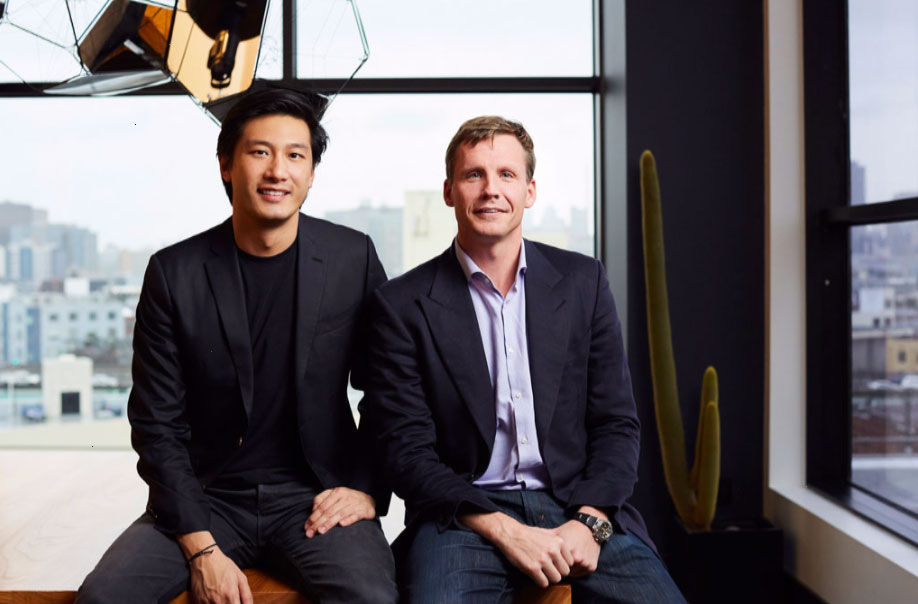
Binary Capital co-founders Jonathan Teo and Justin Caldbeck

Caldbeck, who’s taken to angel investing in the months following the high-profile scandal, was previously a managing director at Lightspeed Venture Partners before launching Binary Capital alongside Teo in 2014. Teo, for his part, was formerly a managing director at General Catalyst. Binary Capital, an early-stage fund, has backed companies including plus-sized clothing business Dia&Co and airfare search engine Skiplagged.

According to several reports, Teo had hoped to keep Binary Capital alive after The Information published a report highlighting six women’s allegations of being groped and propositioned during their professional relationship with Caldbeck.

Caldbeck, however, is less than satisfied with Teo’s handling of those allegations and the wave of “negative press articles” that followed. Caldbeck also claims he resigned from the firm only in exchange for a promise for future financial stability from Teo.

In the months following his departure, Caldbeck asserts Teo took personal vacations to Mongolia, Ibiza and the Burning Man festival. He “went AWOL,” “was completely unresponsive,” “seemed not to care,” and “made no effort to save the firm,” per the filing.

Teo, additionally, allegedly took on an operating role at Binary Capital portfolio company Trillex, where he increased corporate spending limits to purchase gifts for himself, including taking out a more than $2 million unauthorized loan to pay his personal taxes and to assist a family member with a real estate project.

According to a Forbes report on the lawsuit, Teo’s legal team says “The justice system will soon remind Mr. Caldbeck that he alone is responsible for his many misdeeds.” We will update this report when he hear back from Caldbeck and Teo’s legal teams.

Here’s the full lawsuit:


With Slack gearing up to go public and now seeing daily active users of 10 million with 85,000 organizations using it to help employees communicate with each other, Facebook today released some updated numbers of its own for Workplace, its enterprise-focused platform: the company says that there are now 2 million paid users on the service, not counting those who are using its free tier; and NGOs and educational organizations using Workplace for Good — if you add these in you get “millions” more, Facebook said, without providing a concrete number.

The company’s paid tier starts at $3 per month per user, with pricing arranged directly with organizations when numbers exceed 5,000 employees. It started to charge for its service in October 2017, after first launching in October 2016.

Being Facebook and already working at a huge scale with more than 2 billion monthly active users of its flagship service, the company has always pitched Workplace as a tool for very large enterprises, and today it said that it now has 150 companies with more than 10,000 users each on the platform.

These have included companies like Walmart (the world’s biggest employer) as well as Nestle, Vodafone, GSK, Telefonica, AstraZeneca and Delta Airlines.

Picking these metrics to talk about the company’s growth is a strategic move for Facebook. They are different enough from what Slack measures that it’s not immediately easy to draw a comparison and claim that Slack is much larger. At the same time, it highlights Workplace’s success in an area that Slack, Teams and others competing in this space are also chasing: enterprise users. These are the most lucrative customer segment, as they not only generate larger recurring revenues, but they are often slower to churn once they do sign on to your service.

Workplace has made an effort over the last several years to add more features to bring the platform in line both with what basic Facebook offers, as well as other enterprise communication services that Workplace competes with more directly. That includes integrating with a number of key apps, although it’s still far from the hundreds that can be fed into Slack.

The numbers do not give us a total number of users on Workplace but they set out also how Facebook is continuing to drive the product forward as a diverse and distinct revenue stream apart from its ad-based consumer service.

At the end of last year, Facebook appointed a new head of Workplace, Karandeep Anand, who came to Facebook three years ago from Microsoft (and thus has a close understanding of enterprise software). He works alongside Julien Codorniou to focus on the technical development of the product while Codorniou focuses on sales, client relations and business development.


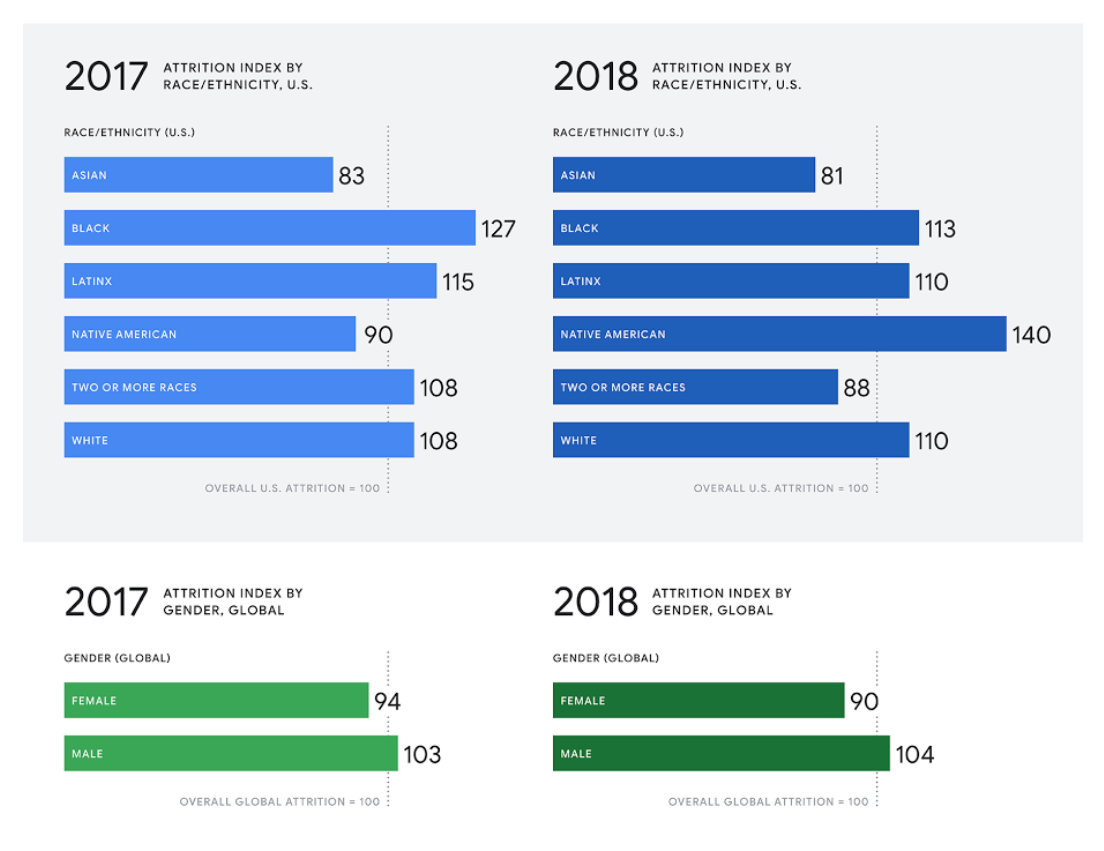
Believe it or not, the retention of black and Latinx employees at Google was better last year than in 2017. Though, Google’s attrition rates of black and Latinx — which indicate the rate at which employees leave on an annual basis — are still higher than the national average.

For Native American employees, Google’s attrition rates significantly increased from the year prior. To be clear, that’s a bad thing. For what it’s worth, Google is also not great at retaining white employees.

Google publishes the data as a weighted index and treats the average attrition rate as 100. The closer each group is to 100, the close to parity Google is. If a group’s index is 90, that means the group’s attrition rate was 10 percent lower than the average.

“While there are positive trends, there is still work to be done,” Global Director of Diversity, Equity & Inclusion Melanie Parker wrote in a blog post. “Specifically, attrition for Native Americans worsened. And while rates improved for Black and Latinx Googlers, they are still not on par with the average. These are all areas we plan to focus on over the coming year.”

Google released its first attrition index last year to show how many employees left the company on annual basis. Based on last year’s data, it was clear Google had the hardest time retaining black and brown employees. In fact, black and brown people were leaving Google at rates faster than the national average.

At the time, then-Google VP of Diversity and Inclusion Danielle Brown told TechCrunch the attrition rates for black and Latinx people were “a clear low light.”

A highlight, however, was that women were leaving Google at lower rates than the average. And this year’s data for women is slightly better, with an attrition rate of 90 compared to 94 the year prior. But we’ll see how the latest wave of controversy (harassment, walkouts, etc) at Google affects its attrition rates for 2019.


MKRdezign

Contact Form

Name

Email *

Message *

Powered by Blogger.
Javascript DisablePlease Enable Javascript To See All Widget