Latest Post

Companies sold a lot of wireless headphone in 2019. You already knew that though, right? What you probably didn’t know was precisely how many constitutes the aforementioned “lot.” New numbers from Canalys shed a light on those successes. The research firm’s classification of audio products is a little wonky, but it drives the point home nonetheless.

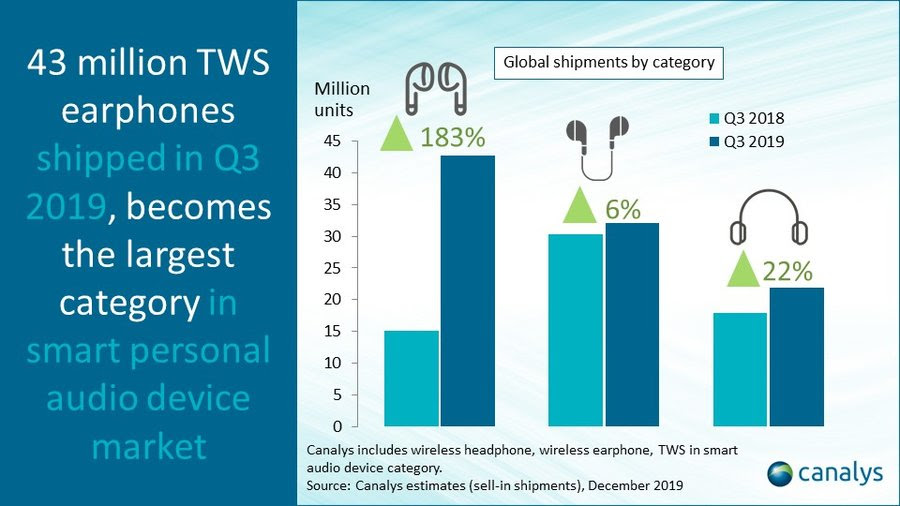
In their terms, we’re talking specifically about “true wireless stereo” products under the umbrella of “smart personal audio devices” — in other words, wireless headphones. Taken as a whole, the category (which also includes tethered wireless earbuds and over/on ear wireless headphones) hit 96.7 million shipments in Q3, making a 53 percent year over year growth. For the fourth quarter (including the holidays), the number is expected to break 100 million, pushing things to around 350 million for the full year.

The “true wireless stereo” segment (fully wireless earbuds) saw a 183% growth for the quarter, overtaking wireless earphones and wireless headphones in the process. Another not surprising thing: Apple led the pack, far and away. The company controls 43% of the market, per the firm. Xiaomi and Samsung are a distant second and third, respectively, at 7% and 6%, respectively. And Apple’s numbers will likely continue to look pretty good with the warm reception of the AirPods Pro.

The market is likely to get even more interesting in 2020 with the arrival of new products from giants like Google and Microsoft, coupled with an increased presence of low cost alternatives. But Apple’s stranglehold, particularly among iOS users, will be a tough one to break.


The age of alternative meats is upon us. 

Beyond Meat is a $5 billion public company selling burgers in Canadian McDonald’s and American Carl’s Jr., breakfast sausages in Dunkin, and even chicken in a limited trial at KFC. Meanwhile, Impossible Foods has become a runaway hit at Burger Kings around the country. And the company is reportedly seeking to raise $300 million and $400 million at a valuation of roughly $3 billion according to reports in Reuters.

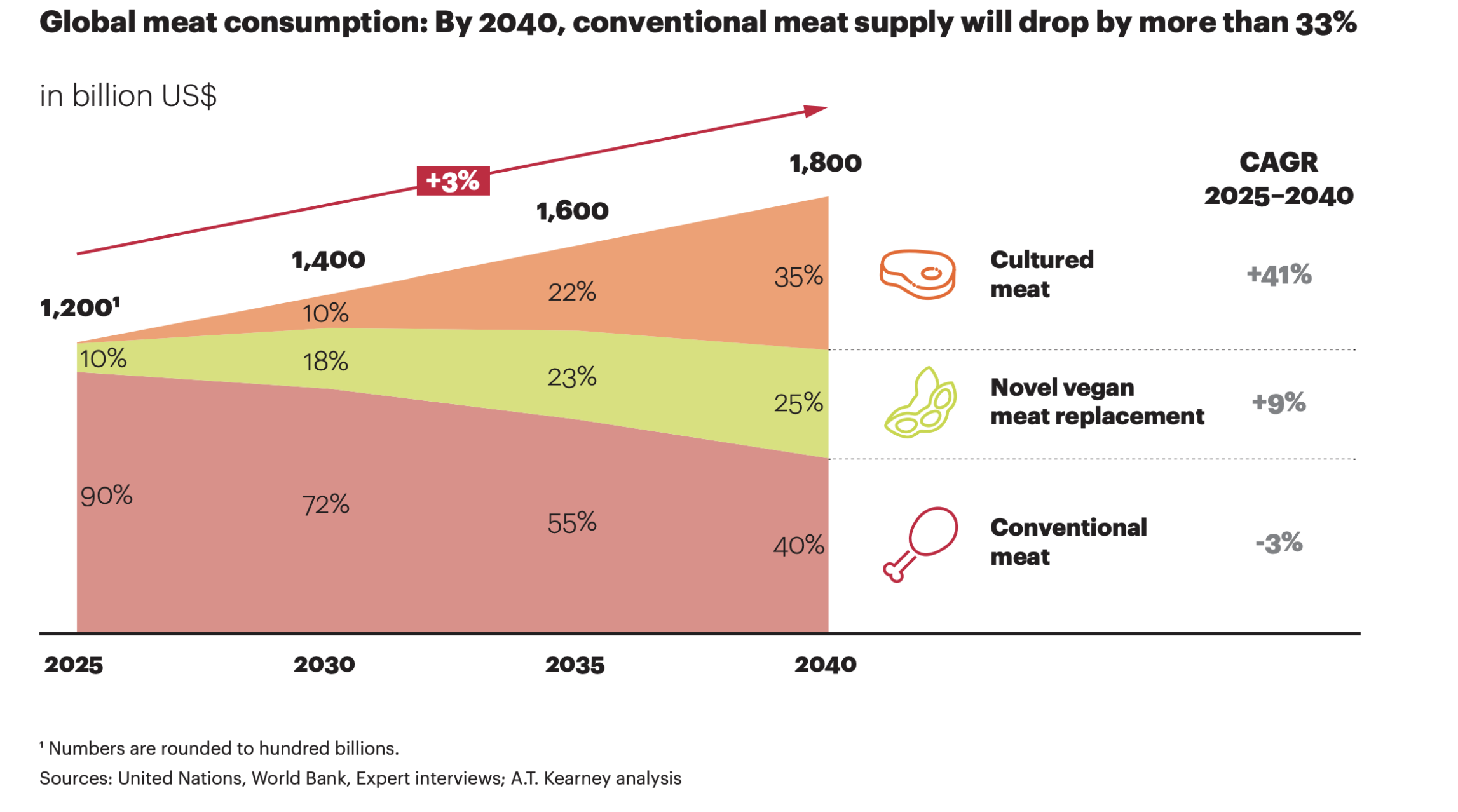
The plant-based up-and-comers have become a big enough threat that the meat industry has hired a marketing hit man to go after the new plant-based contenders to an increasing share of meat’s market. And they have a reason to be worried. By 2040, the conventional meat supply will drop by more than 33%, according to a report from the consulting firm AT Kearney.

As these no-longer-startups bask in the warm glow of success (and the rejuvenation of a sleepy corner of the supermarket) the question is what’s coming next from the research labs and test kitchens that are backed by millions in venture capital dollars.

Where’s the beef?

For the initial wave of investment, driven in part by a desire to appeal to consumers looking for alternatives to animal products, but wary of the cost of cultivating muscle tissue plant-based alternatives seemed obvious. Brown says animals are wholly unnecessary to make products that recreate the taste of a beef steak or a burger — and potentially surpass their flavor, all at a lower price.

Other companies have taken up that challenge as well in the months since Beyond Meat’s historic run in public markets (for a while, the company was the best-performing public offering of 2019). Startups like Rebellyous, Nuggs, and Daring Foods are making chicken replacements (along with big meat producer Tyson Foods through its Raised & Rooted brand).

Meanwhile beef gets its own challengers (outside of Impossible Foods and Beyond Meat) with companies like Nestle’s plant-based pitch Sweet Earth Foods, Tyson Foods, Beyond the Butcher, Hungry Planet and a host of others.

Even shrimp has a plant-based competitor in New Wave Foods, a startup that actually raised cash from Tyson’s venture capital arm earlier this year.

What has set Impossible Foods and Beyond Meat apart from other competitors — at least in the eyes of the investors — is the research and development teams that are working on flavor profiles and products that simply are more direct corollaries to the products they’re looking to supplant.

For Impossible, that’s the use of genetically modified yeast cells that are manufacturing a protein found in soy called leghemoglobin. That’s the core of Impossible’s secret weapon — the use of heme (a protein found in blood) to make its plant products taste meaty.

These same benefits apply to investors’ approach to plant-based dairy alternatives that are trying to one-up soy and almond milks with a more direct one-to-one substitute for dairy.


We’re excited to announce a new Extra Crunch community perk from Typeform. Starting today, annual and two-year members of Extra Crunch can get 25% off an annual Typeform Premium plan.

Typeform lets you create beautiful, interactive experiences across your most important customer touchpoints. Everything from slick surveys, friendly forms and quizzes can all be easily made with Typeform. Typeform is great for collecting feedback, generating leads, conducting research, generating event signups, engaging your audience, training team members and more.

What makes Typeform stand out over products like Google Forms is the carefully crafted interface. It’s designed to keep users engaged and focused, so you get better data. You can learn more about Typeform here.  

Extra Crunch is a membership program from TechCrunch that features how-tos and interviews on company building, intelligence on the most disruptive opportunities for startups, an experience on TechCrunch.com that’s free of banner ads, discounts on TechCrunch events and several community perks like the one mentioned in this article. Our goal is to democratize information about startups, and we’d love to have you join our community.

You can sign up for Extra Crunch here.

Extra Crunch subscribers get 25% off Typeform Premium yearly plans. All you need to do is create a free Typeform account, and then use the coupon code to upgrade. The coupon code will be provided to Extra Crunch annual and two-year subscribers in the welcome email after signing up for our service.

If you are already an annual or two-year Extra Crunch member, you will receive an email with the offer at some point over the next 24 hours. If you are currently a monthly Extra Crunch subscriber and want to upgrade to annual in order to claim this deal, head over to the “my account” section on TechCrunch.com and click the “upgrade” button. 

This is one of several community perks we’ve launched for Extra Crunch annual members. Other community perks include a 20% discount on TechCrunch events, 100,000 Brex rewards points upon credit card sign up and an opportunity to claim $1,000 in AWS credits. For a full list of perks from partners, head here.

If there are other community perks you want to see us add, please let us know by emailing travis@techcrunch.com.

Sign up for an annual Extra Crunch membership today to claim this community perk. You can purchase an annual Extra Crunch membership here.

Disclosure:

This offer is provided as a partnership between TechCrunch and Typeform, but it is not an endorsement from the TechCrunch editorial team. TechCrunch’s business operations remain separate to ensure editorial integrity.


As big tech gets bigger, industry leaders have begun making more noise about helping homeless populations, particularly in those regions where high salaries have driven up the cost of living to heights not seen before. Last January, for example, Facebook and Chan Zuckerberg Initiative, among other participants, formed a group called the Partnership for the Bay’s Future that said it was going to commit hundreds of millions of dollars to expand affordable housing and strengthen “low-income tenant protections” in the five main counties in and around San Francisco. Microsoft meanwhile made a similar pledge in January of last year, promising $500 million to increase housing options in Seattle where low- and middle-income workers are being priced out of Seattle and its surrounding suburbs.

Amazon has made similar pledges in the past, with CEO Jeff Bezos pledging $2 billion to combat homelessness and to fund a network of “Montessori-inspired preschools in underserved communities,” as he said in a statement posted on Twitter at the time, in September 2018.

Now, however, Amazon is taking an approach that immediately raises the bar for its rivals in tech: it’s opening up a space in its Seattle headquarters to a homeless shelter, one that’s expected to become the largest family shelter in the state of Washington.

Business Insider reported the news earlier today, and it says the space will be able to accommodate 275 people each night and that it will offer individual, private rooms for families who are allowed to bring pets. It will also feature an industrial kitchen that’s expected to produce 600,000 meals per year.

The space is scheduled to open in the first quarter of the new year, and is part of a partnership Amazon has enjoyed for years with a nonprofit called Mary’s Place that has been operating a shelter out of a Travelodge hotel on Amazon’s campus since 2016. The new space, which BI says will have enough beds and blankets for 400 families each year, isn’t just owned by Amazon but the company has offered to pay for the nonprofit’s utilities, maintenance, and security for the next 10 years or as long as Mary’s Place needs it.

BI notes that the shelter will make a mere dent in Seattle’s homeless population, which includes 12,500 people in King County, where Seattle is located, but it’s still notable, not least because of the company’s willingness to house the shelter in its own headquarters.

It’s a move that no other tech company of which we’re aware has taken. The decision also underscores other cities’ equivocation over where their own, growing homeless populations should receive support. In just one memorable instance, after San Francisco Mayor London Breed last March floated an idea of turning a parking lot along the city’s Embarcadero into a center that would provide health and housing services and stays for up to 200 of the city’s 7,000-plus homeless residents, neighboring residents launched a campaign to squash the proposal. It was later passed anyway.

Vox noted in report about Microsoft’s $500 million pledge last year that many of these corporate efforts tend to elicit two types of reactions: admiration for the companies’ efforts — or frustration over the publicity these initiatives receive. After all, it’s hard to forget that Amazon paid no federal tax in the U.S. in 2018 on more than $11 billion in profit before taxes. The company also threatened in 2018 to stop construction in Seattle if the city passed a tax on major businesses that would have raised money for affordable housing.

Whether Amazon — one of the most valuable companies in the world, with a current $915 billion market cap — is doing its fair share is certainly worthy of exploring in an ongoing way.

Still, a homeless shelter at the heart of the company is worth acknowledging — and perhaps emulating — too.

“It’s not one entity that’s going to solve this,” Marty Hartman, the executive director of Mary’s Place, tells BI. “It’s not on corporations. It’s not on congregations. It’s not on government. It’s not on foundations. It’s all of us working together.”

Pictured above: A view of the new Mary’s Place Family Center from the street, courtesy of Amazon.


Shares of NIO, a China-based electric car manufacturer, are soaring this morning after the company’s Q3 2019 earnings beat investor expectations. NIO’s surprise win comes directly on the heels of Tesla, a competitor, announcing the delivery of its first cars made in China, NIO’s home market.

NIO went public on the New York Stock Exchange in 2018 for $6.26 per share. Its value has plunged as a public company, seeing its per-share price fall to as little as $1.19. Today, after its earnings report, NIO shares are up more than $1 apiece, to $3.47 per share as of the time of writing. That new price represents a gain of a touch less than 44% in today’s trading.

Earnings

NIO managed to beat both revenue and profit expectations in the quarter. And, the company’s forecast for its next quarter’s car deliveries show a sharp rise in automotive deliveries.

According to Yahoo Finance, investors expected NIO to lose $0.34 per share in Q3 on an adjusted basis off revenue of $230.8 million. In fact, NIO reported $257.0 million in revenue leading to an adjusted $0.33 per share loss. NIO managed a top-and-bottom beat while growing its total revenues by 21.8% compared to the sequentially preceding quarter, and 25% compared to the year-ago period.

While NIO did beat expectations, it remains a company deep in its investment cycle. That’s a polite way of saying that it loses lots of money. For example, in its most recent quarter, NIO’s gross margin on selling automobiles came to -6.8%. That was a bit worse than its year-ago result of -4.3%, if better than what it managed earlier in Q2 2019.

NIO’s core business can’t even cover its cost of revenues, let alone the operating costs of the rest of the company. This means that the company is consuming cash, putting an end date on its ability to operate without more cash.

As NIO put it in its earnings letter (emphasis: TechCrunch):

The Company operates with continuous loss and negative equity. The Company’s cash balance is not adequate to provide the required working capital and liquidity for continuous operation in the next 12 months. The Company’s continuous operation, which has also constituted the basis of preparing the Company’s third quarter unaudited financial information, depends on the Company’s capability to obtain sufficient external equity or debt financing. The Company is currently working on several financing projects, the consummation of which is subject to certain uncertainties. The Company will announce any material developments or information subject to the requirements by applicable laws.

So, NIO needs more money. Luckily for it, with a newly risen share price the firm has a better shot at selling more of itself to raise the capital it needs to stay in business and grow.

And grow it intends, with a written expectation of delivering “over 8,000” vehicles in Q4 2019, which it notes is about two-thirds more than it managed in Q3 2019; so NIO is telling investors that its revenue will be sharply higher in the current period than it was in the preceding three-month period.

All good news for NIO, even if Musk and company are breathing down its neck. And good news for the 2018 IPO class.


We love parties almost as much as we love startups, but we go absolutely bonkers for a hot startup-party mashup. That’s why we’re returning to host our 3rd Annual TechCrunch Winter Party in San Francisco on Friday, February 7. Even better news, party-goers — the second batch of coveted tickets to this wild winter romp are available now. Better get your tickets while you can.

Last year’s inaugural event was a huge success as nearly 1,000 of Silicon Valley’s brightest minds came to relax, connect and celebrate the entrepreneurial spirit of the startup community — and cast a keen eye over some promising startups.

This year’s soiree takes place at Galvanize and features tasty libations, delicious hors d’oeuvres and engaging conversation. That sounds so very civilized, right? Well, don’t dry clean your stuffed shirt just yet, because we’ll have plenty of party games and activities, giveaways and fun surprises. And, of course, plenty of photo ops, baby!

Galvanize may be a multi-level venue, but the space is still limited — as are the tickets. We’re rolling them out in batches over the next few weeks, so keep checking back if you can’t snag a ticket.

Here are the pertinent Winter Party details.

When: Friday, February 7, 6:00 p.m. – 9:00 p.m.
Where: Galvanize, 44 Tehama St., San Francisco, CA 94105
Ticket price: $85 (buy them here)

Here’s another great idea. Why just mingle and schmooze when you can mingle, schmooze and demo your early-stage startup in front of hundreds of the Valley’s top star-makers? Buy a demo table for $1,500 (the price also includes four attendee tickets). Demo tables are limited, so act now before other founders snatch ’em up.

Of course, no TechCrunch party is complete without plenty of awesome prizes, including TC swag and tickets to Disrupt San Francisco 2020. Come on out for a great midwinter’s night of relaxed connection, fun and opportunity. Get your tickets to the 3rd Annual TechCrunch Winter Party at Galvanize today.


Hello and welcome back to our regular morning look at private companies, public markets and the gray space in between.

It’s the second to last day of 2019, meaning we’re very nearly out of time this year; our space for repretrospection is quickly coming to a close. Before we do run out of hours, however, I wanted to peek at some data that former Kleiner Perkins investor and Packagd founder Eric Feng recently compiled.

Feng dug into the changing ratio between enterprise-focused Seed deals and consumer-oriented Seed investments over the past decade or so, including 2019. The consumer-enterprise split, a loose divide that cleaves the startup world into two somewhat-neat buckets, has flipped. Feng’s data details a change in the majority, with startups selling to other companies raising more Seed deals than upstarts trying to build a customer base amongst folks like ourselves in 2019.

The change matters. As we continue to explore new unicorn creation (quick) and the pace of unicorn exits (comparatively slow), it’s also worth keeping an eye on the other end of the startup lifecycle. After all, what happens with Seed deals today will turn into changes to the unicorn market in years to come.

Let’s peek at a key chart from Feng, talk about Seed deal volume more generally, and close by positing a few reasons (only one of which is Snap’s IPO) as to why the market has changed as much as it has for the earliest stage of startup investing.

Changes

Feng’s piece, which you can read here, tracks the investment patterns of startup accelerator Y Combinator against its market. We care more about total deal volume, but I can’t recommend the dataset enough if you have the time.

Concerning the universe of Seed deals, here’s Feng’s key chart:
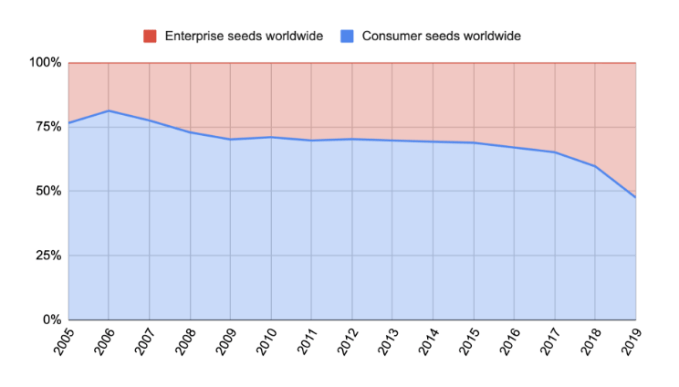
Chart via Eric Feng / Medium

As you can see, the chart shows that in the pre-2008 era, Seed deals were amply skewed towards consumer-focused Seed investments. A new normal was found after the 2008 crisis, with just a smidge under 75% of Seed deals focused on selling to the masses for nearly a decade.

In 2016, however, a new trend emerged: a gradual decline in consumer Seed deals and a shift towards enterprise investments.

This became more pronounced in 2017, sharper in 2018, and by 2019 fewer than half of Seed deals focused on consumers. Now, more than half are targeting other companies as their future customer base. (Y Combinator, as Feng notes, got there first, making a majority of investments into enterprise startups since 2010, with just a few outlying classes.)

This flip comes as Seed deals sit at the 5,000-per-quarter mark. As Crunchbase News published as Q3 2019 ended, global Seed volume is strong:
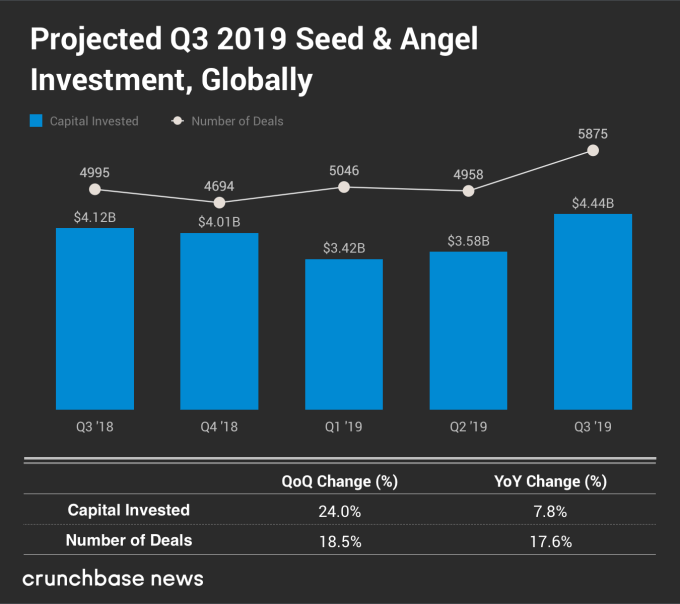
So, we’re seeing a healthy number of deals as the consumer-enterprise ratio changes. This means that the change to more enterprise deals as a portion of all Seed investments isn’t predicated on their number holding steady while Seed deals dried up. Instead, enterprise deals are taking a rising share while volume appears healthy.

Now we get to the fun stuff; why is this happening?

Blame SaaS

As with many trends long in the making, there is no single reason why Seed investors have changed up their investing patterns. Instead, there are likely a myriad that added up to the eventual change. I’m going to ping a number of Seed investors this week to get some more input for us to chew on, but there are some obvious candidates that we can discuss today.

In no particular order, here are a few:

  • Snap’s IPO: Snap went public in early 2017 at $17 per share. Its equity quickly spiked to into the high 20s. By July of that same year, Snap slipped under its IPO price. Its high-growth, high-spend model was under attack by both high costs and slim gross margins. Snap then went into a multi-year purgatory before returning to form — somewhat — in 2019. It’s not great for a category’s investment pace if one of its most prominent companies stumble very publicly, especially for Seed investors who make the riskiest bets in venture.

MKRdezign

Contact Form

Name

Email *

Message *

Powered by Blogger.
Javascript DisablePlease Enable Javascript To See All Widget