Latest Post

Just over two years ago, PerceptIn announced an $8 million Series A. The funding followed a $2 million seed round, and found the startup essentially coming out of stealth to showcase the sensors it was building for a wide range of form factors, from cars to robot vacuums.

The company’s been quite busy in the meantime. In fact, it even went so as changing its name. PerceptIn is now “Trifo” — a punchier name, if not quite as memorable. The company’s currently on its third robotic vacuum, announced today and set to be officially unveiled at CES in a few days.

Along with the arrival of “Lucy,” comes some more big funding from the Samsung Ventures-supported startup. Trifo has just raised a $15 million Series B, bringing its total funding up to $26 million. The round includes backing from Yidu Cloud, Tsinghua AI Fund and Matrix Partners, with a focus on producing more hardware and software solutions in the home robotics space, additional hiring and pushing into the U.S. and European markets.

For now, robot vacuums appear to be the company’s primary public facing output. It’s a tough market — one that’s traditionally been dominated by one player (iRobot). Still, there’s no shortage of alternatives from players big and small looking to crack it.

As for what sets Lucy apart, there are a pair of cameras on board — that could either be a plus or minus, depending on where you land on matters of privacy. The pair combine 1080p color images with depth sensing to provide home surveillance and mapping in light and dark settings. The robot can also be designed to “patrol” the home in pre defined routes. 

Lucy also features built-in obstacle avoidance for objects as short as one inch, room-by-room cleaning and and a 5,200mAh battery for up to two hours of cleaning on a charge. Pricing is $799, putting it in line with iRobot’s offerings. It’s set to arrive at some point in Q1. 



It would be hard to top the 2018 enterprise M&A total of a whopping $87 billion, and predictably this year didn’t come close. In fact, the top 10 enterprise M&A deals in 2019 were less than half last year’s, totaling $40.6 billion.

This year’s biggest purchase was Salesforce buying Tableau for $15.7 billion, which would have been good for third place last year behind IBM’s mega deal plucking Red Hat for $34 billion and Broadcom grabbing CA Technologies for $18.8 billion.

Contributing to this year’s quieter activity was the fact that several typically acquisitive companies — Adobe, Oracle and IBM — stayed mostly on the sidelines after big investments last year. It’s not unusual for companies to take a go-slow approach after a big expenditure year. Adobe and Oracle bought just two companies each with neither revealing the prices. IBM didn’t buy any.

Microsoft didn’t show up on this year’s list either, but still managed to pick up eight new companies. It was just that none was large enough to make the list (or even for them to publicly reveal the prices). When a publicly traded company doesn’t reveal the price, it usually means that it didn’t reach the threshold of being material to the company’s results.

As always, just because you buy it doesn’t mean it’s always going to integrate smoothly or well, and we won’t know about the success or failure of these transactions for some years to come. For now, we can only look at the deals themselves.


The business of selling consumer goods and services online is a relatively young endeavor across Africa, but ecommerce is set to boom.

Over the last eight years, the sector has seen its first phase of big VC fundings, startup duels and attrition.

To date, scaling e-commerce in Africa has straddled the line of challenge and opportunity, perhaps more than any other market in the world. Across major African economies, many of the requisites for online retail — internet access, digital payment adoption, and 3PL delivery options — have been severely lacking.

Still, startups jumped into this market for the chance to digitize a share of Africa’s fast growing consumer spending, expected to top $2 billion by 2025.

African e-commerce 2.0 will include some old and new players, play out across more countries, place more priority on internet services, and see the entry of China.

But before highlighting several things to look out for in the future of digital-retail on the continent, a look back is beneficial.

Jumia vs. Konga

The early years for development of African online shopping largely played out in Nigeria (and to some extent South Africa). Anyone who visited Nigeria from 2012 to 2016 likely saw evidence of one of the continent’s early e-commerce showdowns. Nigeria had its own Coke vs. Pepsi-like duel — a race between ventures Konga and Jumia to out-advertise and out-discount each other in a quest to scale online shopping in Africa’s largest economy and most populous nation.

Traveling in Lagos traffic, large billboards for each startup faced off across the skyline, as their delivery motorcycles buzzed between stopped cars.

Covering each company early on, it appeared a battle of VC attrition. The challenge: who could continue to raise enough capital to absorb the losses of simultaneously capturing and creating an e-commerce market in notoriously difficult conditions.

In addition to the aforementioned challenges, Nigeria also had (and continues to have) shoddy electricity.

Both Konga — founded by Nigerian Sim Shagaya — and Jumia — originally founded by two Nigerians and two Frenchman — were forced to burn capital building fulfillment operations most e-commerce startups source to third parties.

That included their own delivery and payment services (KongaPay and JumiaPay). In addition to sales of goods from mobile-phones to diapers, both startups also began experimenting with verticals for internet based services, such as food-delivery and classifieds.

While Jumia and Konga were competing in Nigeria, there was another VC driven race for e-commerce playing out in South Africa — the continent’s second largest and most advanced economy.

E-tailers Takealot and Kalahari had been jockeying for market share since 2011 after raising capital in the hundreds of millions of dollars from investors Naspers and U.S. fund Tiger Global Management.

So how did things turn out in West and Southern Africa? In 2014, the lead investor of a flailing Kalahari — Naspers — facilitated a merger with Takealot (that was more of an acquisition). They nixed the Kalahari brand in 2016 and bought out Takelot’s largest investor, Tiger Global, in 2018. Takealot is now South Africa’s leading e-commerce site by market share, but only operates in one country.

In Nigeria, by 2016 Jumia had outpaced its rival Konga in Alexa ratings (6 vs 14), while out-raising Konga (with backing of Goldman Sachs) to become Africa’s first VC backed, startup unicorn. By early 2018, Konga was purchased in a distressed acquisition and faded away as a competitor to Jumia.

Jumia went on to expand online goods and services verticals into 14 Africa countries (though it recently exited a few) and in April 2019 raised over $200 million in an NYSE IPO — the first on a major exchange for a VC-backed startup operating in Africa.

Jumia’s had bumpy road since going public — losing significant share-value after a short-sell attack earlier in 2019 — but the continent’s leading e-commerce company still has heap of capital and generates $100 million in revenues (even with losses).


Hello and welcome back to our regular morning look at private companies, public markets and the gray space in between.

It’s finally 2020, the year that should bring us a direct listing from home-sharing giant Airbnb, a technology company valued at tens of billions of dollars. The company’s flotation will be a key event in this coming year’s technology exit market. Expect the NYSE and Nasdaq to compete for the listing, bankers to queue to take part, and endless media coverage.

Given that that’s ahead, we’re going to take periodic looks at Airbnb as we tick closer to its eventual public market debut. And that means that this morning we’re looking back through time to see how fast the company has grown by using a quirky data point.

Airbnb releases a regular tally of its expected “guest stays” for New Year’s Eve each year, including 2019. We can therefore look back in time, tracking how quickly (or not) Airbnb’s New Year Eve guest tally has risen. This exercise will provide a loose, but fun proxy for the company’s growth as a whole.

The numbers

Before we look into the figures themselves, keep in mind that we are looking at a guest figure which is at best a proxy for revenue. We don’t know the revenue mix of the guest stays, for example, meaning that Airbnb could have seen a 10% drop in per-guest revenue this New Year’s Eve — even with more guest stays — and we’d have no idea.

So, the cliche about grains of salt and taking, please.

But as more guests tends to mean more rentals which points towards more revenue, the New Year’s Eve figures are useful as we work to understand how quickly Airbnb is growing now compared to how fast it grew in the past. The faster the company is expanding today, the more it’s worth. And given recent news that the company has ditched profitability in favor of boosting its sales and marketing spend (leading to sharp, regular deficits in its quarterly results), how fast Airbnb can grow through higher spend is a key question for the highly-backed, San Francisco-based private company.

Here’s the tally of guest stays in Airbnb’s during New Years Eve (data via CNBC, Jon Erlichman, Airbnb), and their resulting year-over-year growth rates:

  • 2009: 1,400
  • 2010: 6,000 (+329%)
  • 2011: 3,1000 (+417%)
  • 2012: 108,000 (248%)
  • 2013: 250,000 (+131%)
  • 2014: 540,000 (+116%)
  • 2015: 1,100,000 (+104%)
  • 2016: 2,000,000 (+82%)
  • 2017: 3,000,000 (+50%)
  • 2018: 3,700,000 (+23%)
  • 2019: 4,500,000 (+22%)

In chart form, that looks like this:

Let’s talk about a few things that stand out. First is that the company’s growth rate managed to stay over 100% for as long as it did. In case you’re a SaaS fan, what Airbnb pulled off in its early years (again, using this fun proxy for revenue growth) was far better than a triple-triple-double-double-double.

Next, the company’s growth rate in percentage terms has slowed dramatically, including in 2019. At the same time the firm managed to re-accelerate its gross guest growth in 2019. In numerical terms, Airbnb added 1,000,000 New Year’s Eve guest stays in 2017, 700,000 in 2018, and 800,000 in 2019. So 2019’s gross adds was not a record, but it was a better result than its year-ago tally.


California’s much-debated privacy law officially takes effect today, a year and a half after it was passed and signed — but it’ll be six more months before you see the hammer drop on any scofflaw tech companies that sell your personal data without your permission.

The California Consumer Privacy Act, or CCPA, is a state-level law that requires, among other things, that companies notify users of the intent to monetize their data, and give them a straightforward means of opting out of said monetization.

Here’s a top-level summary of some of its basic tenets:

  • Businesses must disclose what information they collect, what business purpose they do so for and any third parties they share that data with.
  • Businesses will be required to comply with official consumer requests to delete that data.
  • Consumers can opt out of their data being sold, and businesses can’t retaliate by changing the price or level of service.
  • Businesses can, however, offer “financial incentives” for being allowed to collect data.
  • California authorities are empowered to fine companies for violations.

The law is described in considerably more detail here, but the truth is that it will probably take years before its implications for businesses and regulators are completely understood and brought to bear. In the meantime the industries that will be most immediately and obviously affected are panicking.

A who’s-who of internet-reliant businesses has publicly opposed the CCPA. While they have been careful to avoid saying such regulation is unnecessary, they have said that this regulation is unnecessary. What we need, they say, is a federal law.

That’s true as far as it goes — it would protect more people and there would be less paperwork for companies that now must adapt their privacy policies and reporting to CCPA’s requirements. But the call for federal regulation is transparently a stall tactic, and an adequate bill at that level would likely take a year or more of intensive work even at the best of times, let alone during an election year while the President is being impeached.

So California wisely went ahead and established protections for its own residents, though as a consequence it will have aroused the ire of many companies based there.

A six-month grace period follows today’s official activation of the CCPA; This is a normal and necessary part of breaking in such a law, when honest mistakes can go unpunished and the inevitable bugs in the system can be squelched.

But starting in June offenses will be assessed with fines at the scale of thousands of dollars per violation, something that adds up real quick at the scales companies like Google and Facebook work in.

Adapting to the CCPA will be difficult, but as the establishment of GDPR in Europe has shown, it’s far from impossible, and at any rate the former’s requirements are considerably less stringent. Still, if your company isn’t already working on getting in compliance, better get started.


Look, this is the last post I’m writing in 2019 and I’m tired. But I can’t let the year close without taking stock of how well tech stocks did this year. It was bonkers.

So let’s mark the year’s conclusion with some notes for our future selves. Yes, we know that the Nasdaq has been setting new records and SaaS had a good year. But we need to dig in and get the numbers out so that we can look back and remember.

Let’s cap off this year the way it deserves to be remembered, as a kick-ass trip ’round the sun for your local, public technology company.

Keeping score

We’ll start with the indices that we care about:

  • The tech-heavy Nasdaq Composite rose 35% in 2019
  • The SaaS-heavy Bessemer Cloud Index rose 41% this year

Next, the highest-value U.S.-based technology companies:

  • Microsoft was up around 55% in 2019
  • Apple managed an 86% gain in the year
  • Not be left out, Facebook rose 57%
  • Amazon posted its own gain of 23% in 2019
  • Alphabet managed to grow by 29%, as well

Now let’s turn to some companies that we care about, even if they are smaller than the Big Five:

  • Salesforce? Up 19% this year
  • Adobe was up 46% in 2019, which was astounding
  • Intel picked up 28% in the year, making it no slouch
  • Even Oracle managed to gain 17% in 2019

And so on.

The technology industry’s epic run has been so strong that The Wall Street Journal noted this morning that, powered by tech companies, U.S. stocks “are poised for their best annual performance in six years.” The Journal highlighted the performance of Apple and Microsoft in particular for helping drive the boom. I wonder why.

How long will we live in the neighborhood of Nasdaq 9,000? How long can two tech companies be worth more than $1 trillion at the same time? How long can the biggest tech companies be worth a combined $4.93 trillion (I remember when $3 trillion for the Big Five was news, and I recall when the group reach a collective value of $4 trillion).1

But the worst trade in recent years has been the pessimists’ gambit. No matter what, stocks have kept going up, short-term hiccoughs and other missteps aside.

For nearly everyone, that is. While tech stocks in general did very well, some names that we all know did not. Let’s close on those reminders that a rising tide lifts only most boats.

2019 naughty list

Several of the most lackluster public tech companies were 2019 technology IPOs, interestingly enough. Who didn’t do well? Uber earns a spot on the naughty list for not only being underwater from its IPO price, but also from its final private valuations. And as you guessed, Lyft is down from its IPO price as well, which is not good.

Some 2019 IPOs did well in the middle of the year, but fell a little flat as the year came to a close. Pinterest, Beyond Meat and Zoom meet that criteria, for example. And some SaaS companies struggled, even if we think they will reach $1 billion in revenue in time.

But it was mostly a party. The public markets were good, and tech stocks were great. This helped create another 100+ unicorns in the year.

Such was 2019. On to 2020!

  1. In time, those numbers will look small. But sitting here on December 31, 2019, they appear huge and towering and, it must be said, somewhat perilously stacked.


Welcome to the third annual TechCrunch Include Progress Report. Our editorial and events teams work hard throughout the year to ensure that we bring you the most dynamic and diverse group of speakers and judges to our event stages. And finally, at the tail end of 2019, we bring you … 2018 data. (You can see 2017 data here.)

In 2018, TechCrunch produced Disrupts in San Francisco and Berlin, as well as regional Battlefield events in Zug, Switzerland; Lagos, Nigeria; São Paulo, Brazil and Berlin, Germany. We also produced a number of Sessions events, including the increasingly popular Robotics edition, as well as Blockchain and AR/VR.

It is important to us that we foster an environment that reflects the increasingly diverse tech industry. We are pleased to report that we saw an overall increase across the board with regard to inclusion, while still acknowledging that we weren’t yet where we needed to be when it comes to women and people of color across our stages. Happily, 2019 has been even better, and we’ll bring you those numbers soon.

Below we have compiled data from our 2018 events about the makeup of people who appeared as panelists, judges and founders of the Battlefield competitors. 

Disrupt

Our flagship conference attracts speakers, judges and Battlefield contestants from all over the world. It serves as a global arena for startups in all stages of development, as well as investors interested in finding their next big investment.

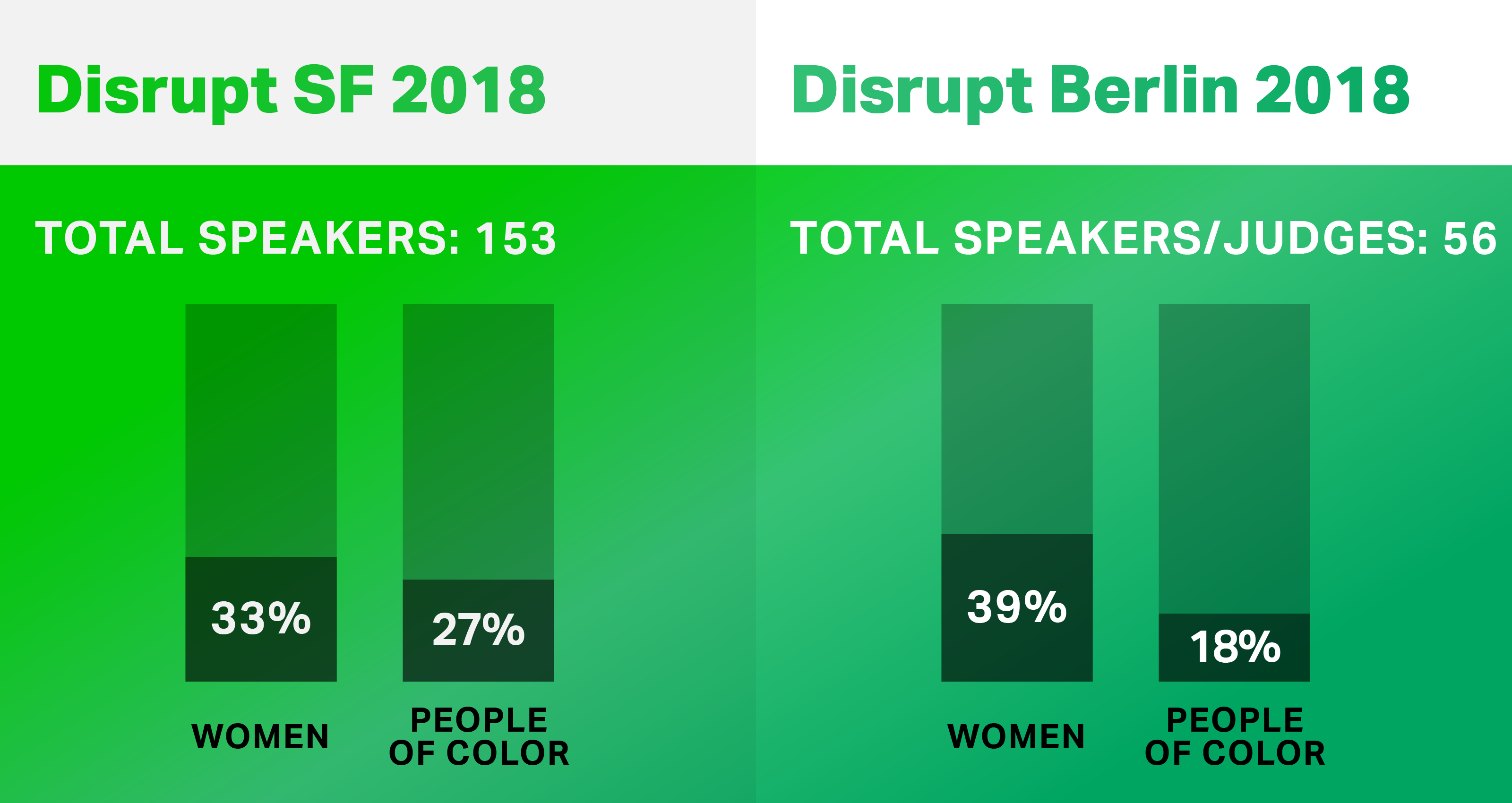
At Disrupt SF in 2018, of the 153 total speakers and judges, 33% were women and 27% were people of color. On the Battlefield stage, of the 22 teams, 36% had female founders. This is up from 29% the year before.

At Disrupt Berlin, of the 56 speakers and judges, 39% were women and 18% were people of color. Of the 12 teams that competed on the Battlefield stage, half the founders were women.

Regional Battlefield 

Our Battlefield competition isn’t limited to Disrupt. We take it on the road in order to give as many startups an opportunity to compete. In addition, these events include panels designed around region-specific topics. In 2018, we hosted Battlefield competitions in the Middle East and North Africa, Latin America and Africa regions.

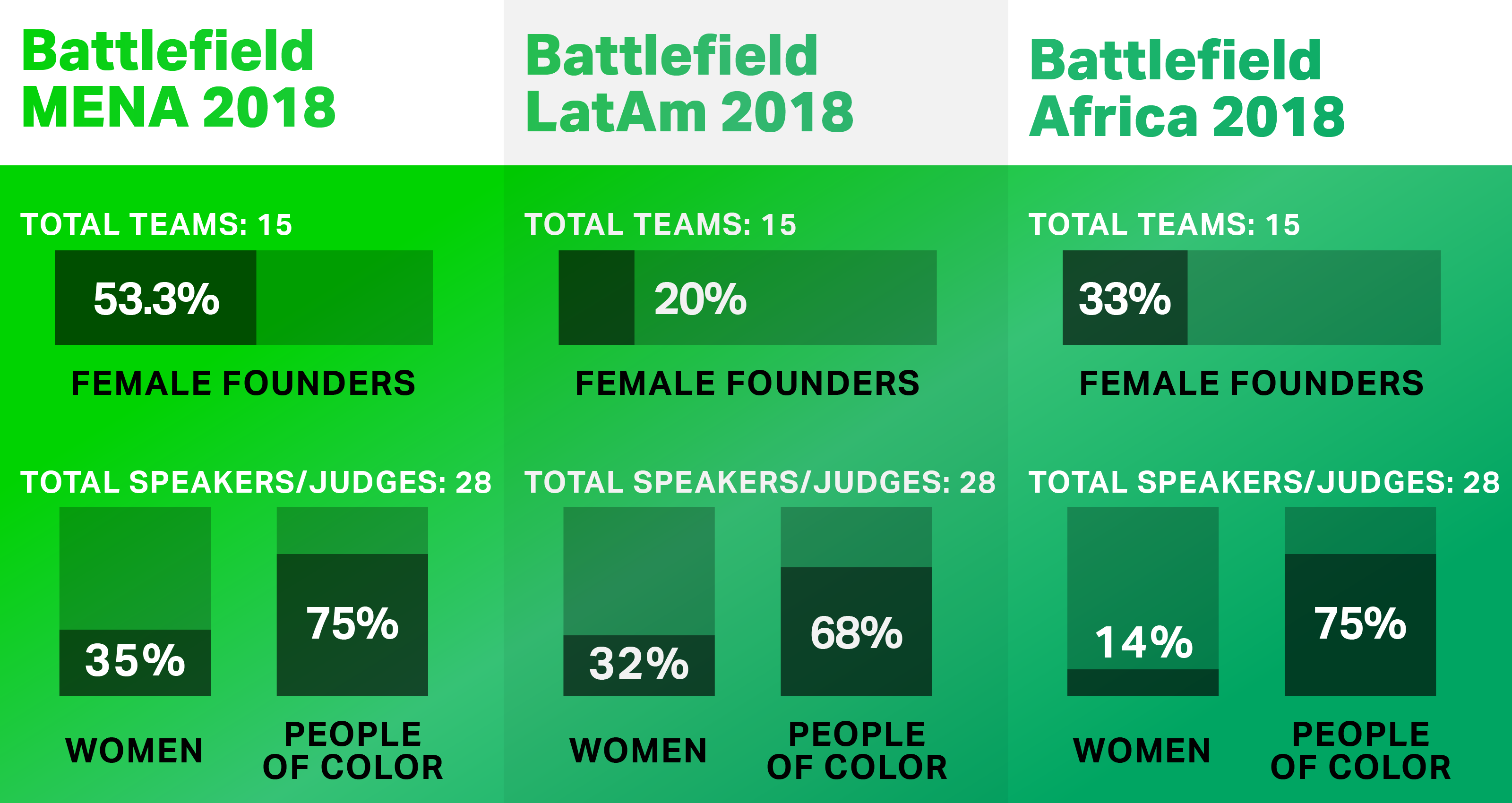
Battlefield MENA showcased 15 teams; of those, 53% were founded by women. Of the 28 speakers and judges, 35% were women and 75% were people of color.

Fifteen teams competed in Battlefield LatAm, 20% of which were led by women. Out of the 28 speakers and judges, 32% were women and 68% were people of color.

And finally, in Battlefield Africa, a total of 15 teams competed. Of those, 33% were founded by women. Of the 28 speakers and judges, 14% were women and 75% were people of color.

Sessions

Our daylong Sessions events are targeted at specific topics. In 2018, we held events about Blockchain, robotics and AR/VR. TechCrunch Sessions events attract to the stage specialists in their industries speaking to rapt audiences.

Of the 28 speakers who appeared onstage in Berkeley for Sessions: Robotics, 25% were women and 21% were people of color. In Zug, Switzerland for Sessions: Blockchain, of the 29 speakers, 17% were women and 21% were people of color. And in Los Angeles at Sessions: AR/VR, 34% of the 29 speakers were women and 24% were people of color.

Miscellaneous

Tel Aviv

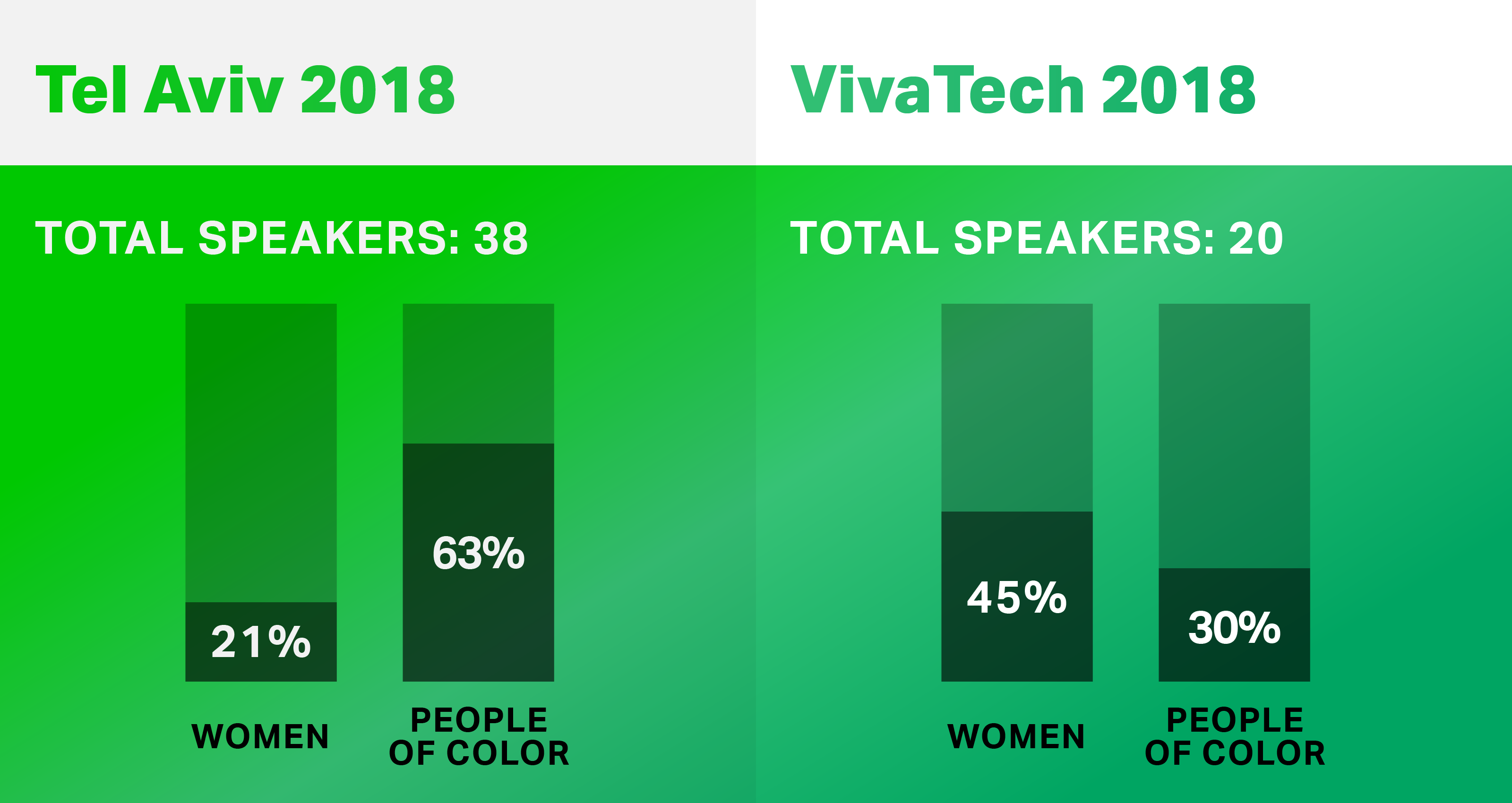
Our event in Tel Aviv leaned heavily toward mobility, and served as a preview of what would become Sessions: Mobility in 2019. Of the 38 speakers in our programming, 21% were women and 63% were people of color.

VivaTech

In 2018, TechCrunch also hosted a hackathon at VivaTech in Paris, as well as presented editorial programming. Of the 20 speakers, 45% were women and 30% were people of color.


MKRdezign

Contact Form

Name

Email *

Message *

Powered by Blogger.
Javascript DisablePlease Enable Javascript To See All Widget