Latest Post

California’s new privacy law is now in effect, allowing state residents to take better control of the data that’s collected on them — from social networks, banks, credit agencies, and more.

There’s just one catch: the companies, many of which lobbied against the law, don’t make it easy.

California’s Consumer Privacy Act (CCPA) allows anyone who resides in the state to access and obtain copies of the data that companies store on them, the right to delete that data, and to opt-out of companies selling or monetizing their data. It’s the biggest state-level overhaul of privacy rules in a generation. State regulators can impose fines and other sanctions for companies that violate the law — although, the law’s enforcement provisions do not take effect until July. That’s probably a good thing for companies, given most major tech giants operating in the state are not ready to comply with the law.

Just as companies did with Europe’s GDPR, many companies have sprung up new privacy policies in preparation and new data portals, which allow consumers access to their data and to opt-out of their data being sold on to third-parties, such as advertisers. But good luck finding them. Most companies aren’t transparent about where their data portals are, often out of sight and buried in privacy policies, near-guaranteeing that nobody will find them.

Just two days into the new law, and some are already fixing it for the average Californian.

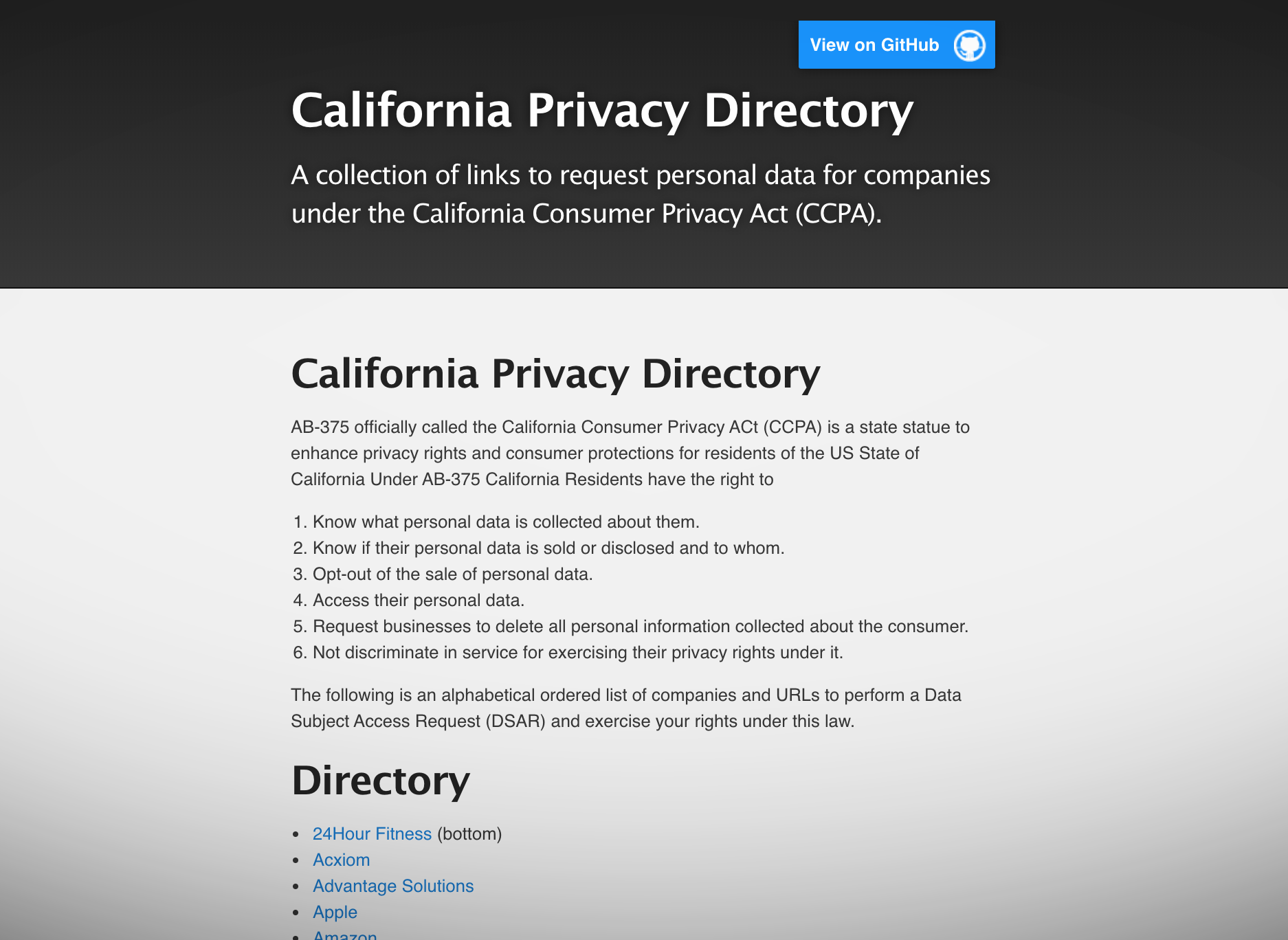
Damian Finol created a running directory of company pages that allow California residents to opt-out of their data being sold, and request their information. The directory is updated frequently, and so far includes banks, retail giants, airlines, car rental services, gaming giants, and cell companies — to name a few.

caprivacy.me is a simple directory of links to where California residents can tell companies not to sell their data, and request what data companies store on them. (Screenshot: TechCrunch)

The project is still in its infancy but relies on community contributions (and anyone can submit a suggestion), he said. In less than a day, it already racked up more than 80 links.

“I’m passionate about privacy and allowing people to declare what their personal privacy model is,” Finol told TechCrunch.

“I grew up queer in the Latin America in the 1990s, so keeping private the truth about me was vital. Nowadays, I think of my LGBTQ siblings in places like the Middle East where if their privacy is violated, they can face capital punishment,” he said, explaining his motivations behind the directory.

There’s no easy way — yet — to opt-out in one go. Anyone in California who wants to opt-out has to go through each link. But once it’s done, it’s done. Put on a pot of coffee and get started.


Hello and welcome back to our regular morning look at private companies, public markets and the gray space in between.

Today we’re adding four new names to the growing $100 million annual recurring revenue (ARR) club. The firms — Sisense, SiteMinder, Monday.com, and Lemonade — add diversity to our current group of yet-private companies which have reached the nine-figure recurring revenue threshold.

Our goal in tracking the companies in this high-flying cohort is to keep tabs on the private firms (often unicorns, it should be said) that could go public if needed. While not every unicorn will or could go public, companies with nine-figure ARR have a clear path to the public markets provided that their economics are in reasonable shape.

And we’ve seen some remarkably efficient companies meet the mark, including Egnyte with just $137.5 million raised, and Braze, with only $175 million on its books. For growth-oriented, venture-backed companies, those are efficient results.

But let’s add a few more members to the club today. Please meet our new centurions, centaurs, or whatever we end up calling them.

Sisense: more than $100 million ARR

Sisense is a business intelligence company that merged with Periscope Data earlier this year. The combined firm has raised just over $200 million, according to Crunchbase, with the lion’s share of that landing in Sisense’s column (about $175 million).

What’s notable about the combination is that the two firms were public about saying that, when brought together, they would have combined ARR of $100 million. That was back in May. Today, Sisense has crested the $100 million mark by itself, according to an interview with TechCrunch. With Periscope added to the mix the company’s total ARR is naturally higher.

Sisense had a few original goals according to CEO Amir Orad, including helping businesses “take complex data and bring it together to get insights.” Its second focus is helping companies “take complex data sets and build [them out] as an analytical application in their products,” he said.

Periscope came into the picture when Orad and the smaller company’s CEO Harry Glaser (now Sisense’s CMO) started talking as friends about their respective markets. According to Orad, Glasser outlined a new sort of organization being built inside some companies that “were not traditional BI teams” or “traditional product teams,” but instead brought together “data engineers and data scientists and very capable individuals who [wanted] to make sense of [the] data sitting in the cloud.” Periscope had built “a very impressive business” supporting those new organizations, with “many hundreds of customers,” Orad said.

That meant that Sisense’s pair of focuses were somewhat two of out three, making the corporate combination an obvious bet.

Regarding what changed as Sisense grew, cresting the $50 million ARR mark and later the $100 million ARR mark, Orad told TechCrunch that what differed was “scale,” saying that at its size “what you do impacts more people, more individuals, more companies, [and] more customers.” (I have interesting notes on how the two companies managed their combination from a culture perspective, let me know if you’d like to read them.)

SiteMinder: AU$100 million ARR

The first Australian member of the nine-figure ARR club is SiteMinder, which we’re letting in on a technicality; the firm’s ARR figure is in Australian dollars, which works out to around $70 million USD. However, its growth curve appears steep so we’re not too worried about including it a little early from a domestic dollar perspective.


Google’s ex-head of international relations, Ross LaJeunesse — who clocked up more than a decade working government and policy related roles for the tech giant before departing last year — has become the latest (former) Googler to lay into the company for falling short of its erstwhile “don’t be evil” corporate motto.

Worth noting right off the bat: LaJeunesse is making his own pitch to be elected as a U.S. senator for the Democrats in Maine, where he’s pitting himself against sitting Republican, Susan Collins. So this lengthy blog post, in which he sets out reasons for joining (“making the world better and more equal”), and — at long last — exiting, Google does look like an exercise in New Year reputation ‘exfoliation’, shall we say.

One that’s intended to anticipate and deflect any critical questions he may face on the campaign trail, given his many years of service to Mountain View. Hence the inclusion of overt political messaging, such as lines like: “No longer can massive tech companies like Google be permitted to operate relatively free from government oversight.”

Still, the post makes more awkward reading for Google. (Albeit, less awkward than the active employee activism the company continues to face over a range of issues — from its corporate culture and attitude towards diversity to product dev ethics.)

LaJeunesse claims that (unnamed) senior management actively evaded his attempts to push for it to adopt a company-wide Human Rights program that would, as he tells it, “publicly commit Google to adhere to human rights principles found in the UN Declaration of Human Rights, provide a mechanism for product and engineering teams to seek internal review of product design elements, and formalize the use of Human Rights Impact Assessments for all major product launches and market entries”.

“[E]ach time I recommended a Human Rights Program, senior executives came up with an excuse to say no,” LaJeunesse alleges, going on to claim that he was subsequently side-lined in policy discussions related to a censored search project Google had been working on to enable it to return to the Chinese market.

The controversial project, code-named Dragonfly, was later shut down, per LaJeunesse’s telling, after Congress raised questions — backing up the blog’s overarching theme that only political scrutiny can put meaningful limits on powerful technologists. (Check that already steady drumbeat for the 2020 US elections.)

He writes:

At first, [Google senior executives] said human rights issues were better handled within the product teams, rather than starting a separate program. But the product teams weren’t trained to address human rights as part of their work. When I went back to senior executives to again argue for a program, they then claimed to be worried about increasing the company’s legal liability. We provided the opinion of outside experts who re-confirmed that these fears were unfounded. At this point, a colleague was suddenly re-assigned to lead the policy team discussions for Dragonfly. As someone who had consistently advocated for a human rights-based approach, I was being sidelined from the on-going conversations on whether to launch Dragonfly. I then realized that the company had never intended to incorporate human rights principles into its business and product decisions. Just when Google needed to double down on a commitment to human rights, it decided to instead chase bigger profits and an even higher stock price.

Reached for comment, a Google spokesman sent us this statement, attributed to a Google spokeswoman: “We have an unwavering commitment to supporting human rights organisations and efforts. That commitment is unrelated to and unaffected by the reorganisation of our policy team, which was widely reported and which impacted many members of the team. As part of this reorganisation, Ross was offered a new position at the exact same level and compensation, which he declined to accept. We wish Ross all the best with his political ambitions.”

LaJeunesse’s blog post also lays into Google’s workplace culture — making allegations that bullying and racist stereotyping were commonplace.

Including even apparently during attempts by management to actively engage with the issue of diversity…

It was no different in the workplace culture. Senior colleagues bullied and screamed at young women, causing them to cry at their desks. At an all-hands meeting, my boss said, “Now you Asians come to the microphone too. I know you don’t like to ask questions.” At a different all-hands meeting, the entire policy team was separated into various rooms and told to participate in a “diversity exercise” that placed me in a group labeled “homos” while participants shouted out stereotypes such as “effeminate” and “promiscuous.” Colleagues of color were forced to join groups called “Asians” and “Brown people” in other rooms nearby.

We’ve asked Google for comment on these allegations and will update this post with any response.

It’s clearly a sign of the ‘techlash’ times that an ex-Googler, who’s now a senator-in-the-running, believes there’s political capital to be made by publicly unloading on his former employer. 

“The role of these companies in our daily lives, from how we run our elections to how we entertain and educate our children, is just too great to leave in the hands of executives who are accountable only to their controlling shareholders who — in the case of Google, Amazon, Facebook and Snap — happen to be fellow company insiders and founders,” LaJeunesse goes on to write, widening his attack to incorporate other FAANG giants.

Expect plenty more such tech giant piñata in the run up to November’s ballot.


Well, we got to January 2nd before the latest angry resignation published by a tech executive on Medium.

Today’s installment comes from Ross LaJeunesse, who was head of international relations at Google and served for more than a decade in various roles at the company. He denounces what he sees as Google’s increasingly failed ambitions to be a company principled on human rights, and poses a series of questions about the future of tech and capitalism:

I think the important question is what does it mean when one of America’s marque’ companies changes so dramatically. Is it the inevitable outcome of a corporate culture that rewards growth and profits over social impact and responsibility? Is it in some way related to the corruption that has gripped our federal government? Is this part of the global trend toward “strong man” leaders who are coming to power around the globe, where questions of “right” and “wrong” are ignored in favor of self-interest and self-dealing? Finally, what are the implications for all of us when that once-great American company controls so much data about billions of users across the globe?

The whole read is interesting, and covers Google’s China operations, its Project Dragonfly censored search crisis, Saudi Arabia’s apps in Google Cloud, and his own personal experience with Google HR.

It’s a manifesto of sorts, and perhaps that isn’t surprising given that LaJeunesse is also running for the Democratic primary in Maine’s senatorial election to compete against Republican incumbent Susan Collins. His critiques of Big Tech seem to be channeling Missouri Republican senator Josh Hawley, and that makes it a fascinating political strategy.

But let’s focus in on the key question at the heart of this debate: does Google have the ability to be “good” or “evil” when it comes to tech’s influence on society? Does it have agency to make a difference on human rights in countries around the world?

My answer is: Google used to have a lot of agency, which is unfortunately declining very, very rapidly.

I’ve talked about the fracturing of the internet into different spheres of influence for quite literally years. Countries like China in particular, but also Russia, Iran and others are seizing more and more exacting control of the internet’s plumbing and applications, subsuming the original internet’s spirit of openness and freedom and placing this communications medium under their iron fists.

As this fracturing has occurred, companies like Google, or Shutterstock, or even the NBA have increasingly faced what I’ve called an “authoritarian straddle” — they can either work with these countries and follow the local rules, or they can just get out, with serious ramifications for their home markets.

Those are the extent of the choices these companies have. Shutterstock is not going to change China’s policy toward photos of the Tiananmen Square protests, any more than Google can try to launch a search engine on the mainland or change Saudi Arabia’s deplorable women’s rights.

To have any agency here at all, you need a monopoly on a product or service so important that the dictatorship has to accept the terms you offer. In other words, these companies need extreme leverage, essentially the ability to go to the regimes and say, “No, fuck you, here’s how it is going to work, we’re going to follow human rights, and you have no choice in the matter.”

What tech companies are discovering — even massive giants like Google, Facebook, Apple, Amazon, and Microsoft — is that they really, truly don’t have that kind of leverage in these countries anymore. Not even Apple, which employs hundreds of thousands of manufacturing workers through its subcontractors in China, can move the needle in that country anymore. Iran shut off the internet for a period of time to dampen the intensity of political protests in that country. Russia last week tested shutting off the internet to make sure it can just pull the plug when it wants.

If whole countries can just flip the switch and turn off “tech,” exactly what leverage do any of these companies have in the first place?

And that diminution of power is a trend that tech companies, and particularly American tech companies, haven’t fully grappled with. They don’t really get a choice anymore in the decisions here. China has its own search engine, and increasingly, its own mobile phone ecosystem unencumbered by U.S. patents and therefore U.S. policy. If Azure leaves Saudi Arabia, Alibaba Cloud is more than willing to step into the gap and make the money instead.

So when you get to LaJeunesse’s comments that he pushed Google internally to formalize some of its values:

My solution was to advocate for the adoption of a company-wide, formal Human Rights Program that would publicly commit Google to adhere to human rights principles found in the UN Declaration of Human Rights, provide a mechanism for product and engineering teams to seek internal review of product design elements, and formalize the use of Human Rights Impact Assessments for all major product launches and market entries.

… one can’t help but feel solace for an optimistic world where a better product design review process might have once improved global human rights.

The issue is far simpler though than it was in the past. You don’t need a human rights protocol, or some sort of review process for market entry. You are either in, or you are out. You either launch in these countries and deal with the inevitable human rights abuses and concomitant consumer protests in the home market, or you maintain your values and you walk away, ignoring the profit mirage from these regimes in the process.

That’s why I recently argued that Google and the NBA should just walk away. I still hold that belief. It’s also why I called on Shutterstock to leave China and return to its more open and free values. No U.S. tech company today has the leverage to make a dent on human rights the way that they did a decade ago. The internet has fractured, data sovereignty is on the rise, and there’s a binary choice to be made whether to engage or to flee. Ultimately, I take LaJeunesse’s side — these companies should walk, because there really isn’t much choice otherwise.


It’s tough to be a competitive gamer once you’re an adult. Simply fitting tournament time into a busy schedule is challenge enough, but even if you can make the time, where do you go to find other adults who are competitively playing the games you love?

That’s where Lowkey.gg comes in. Lowkey.gg is a tournament platform for adult gamers. The company is particularly focused on helping professional organizations set up their esports squads just like company basketball or softball teams.

One of the challenges here is that it’s incredibly difficult for adult gamers to find each other. Most of them don’t usually broadcast their affinity for video games. Searching for other competitive gamers who are above the age of 18 is a bit of a lost cause.

The hope for Lowkey is that they can connect adult gamers with one another to get the most out of their gaming experience. Everyone playing through Lowkey must be 18 years of age or older and have a full-time job.

Users can register as a solo gamer for $39, plus a subscription fee of $13/month, and get automatically matched with a team. Lowkey takes into account things like location, job, alma mater and other bits of information (all shown on your public Lowkey profile) to create teams with like-minded players. The company says this transparency reduces the toxicity around teammates. Conversely, users can also form a squad in real life and sign up as a pre-made team for $195/month.

Thus far, Lowkey has signed up teams from Google, Apple, Robinhood and Twitch.

Lowkey is launching with League of Legends as its first game, and Season 1 starts on January 13.

Seasons last a minimum of 8 weeks, with players scheduled to play for one hour one night a week. Lowkey has also built a relatively sophisticated Discord chatbot that lets users check-in to say they’re ready for a game and automatically puts the teams in a chat together to coordinate the match.

Like many startups, Lowkey is actually the result of a pivot. The company was originally called Camelot.

In March of 2017, Camelot launched out of YC to allow YouTube and Twitch audiences to pay to see what they want. Users could submit bounties to see their favorite YouTuber play a game with pistols only, or to play a game while standing on a skateboard.

Turns out, there were two big issues. Cofounder Jesse Zhang explained that it wasn’t sustainable to build a platform on top of a platform, particularly a platform that is incredibly top heavy and potentially overhyped.

“Sometimes hype can be misaligned with the size of the market, and it felt like streaming was one example of that,” said Zhang. “Even after we organically got several really large streamers using it, and the product performed almost perfectly, the volume is still not nearly the scale that you could turn into a real business.”

Which brings us to the second issue. The money that flows through Twitch from viewers to streamers is almost always based on altruism and emotion. It’s exciting to hear your favorite streamer thank you for a $5 donation or gifted sub. Viewers aren’t paying for the content; they’re paying for a connection.

So Camelot quickly went back to the drawing board and came out on the other side as Lowkey.gg.

Lowkey has raised capital but declined to share the amount. After the launch of League of Legends, the company plans to launch seasons for other titles including Overwatch, TFT, DotA, and Smash Ultimate.


In Marc Benioff’s book, Trailblazer, he tells the tale of how Steve Jobs planted the seeds of the idea that would become the first enterprise app store, and how Benioff eventually paid Jobs back with the gift of the AppStore.com domain.

While Salesforce did truly help blaze a trail when it launched as an enterprise cloud service in 1999, it took that a step further in 2006 when it became the first SaaS company to distribute related services in an online store.

In an interview last year around Salesforce’s 20th anniversary, company CTO and co-founder Parker Harris told me that the idea for the app store came out of a meeting with Steve Jobs three years before AppExchange would launch. Benioff, Harris and fellow co-founder Dave Moellenhoff took a trip to Cupertino in 2003 to meet with Jobs. At that meeting, the legendary CEO gave the trio some sage advice: to really grow and develop as a company, Salesforce needed to develop a cloud software ecosystem. While that’s something that’s a given for enterprise SaaS companies today, it was new to Benioff and his team in 2003.

As Benioff tells it in his book, he asked Jobs to elucidate on what he meant by an application ecosystem. Jobs replied that how he implemented the idea was up to him. It took some time for that concept to bake, however. Benioff wrote that the notion of an app store eventually came to him as an epiphany at dinner one night a few years after that meeting. He says that he sketched out that original idea on a napkin while sitting in a restaurant.

“One evening over dinner in San Francisco, I was struck by an irresistibly simple idea. What if any developer from anywhere in the world could create their own applications for the Salesforce platform? And what if we offered to store these apps in an online directory that allowed any Salesforce user to download them?”

Whether it happened like that or not, the app store idea would eventually come to fruition, but it wasn’t originally called the AppExchange as it is today. Instead, Benioff says he liked the name AppStore.com, so much so that he had his lawyers register the domain the next day.

When Benioff talked to customers prior to the launch, while they liked the concept, they didn’t like the name he had come up with for his online store. He eventually relented and launched in 2006 with the name AppExchange.com instead. Force.com would follow in 2007, giving programmers a full-fledged development platform to create applications, and then distribute them in AppExchange.

Meanwhile, AppStore.com sat dormant until 2008 when Benioff was invited back to Cupertino again for a big announcement around iPhone. As Benioff wrote, “At the climactic moment, [Jobs] said [five] words that nearly floored me: ‘I give you App Store.”

Benioff wrote that he and his executives actually gasped when they heard the name. Somehow, even after all that time had passed since that the original meeting, both companies had settled upon the same name. Only Salesforce had rejected it, leaving an opening for Benioff to give a gift to his mentor. He says that he went backstage after the keynote and signed over the domain to Jobs.

In the end, the idea of the web domain wasn’t even all that important to Jobs in the context of an app store concept. After all, he put the App Store on every phone, and it wouldn’t require a website to download apps. Perhaps that’s why today, the domain points to the iTunes store, and launches iTunes (or gives you the option of opening it).

Even the App Store page on Apple.com uses the sub-domain ‘app-store’ today, but it’s still a good story of how a conversation between Jobs and Benioff would eventually have a profound impact on how enterprise software was delivered, and how Benioff was able to give something back to Jobs for that advice.


Just over two years ago, PerceptIn announced an $8 million Series A. The funding followed a $2 million seed round, and found the startup essentially coming out of stealth to showcase the sensors it was building for a wide range of form factors, from cars to robot vacuums.

The company’s been quite busy in the meantime. In fact, it even went so as changing its name. PerceptIn is now “Trifo” — a punchier name, if not quite as memorable. The company’s currently on its third robotic vacuum, announced today and set to be officially unveiled at CES in a few days.

Along with the arrival of “Lucy,” comes some more big funding from the Samsung Ventures-supported startup. Trifo has just raised a $15 million Series B, bringing its total funding up to $26 million. The round includes backing from Yidu Cloud, Tsinghua AI Fund and Matrix Partners, with a focus on producing more hardware and software solutions in the home robotics space, additional hiring and pushing into the U.S. and European markets.

For now, robot vacuums appear to be the company’s primary public facing output. It’s a tough market — one that’s traditionally been dominated by one player (iRobot). Still, there’s no shortage of alternatives from players big and small looking to crack it.

As for what sets Lucy apart, there are a pair of cameras on board — that could either be a plus or minus, depending on where you land on matters of privacy. The pair combine 1080p color images with depth sensing to provide home surveillance and mapping in light and dark settings. The robot can also be designed to “patrol” the home in pre defined routes. 

Lucy also features built-in obstacle avoidance for objects as short as one inch, room-by-room cleaning and and a 5,200mAh battery for up to two hours of cleaning on a charge. Pricing is $799, putting it in line with iRobot’s offerings. It’s set to arrive at some point in Q1. 


MKRdezign

Contact Form

Name

Email *

Message *

Powered by Blogger.
Javascript DisablePlease Enable Javascript To See All Widget