Latest Post

Uber Eats has beefed up grocery delivery options in three markets hard hit by the coronavirus.

Uber’s food delivery division said today it’s inked a partnership with supermarket giant Carrefour in France to provide Parisians with 30 minute home delivery on a range of grocery products, including everyday foods, toiletries and cleaning products.

The service is starting with 15 stores in the city, with Uber Eats saying it plans to scale it out rapidly nationwide “in the coming weeks”.

In Spain it’s partnered with the Galp service station brand to offer a grocery delivery service that consists of basic foods, over the counter medicines, beverages and cleaning products in 15 cities across the following 8 provinces: Badajoz, Barcelona, Cádiz, Córdoba, Madrid, Málaga, Palma de Mallorca and Valencia.

Uber Eats said there will be an initial 25 Galp convenience stores participating. The service will not only be offered via the Uber Eats app but also by phone for those without access to a smartphone or Internet.

The third market it’s inked deals in is Brazil, where Uber said it’s partnering with a range of pharmacies, convenience stores and pet shops in Sao Paulo to offer home delivery on basic supplies.

“Over the counter medicines will be available from the Pague Menos chain of pharmacies, grocery products from Shell Select convenience stores and pet supplies from Cobasi — one of the largest pet shop chains in the country,” it said. “The new services will be available on the Uber Eats app, with plans to launch in other Brazil states and cities in the coming weeks.”

The grocery tie-ups are not Uber Eats’ first such deals. The company had already inked partnerships with a supermarket in Australia (Coles) and the Costcutter brand in the UK, where around 600 independent convenience stores are offered via its app.

Uber Eats also lets independent convenience stores in countries around the world self listed on its app. However the latest tie-ups put more branded meat on the bone of its grocery offer in Europe and LatAm — with the Carrefour tie-up in France marking its first partnership with a major supermarket in Europe.

It’s worth noting Spain’s food delivery rival, Glovo, has an existing grocery-delivery partnership with the French supermarket giant in markets including its home country — which likely explains why Uber Eats has opted for a different partner in Spain.

Asked whether it’s looking to further expand grocery deliveries in other markets hit by the public health emergency Uber Eats told us it’s exploring opportunities to partner with more supermarkets, convenience stores and other retailers around the world.

As part of its response to the threat posed by the COVID-19 pandemic, the company has switched all deliveries to contactless by default — with orders left at the door or as instructed by a user.

It also told us it’s providing drivers and delivery people with access to hand sanitiser, gloves and disinfectant wipes, as soon as they become available. And said it’s dispensing guidance to users of its apps on hygiene best practice and limiting the spread of the virus.

Uber Eats has previously said it will provide 14 days of financial support for drivers and delivery people who get diagnosed with COVID-19 or are personally placed in quarantine by a public health authority due to their risk of spreading the virus, with the amount based on their average earnings over the last six months or less.

The policy is due for review on April 6.



Grab announced today that it has hired Peter Oey as its new chief financial officer. Prior to joining Grab, Oey was the chief financial officer at LegalZoom, an online legal services company based near Los Angeles.

Before that, he served the same role at Mylife.com, an online platform that aggregates information about people based on public records. Oey also held financial leadership positions at Activision for twelve years, including corporate controller.

Grab, whose services include ride-sharing, food delivery and online financial services provider GrabPay, announced in February that it had raised a total of $856 million from Japanese investors Mitsubishi UFJ Financial Group and TIS INTEC, to grow its financial services and digital payments infrastructure.

In a statement, Grab said Oey will be based in Singapore and report to co-founder and CEO Anthony Tan. He will also work with Grab president Ming Maa, who took over many responsibilities from Grab’s last CFO, Linda Hoglund, when she left in 2016. Grab said Maa will continue to lead its strategic business planning.

Grab, which acquired Uber’s Southeast Asia business in March 2018, has reportedly been in discussions to merge with merge with rival GoJek.


In a press statement, the company said that in 2019, GrabFood’s gross merchandise volume grew by over 400%, while GrabPay increased payment volume by 170%, thanks to strong performance in Indonesia.

Tan said “Last year, we made tremendous progress in growing our food delivery, payments and financial services business. The growth of these businesses give us a good foundation for achieving long-term sustainable growth for our company. I’m excited to welcome Peter to the Grab family where his extensive experience scaling rapidly growing technology companies makes him a valuable addition to our business.”

Grab has raised a total of about $9.9 billion from investors including SoftBank Vision Fund, which invested $1.46 billion into the company last year. Tan told CNBC last November that the company will not go public until its entire business is profitable.


In March, the virus gripping the world — COVID-19 — started to spread in Africa. In short order, actors across the continent’s tech ecosystem began to step up to stem the spread.

Early in March Africa’s coronavirus cases by country were in the single digits, but by mid-month those numbers had spiked leading the World Health Organization to sound an alarm.

“About 10 days ago we had 5 countries affected, now we’ve got 30,” WHO Regional Director Dr Matshidiso Moeti said at a press conference on March 19. “It’s has been an extremely rapid…evolution.” 

By the World Health Organization’s stats Tuesday there were 3671 COVID-19 cases in Sub-Saharan Africa and 87 confirmed deaths related to the virus — up from 463 cases and 8 deaths on March 18.

As the COVID-19 began to grow in major economies, governments and startups in Africa started measures to shift a greater volume of transactions toward digital payments and away from cash — which the World Health Organization flagged as a conduit for the spread of the coronavirus.

Africa’s leader in digital payment adoption — Kenya — turned to mobile-money as a public-health tool.

At the urging of the Central Bank and President Uhuru Kenyatta, the country’s largest telecom, Safaricom, implemented a fee-waiver on East Africa’s leading mobile-money product, M-Pesa, to reduce the physical exchange of currency.

The company announced that all person-to-person (P2P) transactions under 1,000 Kenyan Schillings (≈ $10) would be free for three months.

Kenya has one of the highest rates of digital finance adoption in the world — largely due to the dominance of M-Pesa  in the country — with 32 million of its 53 million population subscribed to mobile-money accounts, according to Kenya’s Communications Authority.

On March 20, Ghana’s central bank directed mobile money providers to waive fees on transactions of GH₵100 (≈ $18), with restrictions on transactions to withdraw cash from mobile-wallets.

Ghana’s monetary body also eased KYC requirements on mobile-money, allowing citizens to use existing mobile phone registrations to open accounts with the major digital payment providers, according to a March 18 Bank of Ghana release.

Growth in COVID-19 cases in Nigeria, Africa’s most populous nation of 200 million, prompted one of the country’s largest digital payments startups to act.

Lagos based venture Paga made fee adjustments, allowing merchants to accept payments from Paga customers for free — a measure “aimed to help slow the spread of the coronavirus by reducing cash handling in Nigeria,” according to a company release.

In March, Africa’s largest innovation incubator, CcHub, announced funding and engineering support to tech projects aimed at curbing COVID-19 and its social and economic impact.

The Lagos and Nairobi based organization posted an open application on its website to provide $5,000 to $100,000 funding blocks to companies with COVID-19 related projects.

CcHub’s CEO Bosun Tijani expressed concern for Africa’s ability to combat a coronavirus outbreak. “Quite a number of African countries, if they get to the level of Italy or the UK, I don’t think the system… is resilient enough to provide support to something like that,” Tijani said.

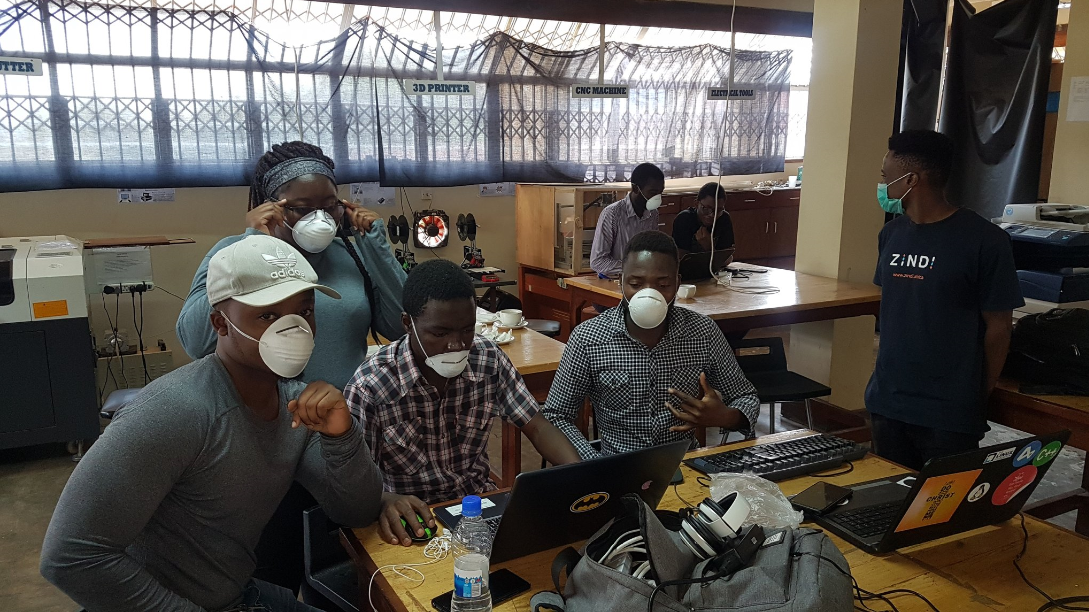
Cape Town based crowdsolving startup Zindi — that uses AI and machine learning to tackle complex problems — opened a challenge to the 12,000 registered engineers on its platform.

The competition, sponsored by AI4D, tasks scientists to create models that can use data to predict the global spread of COVID-19 over the next three months. The challenge is open until April 19, solutions will be evaluated against future numbers and the winner will receive $5,000.

Zindi will also sponsor a hackathon in April to find solutions to coronavirus related problems.

Image Credits: Sam Masikini via Zindi

On the digital retail front, Pan-African e-commerce company Jumia announced measures it would take on its network to curb the spread of COVID-19.

The Nigeria headquartered operation — with online goods and services verticals in 11 African countries — said it would donate certified face masks to health ministries in Kenya, Ivory Coast, Morocco, Nigeria and Uganda, drawing on its supply networks outside Africa.

The company has also offered African governments use of of its last-mile delivery network for distribution of supplies to healthcare facilities and workers.

Jumia is reviewing additional assets it can offer the public sector. “If governments find it helpful we’re willing to do it,” CEO Sacha Poignonnec told TechCrunch.

More Africa-related stories @TechCrunch

African tech around the ‘net


Just three months after capping what was the best year for Indian startups, having raised a record $14.5 billion in 2019, they are beginning to struggle to raise new capital as prominent investors urge them to “prepare for the worst”, cut spending and warn that it could be challenging to secure additional money for the next few months.

In an open letter to startup founders in India, ten global and local private equity and venture capitalist firms including Accel, Lightspeed, Sequoia Capital, and Matrix Partners cautioned that the current changes to the macro environment could make it difficult for a startup to close their next fundraising deal.

The firms, which included Kalaari Capital, SAIF Partners, and Nexus Venture Partners — some of the prominent names in India to back early-stage startups — asked founders to be prepared to not see their startups’ jump in the coming rounds and have a 12-18 month runway with what they raise.

“Assumptions from bull market financings or even from a few weeks ago do not apply. Many investors will move away from thinking about ‘growth at all costs’ to ‘reasonable growth with a path to profitability.’ Adjust your business plan and messaging accordingly,” they added.

Signs are beginning to emerge that investors are losing appetite to invest in the current scenario.

Indian startups participated in 79 deals to raise $496 million in March, down from $2.86 billion that they raised across 104 deals in February and $1.24 billion they raised from 93 deals in January this year, research firm Tracxn told TechCrunch. In March last year, Indian startups had raised $2.1 billion across 153 deals, the firm said.

New Delhi ordered a complete nation-wide lockdown for its 1.3 billion people for three weeks earlier this month in a bid to curtail the spread of COVID-19.

The lockdown, as you can imagine, has severely disrupted businesses of many startups, several founders told TechCrunch.

Vivekananda Hallekere, co-founder and chief executive of mobility firm Bounce, said he is prepared for a 90-day slowdown in the business.

Founder of a Bangalore-based startup, which was in advanced stages to raise more than $100 million, said investors have called off the deal for now. He requested anonymity.

Deepinder Goyal, co-founder and chief executive of food delivery firm Zomato, said in January the startup would close a round of up to $600 million by the end of the month. Two months later, Zomato has only raised $150 million.

Many startups are already beginning to cut salaries of their employees and let go of some people to survive an environment that aforementioned VC firms have described as “uncharted territory.”

Travel and hotel booking service Ixigo said it had cut the pay of its top management team by 60% and rest of the employees by up to 30%. MakeMyTrip, the giant in this category, also cut salaries of its top management team.

Beauty products and cosmetics retailer Nykaa on Tuesday suspended operations and informed its partners that it would not be able to pay their dues on time.

Investors cautioned startup founders to not take a “wait and watch” approach and assume that there will be a delay in their “receivables,” customers would likely ask for price cuts for services, and contracts would not close at the last minute.

“Through the lockdown most businesses could see revenues going down to almost zero and even post that the recovery curve may be a ‘U’ shaped one vs a ‘V’ shaped one,” they said.


Vericool, a Livermore, Calif.-based startup that’s replacing plastic coolers and packaging with plant-based products, has raised $19.1 million in a new round of financing.

The company’s stated goal is to replace traditional packaging materials like polystyrene with plant-based insulating packaging materials.

Its technology uses 100% recycled paper fibers and other plant-based materials, according to the company, and are curbside recyclable and compostable.

Investors in the round include Radicle Impact Partners, The Ecosystem Integrity Fund, ID8 Investments and AiiM Partners, according to a statement.

“We’re pleased to support Vericool because of the company’s track record of innovation, high-performance products, well-established patent portfolio and focus on environmental resilience. We are inspired by the company’s social justice commitment to address recidivism and provide workplace opportunity to formerly incarcerated individuals,” said Dan Skaff, managing partner of Radicle Impact Partners and Vericool’s new lead director. 


Even though this might seem to be the absolute worst time to try to round up funding for a restaurant-related startup, Allset is announcing that it’s raised an $8.25 million Series B.

It was not, to be clear, an easy process. CEO Stas Matviyenko (who founded the company with COO Anna Polishchuk) admitted that when he set out to fundraise, the goal was actually $12 million. And at one point, it looked like he might even raise more than that — but as he finalized the round in the week before widespread social distancing measures started to take effect around the United States (effectively ending dine-in options in some cities), he said, “A few investors just disappeared.”

Still, Matviyenko said he feels “lucky” to have closed out the round at all. And he pointed to signs that consumers and restaurants are still turning to Allset during the COVID-19 pandemic.

The company started out with a focus on delivering a quick dining experience in restaurants, allowing diners to make a reservation, order ahead and then pay directly through the Allset app. Over time, Matviyenko said, the app also began to offer personalized, healthy recommendations at each restaurant.

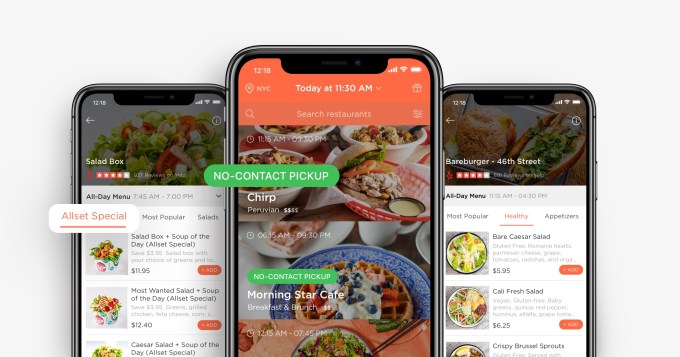
At the same time, Allset has added takeout options — and most recently, a feature that allows restaurants to offer contactless takeout, akin to the contactless option offered by many restaurant delivery apps. In fact, Allset is waiving its 12 percent commission fee for restaurants offering this option. (It’s also been promoting usage by offering a daily $4 discount for takeout orders.)

Allset

Image Credits: Allset

And while Matviyenko said that orders dropped by around 60 percent as social distancing measures went into place, they’ve apparently they’ve bounced back (by 10 percent as Allset signed up new partners — usually in more residential neighborhoods, away from the office-heavy areas where the companies had previously focused. Matviyenko said the startup has added more than 200 new restaurants in the past couple weeks.

He also emphasized the distinction between AllSet and the various delivery apps. He didn’t rule out adding a delivery option to Allset in the future, but since delivery requires such an investment in logistics, he’d likely to do it by partnering with a company already working in this area. Conversely, he suggested that for most delivery apps, takeout is usually an afterthought (assuming they support it at all), while Allset is trying to offer “the best [takeout] experience” possible.

The new round brings Allset’s total funding to $16.6 million. It was led by led by EBRD (the European Bank for Reconstruction and Development), with participation from Andreessen Horowitz, Greycroft, SMRK VC Fund and Inovo Venture Partners.

“The Allset team is building a great product and their effective execution yields strong unit economics with sustainable growth,” said EBRD’s Maria Barsuk in a statement. “We’re excited to partner with them in their next phase, as well as proud to support their efforts in serving local businesses and customers during this unprecedented time for the restaurant industry.”


GM today announced manufacturing details around building much-needed medical face masks. According to the company’s press release, it took the company less than seven days to go from nothing to producing the first production-made mask. The automotive giant said today in a released statement it expects to deliver 20,000 masks on April 8 and soon after, able to produce 50,000 masks a day once the production line is at full capacity.

These face masks are a vital piece of personal protective equipment (PPE) used by front-line healthcare staff to protect themselves against the virus-causing droplets that are spread by patients through coughing and sneezing in clinical settings.

GM turned to global partners to create this manufacturing line within a week. The company sourced material from GM’s existing supply chain and acquired manufacturing equipment from JR Automation in Holland, Michigan, and Esys Automation in Auburn Hills, Michigan. As the company’s press release says, GM even created an ISO Class 8-equivalent cleanroom in GM’s Warren manufacturing plant. GM and the UAW will seek two dozen volunteers to staff this new assembly line.

“The first people we called were those who work with fabric vehicle components,” said Karsten Garbe, GM plant director, Global Pre-Production Operations. “In a few days, the company’s seat belt and interior trim experts became experts in manufacturing face masks.”

While this team was creating a face mask assembly line, others within GM were working towards creating ventilators. Last Friday, March 27, President Donald Trump signed a presidential directive ordering GM to produce ventilators and to prioritize federal contracts. This came hours after the automaker announced plans to manufacture the critical medical equipment needed for patients suffering from COVID-19, the disease caused by the coronavirus.

Other automakers joined the fight, as well. Ford and GE Healthcare licensed a ventilator design from Airon Corp and plan to produce as many as 50,000 of them at a Michigan factory by July as part of a broader effort to provide a critical medical device used to treat people with COVID-19. Under this partnership, Ford said it expects to produce 1,500 Airon ventilators by the end of April, 12,00 by the end of May, and 50,000 by July.


MKRdezign

Contact Form

Name

Email *

Message *

Powered by Blogger.
Javascript DisablePlease Enable Javascript To See All Widget