Latest Post

Founded in 2012, Whoop is far from a household name in the world of fitness trackers. But over the years, the company has attracted its share of converts. It hasn’t had any issue attracting venture capital over the years, either. Last time we checked in on the Boston-based company was in late-2019, when it raised $55 million. Now it’s back with a massive $200 million raise.

The Series F round brings Whoop’s total funding to nearly $405 million — a pretty massive investment for a company of its size. The round, led by SoftBank’s Vision Fund 2, puts the valuation at a jaw-dropping $3.6 billion valuation.

Additional investors include IVP, Cavu Venture Partners, Thursday Ventures, GP Bullhound, Accomplice, NextView Ventures and Animal Capital. They join a long list of former backers, including the National Football League Players Association, Jack Dorsey and a number of professional athletes.

The company’s targeting of athletes marks a strong contrast with leading consumer wearables like the Apple Watch and Fitbit. In fact, the company has a specific offering for sports teams, as well as solutions for businesses, healthcare and government/defense.

Whoop’s name made the rounds recently when Fitbit announced a “Daily Readiness Score” for the Charge 5, which many likened to the company’s more advanced analytics.

The company cites “rapid growth” in its membership offering over the past year as a motivation behind seeking additional funding. That was likely driven, in part, by the decision in 2019 to make the $500 wearable free, while focusing on a subscription service that starts at $18 a month for an 18-month membership (the shorter the membership, the more the monthly fee).

Whoop is eying international expansion beyond the U.S. and using the massive influx of cash on R&D for its hardware, software and analytics solutions. Money will also go toward expanding headcount, which is currently in excess of 500 (with nearly half of those employees having joined in the past year).

“We are thrilled to deepen our partnership with SoftBank as we grow internationally,” founder and CEO Will Ahmed said in a release. “While we have experienced amazing growth in the past year, the potential of our technology and the vast market for health monitoring remains largely untapped.”



Amsterdam-based challenger bank Bunq is updating its service with a handful of new features. In addition to Dutch, German and French bank account numbers, existing and new users in Spain can now get a Spanish IBAN.

European IBANs are supposed to work across Europe. Your employer or internet provider can’t force you to get a local IBAN. And yet, that’s rarely the case. When you move to another European country, chances are the first thing you do is that you open a local bank account.

While European fintech companies have teamed up to create a lobbying effort called ‘Accept my IBAN’, some challenger banks, such as Bunq, are adding the ability to get local bank account numbers as an intermediary fix. Bunq users can also choose to associate IBANs from multiple European countries with their account. You have to pay a one-time fee of €9.99 every time you add a new local IBAN.

Bunq is also drawing inspiration from Revolut, Wise, Vivid Money and others as you’ll soon be able to receive, convert and hold other currencies. For instance, if you’re going to a non-Euro country for an internship, you will be able to receive your salary on your Bunq account. Bunq is starting with USD accounts with plans to add more currencies down the road.

Other new features include the ability to receive reminders the day before a direct debit occurs, a subscription view that lets you view current subscriptions and when they’re set to expire, an improved search feature and the ability to automatically accept direct debits and payment requests from your friends — make sure you set up a limit before enabling that feature.

Bunq recently announced plans to raise $228 million (€193 million) at a $1.9 billion valuation (€1.6 billion). The investment round hasn’t been approved by the Netherlands’ banking regulator just yet. Bunq is currently operating in 29 European markets and has more than €&billion in user deposits.


Apna, a 21-month-old startup that is helping millions of blue and gray-collar workers in India upskill themselves, find communities and land jobs, is inching closer to becoming the fastest tech firm in the world’s second largest internet market to become a unicorn.

Tiger Global is in advanced stages of talks to lead a $100 million round in Apna, according to four sources familiar with the matter. The proposed terms value the startup at over $1 billion, the sources said.

The round hasn’t closed yet so terms of the deal may change, some of the sources cautioned.

If the round materializes, Apna will become the youngest Indian startup to attain the much coveted unicorn status. The startup, which launched its app in December 2019, was valued at $570 million in its Series B financing round in June this year. It will also be the third financing round Apna would have secured in a span of less than seven months.

Tiger Global, an existing investor in Apna, didn’t respond to a request for comment earlier this month. Apna founder and chief executive Nirmit Parikh, an Apple alum, declined to comment on Tuesday.

Indian cities are home to hundreds of millions of low-skilled workers who hail from villages in search of work. Many of them have lost their jobs amid the coronavirus pandemic that has slowed several economic activities in the world’s second-largest internet market.

Apna, whose name is inspired from a 2019 Bollywood song, is building a scalable networking infrastructure so that these workers can connect to the right employers and secure jobs. On its eponymous Android app, users also upskill themselves, review their interview skills, and become eligible for more jobs.

As of June this year, Apna had amassed over 10 million users and was facilitating more than 15 million job interviews each month. All jobs listed on the Apna platform are verified by the startup and free of cost for the candidates.

The startup has also partnered with some of India’s leading public and private organizations and is providing support to the Ministry of Minority Affairs of India, National Skill Development Corporation and UNICEF YuWaah to provide better skilling and job opportunities to candidates.

The investment talks further illustrate Tiger Global’s growing interest in India. The New York-headquartered firm has made several high-profile investments in India this year including in BharatPe, Gupshup, DealShare, Classplus, Urban Company, Coinswitch Kuber, and Groww.

More than two dozen Indian startups have become a unicorn this year, up from 11 last year, as several high-profile investors including Tiger Global, SoftBank, and Falcon Edge have increased the pace of their investments in the world’s second most populous nation.

Apna also counts Insight Partners, Lightspeed, and Sequoia Capital among its existing investors.


Startups are hard work, but the complexities of global supply chains can make running hardware companies especially difficult. Instead of existing within a codebase behind a screen, the key components of your hardware product can be scattered around the world, subject to the volatility of the global economy.

I’ve spent most of my career establishing global supply chains, setting up manufacturing lines for 3D printers, electric bicycles and home fitness equipment on the ground in Mexico, Hungary, Taiwan and China. I’ve learned the hard way that Murphy’s law is a constant companion in the hardware business.

But after more than a decade of work on three different continents, there are a few lessons I’ve learned that will help you avoid unnecessary mistakes.

Expect cost fluctuations, especially in currency and shipping

Shipping physical products is quite different from “shipping” code — you have to pay a considerable amount of money to transport products around the world. Of course, shipping costs become a line item like any other as they get baked into the overall business plan. The issue is that those costs can change monthly — sometimes drastically.

At this time last year, a shipping container from China cost $3,300. Today, it’s almost $18,000 — a more than fivefold increase in 12 months. It’s safe to assume that most 2020 business plans did not account for such a cost increase for a key line item.

Shipping a buggy hardware product can be exponentially costlier than shipping buggy software. Recalls, angry customers, return shipping and other issues can become existential problems.

Similar issues also arise with currency exchange rates. Contract manufacturers often allow you to maintain cost agreements for any fluctuations below 5%, but the dollar has dropped much more than 5% against the yuan compared to a year ago, and hardware companies have been forced to renegotiate their manufacturing contracts.

As exchange rates become less favorable and shipping costs increase, you have two options: Operate with lower margins, or pass along the cost to the end customer. Neither choice is ideal, but both are better than going bankrupt.

The takeaway is that when you set up your business, you need to prepare for these possibilities. That means operating with enough margin to handle increased costs, or with the confidence that your end customer will be able to handle a higher price.

Overorder critical parts

Over the past year, many businesses have lost billions of dollars in market value because they didn’t order enough semiconductors. As the owner of a hardware company, you will encounter similar risks.

The supply for certain components, like computer chips, can be limited, and shortages can arise quickly if demand increases or supply chains get disrupted. It’s your job to analyze potential choke points in your supply chain and create redundancies around them.


Independent restaurants don’t typically have the luxury to create their own online food ordering and delivery capabilities or negotiate for lower rates from legacy ordering platforms like the large restaurant chains do.

Here’s where Owner.com comes in. The Beverly Hills-based company provides a free online ordering, delivery and marketing platform for independent restaurants that puts them on similar playing fields with the big guys. And unlike the legacy food delivery services, Owner.com restaurants own their customer data and can automate marketing campaigns.

Adam Guild is the company’s 21-year-old co-founder and CEO, a high school dropout and a Thiel Fellow, who originally started by assisting his mother’s dog grooming business that was having difficulties attracting customers. After stepping in with some online marketing methods, her business grew, and later expanded into multiple locations. Guild then wanted to work with a bigger group of people and stumbled across restaurants while helping some clients create online landing pages.

With consumer demand shifting to primarily online ordering and delivery over the past 18 months, online ordering revenue is expected to double from $248 billion in 2020 to $449 billion by 2025. Ordering platforms like Doordash, Uber Eats and Grubhub control 80% of orders and typically charge between 20% and 30% per order to restaurants and additional fees to consumers.

In contrast, Owner.com is free for restaurants and charges customers a flat $4 fee when they order from the website. Guild explained that larger restaurant chains have the buying power to negotiate lower rates, while independent restaurants do not. With the inability to keep up, some 110,000 restaurants in the U.S. closed in 2020.

Guild initially bootstrapped his company, working with large restaurant chains, like P.F. Chang’s, drive online orders. Then the global pandemic hit. He ended up losing all of his revenue and had to let all of his employees go but one. To add to his bad luck, he was then rejected from Y Combinator and other accelerator programs.

“For the first three days, I was depressed,” Guild told TechCrunch. “I had spent two years building a company and now it was dead. In the same way we were disrupted, I began to think there was no better position to be in than a scrappy startup. I didn’t know what the next business would look like, so I started cold-calling restaurant owners, asking how I can be helpful and what type of technology they were looking for. Many of them told me that online ordering sucked, but if they didn’t solve it soon, they would go out of business.”

One pivot and a year later with co-founder Dean Bloembergen, Owner.com closed on $10.7 million in seed funding led by SaaStr Fund, with participation from Redpoint Ventures and Day One Ventures, as well as a group of individual investors including Naval Ravikant, CNBC’s The Profit host Marcus Lemonis, The Kitchen Restaurant Group’s Kimbal Musk, DoNotPay founder Joshua Browder, Figma founder Dylan Field, The Chainsmokers and independent restaurant owners and customers of Owner.com.

Jason Lemkin, founder of SaaStr Fund, said restaurant SaaS was a space in which his firm was interested in investing, but thought it was a bit boring — there were already quite a few vendors in the space, like Toast and Grubhub, and most were just technology solutions. However, when he heard that Owner.com was a break-out company from the monotony, he said he had to take a look.

“The ability to own the customer relationship is that ultimate differentiation,” Lemkin said. “Their ultimate goal is to provide a robust technology platform to increase margins, have people order more and come back often.”

Meanwhile, Guild intends to use the new funding to continue product development and add new features like landing pages, the ability to make reservations and native apps for white-label service.

Since the launch last year, the company has reached a seven-figure run-rate and over 105% monthly revenue retention across over 700 restaurant locations, Guild said. To date, Owner.com has transacted over $18 million and helped its restaurant customers avoid paying $3 million to online order platform fees annually.

“It’s all about empowering the 40% of the restaurant industry that is run by people who started off in entry-level positions, and over the years, worked their way up to own the ‘American Dream,’ ” he added.


Max Q is a weekly newsletter from TechCrunch all about space. Sign up here to receive it weekly on Mondays in your inbox.

We had a few launches this week, including SpaceX’s first one after one of its longer recent pauses in activity. Astra hoped to have its first commercial payload mission go well, but instead it had one of the more visually interesting takeoff mishaps in private spaceflight.

Astra’s launch drifts and then nearly recovers

Image Credits: Astra

Astra’s launch from Kodiak, Alaska was its first attempt since it nearly reached orbit with a successful test last year. The engines all lit as planned, but almost as quickly, one of those went out and the result was a rocket that nearly toppled over, before floating horizontally for a while, while the remaining engines redistributed power to ultimately start the vehicle climbing skyward.

It’s perhaps more impressive that the Astra rocket didn’t crash and burn right away, even if this was ultimately a failure. The rocket eventually climbed to an altitude of around 160,000 feet before Astra’s flight engineers issued an abort command and the vehicle returned safely to Earth after the engines cut off.

This was a disappointment because the mission was meant to be Astra’s first commercial flight, since it was carrying a simulated test payload on behalf of client the U.S. Space Force. But it also was still technically a test, and the company says it gathered a lot of valuable data from the roughly 2.5 minutes that the rocket was flying before the abort command was given.

While the newly public Astra’s share price took a hit on the news, I think the more instructive bit for the company’s long-term fortunes will be how long it takes to recover from this mishap and try again, and also what the result will be of that follow-up mission.

SpaceX breaks in its new landing barge

Image Credits: SpaceX

SpaceX’s return to flight was another of the Commercial Resupply Services flights it performs for NASA to the International Space Station, and this one went smoothly as usual. The cargo included a new robotic arm for use on the station, as well as interesting experiments including live ants.

The launch also saw SpaceX use its new ‘A Shortfall of Gravitas’ autonomous drone ocean landing ship for the first time. This is the third drone ship that SpaceX has in its fleet, and everything went smoothly with the landing for a successful recovery of the first stage booster used for the flight.

Blue Origin launches suborbital, non-crewed flight

Image Credits: Blue Origin

Blue Origin has launched its 17th New Shepard reusable rocket mission, though this one wasn’t as impressive as its last effort: No Jeff Bezos on board. Unlike that first human spaceflight, there weren’t any passengers in the capsule this go around, but there were a healthy collection of experiments.

One of those was a NASA experimental landing system component that’s going to be used eventually for the agency’s lunar landing vehicle. The interesting subtext here is that Blue Origin is actually suing the agency over its award process for the human lander contract, which selected SpaceX (and only SpaceX) as a lunar lander vehicle provider earlier this year.

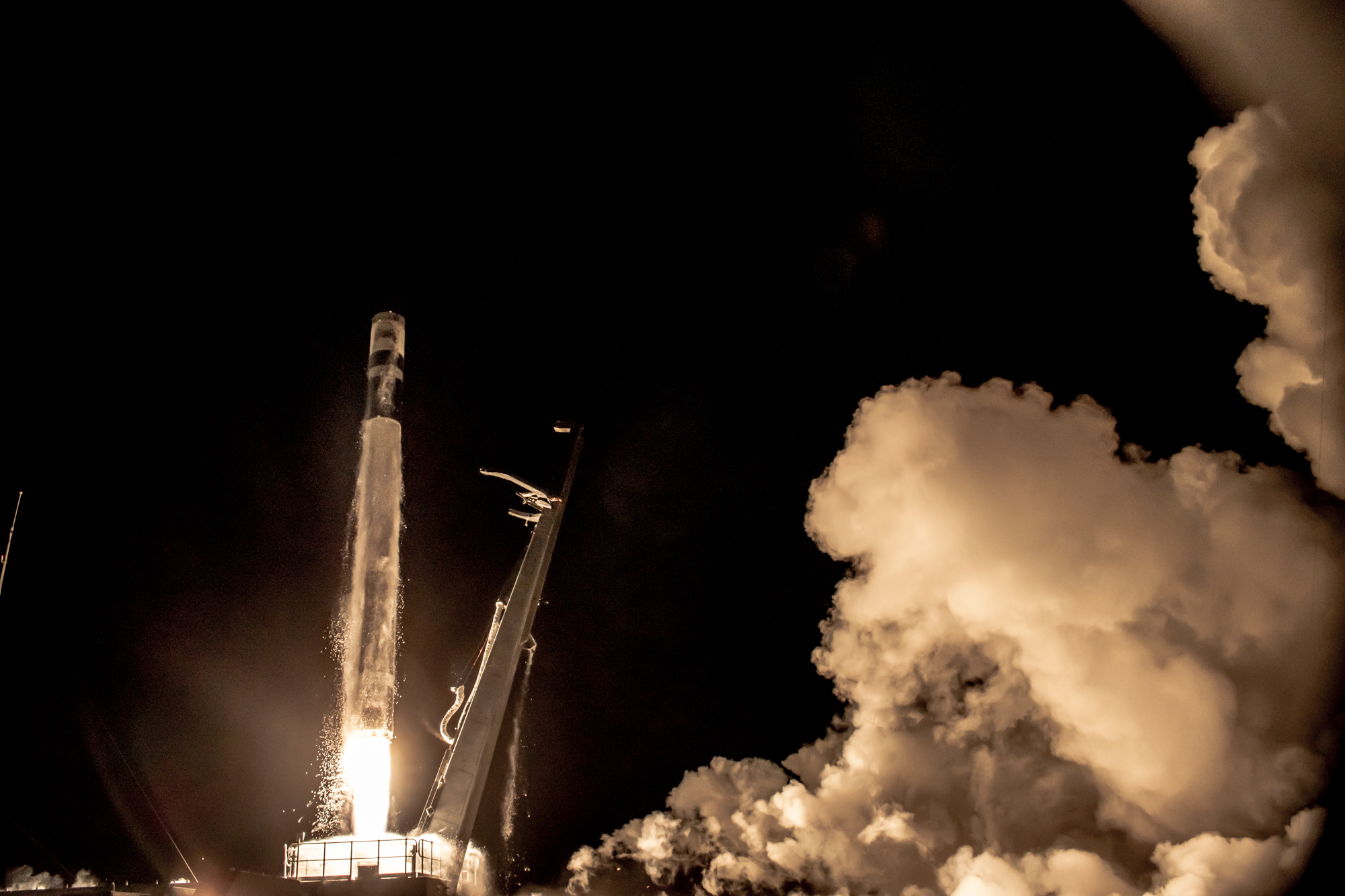
Rocket Lab goes public

Image Credits: Rocket Lab

Rocket Lab is now a public company, trading under the name RKLB on the NASDAQ after a SPAC merger. This is one of the largest private space companies yet to go public via any means, and our own Aria Alamalhodaei spoke to Rocket Lab founder and CEO Peter Beck to get the low-down on the company and what it means to be a member of the public markets.

Meanwhile, ispace is creating a larger lunar lander that can make it through lunar nights. Its existing small lander design isn’t intended to last long in the dark, since its power reserves would deplete quickly and also the super low temperatures are not kind to most electronics.

Join us at TC Sessions: Space in December

Last year we held our first dedicated space event, and it went so well that we decided to host it again in 2021. This year, it’s happening December 14 and 15, and it’s once again going to be an entirely virtual conference, so people from all over the world will be able to join — and you can, too.


The rumored satellite features for future iPhones are reserved for emergency uses only, according to Bloomberg’s Mark Gurman. A few days ago, a report by well-known analyst Ming-Chi Kuo said the next iPhones will come with support for Low Earth Orbit satellite calls and messages. Gurman’s sources said, however, that Apple isn’t turning its devices into actual satellite phones, at least for now. Instead, the tech giant is reportedly developing at least two emergency-related features relying on satellite networks.

The first feature is called Emergency Message via Satellite and will be added as a third protocol, alongside iMessage and SMS, to the Messages app. It’s apparently codenamed Stewie inside the company and will allow users to text emergency services even when there’s no signal, which sounds especially useful during emergencies in remote locations, such as mountains and forests.

The tool will also give users a way to text their emergency contacts simply by typing Emergency SOS in the recipient line. Messages will be restricted to a shorter length, but the senders’ contacts will get a notification for them even if their phone is set to Do Not Disturb. Satellite messages will appear as gray bubbles instead of blue or green so they can be easily identified. Eventually, the feature could handle phone calls, as well.

Apple is also reportedly working on a second satellite feature that will allow users to report crisis situations like plane crashes and fires. This system will give users a way to report the incident at length and will ask them specifics, such as if anybody needs search-and-rescue services or if anybody in the vicinity is armed. It can also automatically send authorities the reporter’s location and their details from the Health app, such as their medical history, age, medications and information like height and weight. The feature can also a notify the reporter’s emergency contacts for them.

While both features sound useful, their availability is restricted by satellite location and reach. They might not work for some regions, and in some cases, users may have to walk outdoors in a certain direction where their iPhone can connect to a satellite. Also, Gurman’s sources said it’s unlikely that the features will be ready before the year ends, which means the next iPhones expected be announced sometime in September won’t be able to send messages via satellite yet.

Editor’s note: This post originally appeared on Engadget.


MKRdezign

Contact Form

Name

Email *

Message *

Powered by Blogger.
Javascript DisablePlease Enable Javascript To See All Widget