Latest Post

Russian internet and ride-hail giant Yandex has acquired Uber’s stake in its Self-Driving Group (SDG), as well as Uber’s indirect interest in Yandex.Eats, Yandex.Lavka and Yandex.Delivery. The total cost of the deal came to $1 billion, giving the Russian company 100% ownership over all four businesses.

Yandex SDG is an autonomous technology spinout from MLU B.V., the ride-hailing and food delivery joint venture Yandex formed with Uber in 2018 by merging Yandex.Taxi and Uber’s Russian operations. At the time, Uber had a 36.6% stake in the new company. Last year, when SDG was spun out into a separate business, Uber was left with an 18.2% stake in the company, which has just been bought out by Yandex. Yandex also purchased Uber’s 33.5% collective interest in Yandex’s food delivery service, last-mile logistics service and 15-minute convenience store delivery service.

Back in 2019, Yandex and Uber were reportedly considering an IPO for their JV, which Morgan Stanley estimated to be valued at around $7.7 billion. Yandex says autonomous driving technology is “highly synergistic to the Yandex ecosystem, which includes ride-hailing, e-commerce and food-tech businesses.” It makes sense that the company would want to control all of that potential growth. Uber, which reported a Q2 loss of $509 million before EBITDA this year, might be looking to make a lucrative exit and refocus its priorities closer to home. 

“This acquisition will enable Yandex to further increase its capacity for strategic management and flexibility when it comes to self-driving technology,” a Yandex spokesperson told TechCrunch. “It will unlock further growth potential for both Yandex and Yandex SDG, creating new sources of value for shareholders.”

The acquisitions are part of a larger restructuring of the MLU B.V. and Yandex SDG joint ventures, according to Uber’s SEC filing on Monday. They will happen in two stages. Stage 1, which is expected to close by the end of Q3 this year, will give Yandex a 4.5% interest in the newly restructured MLU, which will focus on mobility businesses like ride-hailing and car-sharing. This gives Yandex a total of 71% ownership in the JV, 2.8% of which is reserved for an employee equity incentive program. Uber’s total 18.2% stake in SDG is also expected to be sold during the first stage.

Stage 2, which is expected to close by the end of this year, includes the demerger of Yandex.Eats, Yandex.Lavka and Yandex.Delivery from MLU and subsequent acquisition of Uber’s interest in these businesses.

Yandex will also receive a two-year American call option to acquire the rest of Uber’s interest in MLU at a more or less fixed price of $1.8 billion, depending on agreed increases over the option period. This number will increase to $2 billion if exercised in 2023. The Russian company will also continue to use the Uber brand exclusively in Russia and other countries until August 2030.

Yandex will also get an extension of the current license for the exclusive right to use the Uber brand in Russia and certain other countries until August 2030, assuming the exercise of the option. Yandex’s stock was up 5.16% on Tuesday at market close.
Even Harry Stamper would probably like these odds.

Recently NASA updated its forecast of the chances that the asteroid Bennu, one of the two most hazardous known objects in our solar system, will hit Earth in the next 300 years. New calculations put the odds at 1 in 1,750, a figure slightly higher than previously thought.

The space agency, which has been tracking the building-sized rock since it was discovered in 1999, revised its prediction based on new tracking data.

Even with the small shift in odds, it seems likely we won’t face the kind of scenario featured that in the 1998 science-fiction disaster film “Armageddon” when Stamper, played by Bruce Willis, and his team had to try to blow up a huge asteroid that was on an extinction-making collision course with the Earth.

(In an unrelated development, NASA plans to launch a mission in November to see whether a spacecraft could hit a sizeable space rock and change its trajectory just in case it ever needs to.)

This begs the question of just how good should we feel about our odds? We put that question to Lucas B. Janson and Morgane Austern, both assistant professors of statistics.

They compared Bennu’s chances of hitting Earth to the approximate likelihood of:

  • Flipping a coin and having the first 11 attempts all land heads.
  • Any four random people sharing a birthday in the same month (the odds of this are 1 in 1,750 exactly).
  • Throwing a dart at a dartboard with your eyes closed and hitting a bullseye.
  • Winning the state’s VaxMillions lottery on two separate days if every eligible adult resident is entered and a new drawing is held every second.

Bottom line? Janson, an affiliate in computer science, says that if he were a betting man, he would put his money on our being just fine. Then again, he points out, if he is wrong, “Paying up would be the least of my worries.”


One of Hollywood’s biggest talent agencies is getting into the NFT game.

Larva Labs, the creator of CryptoPunks, just signed with United Talent Agency (UTA) in a representation deal that will bring one of the earliest and most iconic NFT projects into the entertainment and branding worlds.

“I would say that it is one of the first opportunities for an IP that fully originated in crypto-world to enter a broader entertainment space, and they earned it,” head of UTA Digital Assets Lesley Silverman told The Hollywood Reporter. “They really have hit the zeitgeist in a tremendous way.”

The deal could see CryptoPunks popping up across film, TV, video games and other licensing areas. Larva Labs’ other art projects, Meebits and Autoglyphs, will also be represented by UTA moving forward. The terms of the deal weren’t disclosed.

As speculative investment in NFTs explodes, CryptoPunks remain one of the most recognizable — and valuable — pioneers in the space. Larva Labs launched 10,000 of the individual algorithmically-generated pixelated figures on the Ethereum blockchain back in 2017.

To the untrained eye, and arguably to the trained eye too, CryptoPunks are just little pixelated portraits of different characters, some wearing pirate hats, others in aviator glasses smoking pipes. But to the crypto world, punks are a social signifier, communicating early investment into NFTs, personal style and, importantly, wealth.

The value of CryptoPunks skyrocketed from zero (they were initially given away for free) and now even the least expensive collectible punks run for hundreds of thousands of dollars, with the most valuable selling for millions. In May, a bundle of nine CryptoPunks sold for just under $17 million in an auction run by Christie’s. And last week, even Visa got in the game, spending $150,000 on CryptoPunk #7610, a digital illustration sporting a mohawk and green face makeup.

It’s noteworthy that a traditional talent agency best known for representing A-list celebrities is getting into the NFT game, but it’s not the group’s first time getting its feet wet in the wild world of crypto. Earlier this month, UTA signed a company called Rally that runs a platform that helps creators issue branded social tokens that fans can spend on merch and exclusive content.


What do LinkedIn and Twitter have in common? They both introduced ephemeral story features that were pretty fleeting. LinkedIn announced today that it will suspend its Stories feature on September 30 and begin working on a different way to add short-form videos to the platform.

LinkedIn announced the upcoming change to warn advertisers who might have already purchased ads that would run in between Stories. Those will instead be shared on the LinkedIn feed, but users who promoted or sponsored Stores directly from their page will need to remake them.

LinkedIn introduced Stories in September, around the same time that Twitter rolled out Fleets to all users before doing away with the feature. This was part of a larger web and mobile redesign, which also added integrations with Zoom, BlueJeans and Teams to help professionals stay connected while working from home. But according to LinkedIn, these temporary posts didn’t quite work on the platform.

“In developing Stories, we assumed people wouldn’t want informal videos attached to their profile, and that ephemerality would reduce barriers that people feel about posting,” wrote LinkedIn’s Senior Director of Product Liz Li in a blog post today. “Turns out, you want to create lasting videos that tell your professional story in a more personal way and that showcase both your personality and expertise.”

Li also noted that users want “more creative tools to make engaging videos.” While Stories included stickers and prompts, users wanted more creative functionality.

If LinkedIn is successful in its plans to create a short-form video feature, it would join platforms like Snapchat and Instagram that have built their own TikTok-like feeds. Sure, most users probably don’t post the same content on LinkedIn and their personal social media accounts, but there actually are some prominent TikTokers sharing career advice, interview tips, and resume guidance, so LinkedIn’s pivot to video might not be as weird as it seems.


Can reading glasses actually be cool? A new eyewear company called Cheeterz Club thinks so. The startup is working to change the perception of reading glasses from being just cheap, disposable items you pick up from a rotating display rack at your local drug store to being something you’d actually be proud to wear. To do so, the company is designing its glasses with quality lenses and frames in range of styles, while still keeping the pricing affordable.

The startup — whose name is a reference to the slang term for glasses, “cheaters,” — was founded by Jennifer Farrelly, whose background includes work in advertising and sales at companies like Uber and Virool.

She said the idea to make a better set of readers came to her because she found herself frustrated by the current options on the market.

“It all started a few years ago. My friends were posting on social media these really depressing comments and posts like: ‘I’m old and turning into my parents, this is awful.’ And I [thought to myself] why does it have to be like that? I feel just as young today as I did ten years ago,” Farrelly explains. “Why are my friends and I feeling forced to feel old because of something that happens overnight?,” she says, of what felt like the sudden onset of middle age and the hardships it brings.

What’s worse, Farrelly says, is that when you finally make your way to the drugstore to pick out some reading glasses, all you’ll find are bad, plastic pairs that both look and feel cheap.

“That’s even more demoralizing,” she adds.

OLYMPUS DIGITAL CAMERA

So Farrelly teamed up with a former Warby Parker and Pair Eyewear Head of Product, Lee Zaro, to design a new line of more fashion-forward eyewear.

Zaro, who’s based in the L.A. area, immediately saw the opportunity.

“Drugstore reading glasses are typically poor in quality, and can feel like they are designed with our parents in mind, leaving a huge unmet need for sophisticated eyewear options,” he said. “When Jennifer approached me to help design her first line of eyewear, I knew it was a brilliant idea.”

To differentiate itself from lower-end readers, Cheeterz Club glasses are made with 100% acetate and feature spring hinges and stainless steel. The lenses, meanwhile, offer more clarity than is often found in reading glasses.

Image Credits: Cheeterz Club

Typically, ophthalmic plastic lens materials have an Abbe value — a measure of the degree at which light is dispersed or separated — between 30 and 58. The higher number offers better optical performance. Crown glass can have an Abbe value as high as 59, but polycarbonate readers (like those from Warby Parker, Farrelly notes) would have an Abbe value of 30. Cheeterz Club lenses, which are CR-39 lenses, are at at 58. This is a difference you can tell when trying the glasses on alongside your drugstore readers.

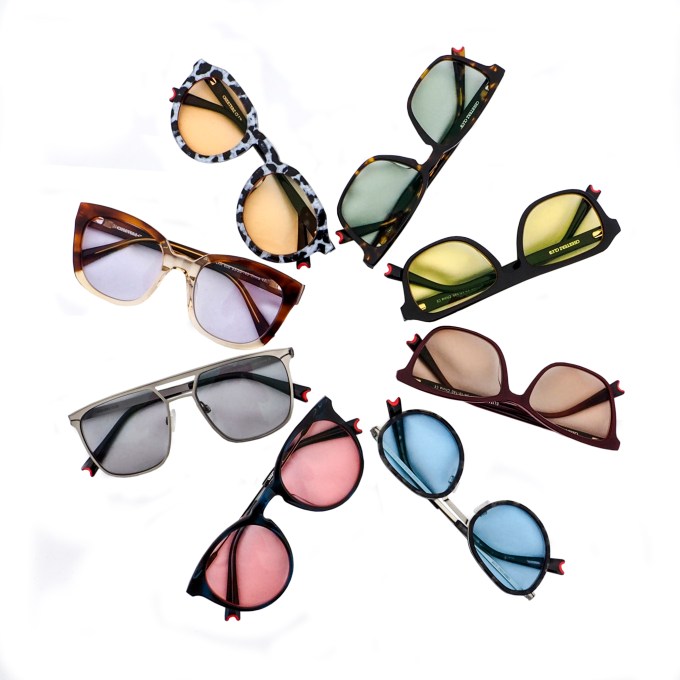
Cheeterz’ lenses also offer 100% UVA/UVB protection, and are oil and water repellent. They can optionally be bought in one of eight fashion tints, from pink to blue, or in two sun shades. Consumers can also opt to add Blue Light coating to help with screen-induced eye fatigue or they can choose Progressive lenses, which combine distance vision with a reading lens.

Tints are an extra $10, Blue Light protection is $25, and Progressive lenses are $40.99 — lower than market rates.

At launch, Cheeterz Club offers 14 different styles ranging from traditional to the more modern, starting at $28.99.

Farrelly says finding the right price was key, because unlike regular glasses, consumers often buy multiple pairs of readers to leave around the house or car, pack in purses and bags, and so on.

“If I break something that costs me a couple $100, I’d be really upset about it,” she says. “But at a drugstore price of under $30, I can have them in all sorts of colors and different tints.”

For Farrelly, making the startup a success goes beyond brining higher-quality reading glasses to market. It’s also about serving a demographic that often gets overlooked.

“Founders in their forties do not get representation, and it’s unfortunate. And there are also people in their forties and fifties that have disposable income and are looking for cute things. They’re spending so much money on facial creams and Botox,” she says, “but then you’re forced to put this really ugly pair of glasses on your face that make you feel bad about yourself.”

While Cheeterz Club today is selling direct to the consumer, the company is talking to eye doctors, boutiques and others who may eventually resell for them, as more of a B2B model. It’s also testing selling on Amazon with one pair of Blue Light glasses.

Cheeterz Club plans to start discussing fundraising with seed investors later this fall.


A cybersecurity company says a popular smart home security system has a pair of vulnerabilities that can be exploited to disarm the system altogether.

Rapid7 found the vulnerabilities in the Fortress S03, a home security system that relies on Wi-Fi to connect cameras, motion sensors, and sirens to the internet, allowing owners to remotely monitor their home anywhere with a mobile app. The security system also uses a radio-controlled key fob to let homeowners arm or disarm their house from outside their front door.

But the cybersecurity company said the vulnerabilities include an unauthenticated API and an unencrypted radio signal that can be easily intercepted.

Rapid7 revealed details of the two vulnerabilities on Tuesday after not hearing from Fortress in three months, the standard window of time that security researchers give to companies to fix bugs before details are made public. Rapid7 said its only acknowledgment of its email was when Fortress closed its support ticket a week later without commenting.

Fortress owner Michael Hofeditz opened but did not respond to several emails sent by TechCrunch with an email open tracker. An email from Bottone Riling, a Massachusetts law firm representing Fortress, called the claims “false, purposely misleading and defamatory,” but did not provide specifics that it claims are false, or if Fortress has mitigated the vulnerabilities.

Rapid7 said that Fortress’ unauthenticated API can be remotely queried over the internet without the server checking if the request is legitimate. The researchers said by knowing a homeowner’s email address, the server would return the device’s unique IMEI, which in turn could be used to remotely disarm the system.

The other flaw takes advantage of the unencrypted radio signals sent between the security system and the homeowner’s key fob. That allowed Rapid7 to capture and replay the signals for “arm” and “disarm” because the radio waves weren’t scrambled properly.

Vishwakarma said homeowners could add a plus-tagged email address with a long, unique string of letters and numbers in place of a password as a stand-in for a password. But there was little for homeowners to do for the radio signal bug until Fortress addresses it.

Fortress has not said if it has fixed or plans to fix the vulnerabilities. It’s not clear if Fortress is able to fix the vulnerabilities without replacing the hardware. It’s not known if Fortress builds the device itself or buys the hardware from another manufacturer.

Read more:


Heroes, one of the new wave of startups aiming to build big e-commerce businesses by buying up smaller third-party merchants on Amazon’s Marketplace, has raised another big round of funding to double down on that strategy. The London startup has picked up $200 million, money that it will mainly be using to snap up more merchants. Existing brands in its portfolio cover categories like baby, pets, sports, personal health and home and garden categories — some of them, like PremiumCare dog chews, the Onco baby car mirror, gardening tool brand Davaon and wooden foot massager roller Theraflow, category best-sellers — and the plan is to continue building up all of these verticals.

Crayhill Capital Management, a fund based out of New York, is providing the funding, and Riccardo Bruni — who co-founded the company with twin brother Alessio and third brother Giancarlo — said that the bulk of it will be going towards making acquisitions, and is therefore coming in the form of debt.

Raising debt rather than equity at this point is pretty standard for companies like Heroes. Heroes itself is pretty young: it launched less than a year ago, in November 2020, with $65 million in funding, a round comprised of both equity and debt. Other investors in the startup include 360 Capital, Fuel Ventures and Upper 90.

Heroes is playing in what is rapidly becoming a very crowded field. Not only are there are tens of thousands of businesses leveraging Amazon’s extensive fulfillment network to sell goods on the e-commerce giant’s Marketplace; but some days it seems we are also rapidly approaching a state of nearly as many startups launching to consolidate these third-party sellers.

Many a roll-up play follows a similar playbook, which goes like this: Amazon provides the Marketplace to sell goods to consumers, and the infrastructure to fulfill those orders, by way of Fulfillment By Amazon and its Prime service. Meanwhile, the roll-up business — in this case Heroes — buys up a number of the stronger companies leveraging FBA and the Marketplace. Then, by consolidating them into a single tech platform that they have built, Heroes creates better economies of scale around better and more efficient supply chains, sharper machine learning and marketing and data analytics technology, and new growth strategies. 

What is notable about Heroes, though — apart from the fact that it’s the first roll-up player to come out of the UK, and continues to be one of the bigger players in Europe — is that it doesn’t believe that the technology plays as important a role as having a solid relationship with the companies it’s targeting, key given that now the top Marketplace sellers are likely being feted by a number of companies as acquisition targets.

“The tech is very important,” said Alessio in an interview. “It helps us build robust processes that tie all the systems together across multiple brands and marketplaces. But what we have is very different from a SaaS business. We are not building an app, and tech is not the core of what we do. From the acquisitions side, we believe that human interactions ultimately win. We don’t think tech can replace a strong acquisition process.”

Image Credits: Heroes

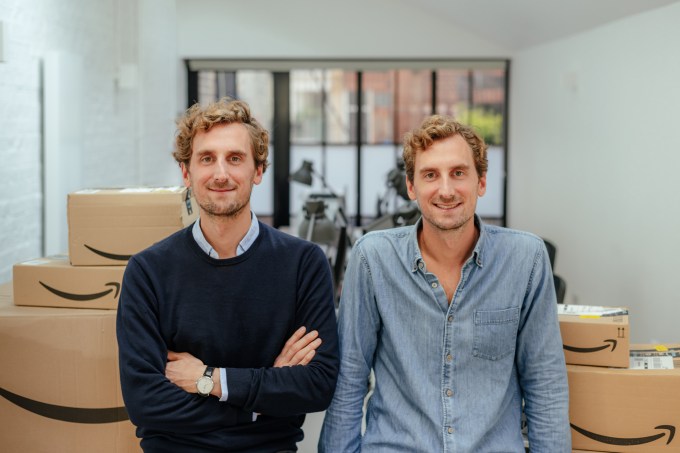
Heroes’ three founder-brothers (two of them, Riccardo and Alessio, pictured above) have worked across a number of investment, finance and operational roles (the CVs include Merrill Lynch, EQT Ventures, Perella Weinberg Partners, Lazada, Nomura and Liberty Global) and they say there have been strong signs so far of its strategy working: of the brands that it has acquired since launching in November, they claim business (sales) has grown five-fold.

Collectively, the roll-up startups are raising hundreds of millions of dollars to fuel these efforts. Other recent hopefuls that have announced funding this year include Suma Brands ($150 million); Elevate Brands ($250 million); Perch ($775 million); factory14 ($200 million); Thrasio (currently probably the biggest of them all in terms of reach and money raised and ambitions), HeydayThe Razor GroupBrandedSellerXBerlin Brands Group (X2), Benitago, Latin America’s Valoreo and Rainforest and Una Brands out of Asia. 

The picture that is emerging across many of these operations is that many of these companies, Heroes included, do not try to make their particular approaches particularly more distinctive than those of their competitors, simply because — with nearly 10 million third-party sellers today on Amazon globally — the opportunity is likely big enough for all of them, and more, not least because of current market dynamics.

“It’s no secret that we were inspired by Thrasio and others,” Riccardo said. “Combined with Covid-19, there has been a massive acceleration of e-commerce across the continent.” It was that, plus the realization that the three brothers had the right e-commerce, fundraising and investment skills between them, that made them see what was a “perfect storm” to tackle the opportunity, he continued. “So that is why we jumped into it.”

In the case of Heroes, while the majority of the funding will be used for acquisitions, it’s also planning to double headcount from its current 70 employees before the end of this year with a focus on operational experts to help run their acquired businesses. 


MKRdezign

Contact Form

Name

Email *

Message *

Powered by Blogger.
Javascript DisablePlease Enable Javascript To See All Widget