Latest Post

The NFT space has had quite the year, and while it can be difficult to separate the billions of dollars in crypto speculation from the potential infrastructure shifts, plenty of mainstream tech companies are dipping their toes into the space and signaling future interest.

This time it’s TikTok’s turn. The fast-growing social media platform which just crossed 1 billion monthly users worldwide has lined up its own NFT drop, leveraging content from some of its top creators, including Lil Nas X, Grimes, Bella Poarch, Rudy Willingham and Gary Vaynerchuk. The release of one-of-one and limited edition NFTs seems to be focused on generating buzz among the existing NFT community rather than exposing users inside the app to non-fungible tokens.

The company is side-stepping blockchain energy concerns by placing their NFTs on a dedicated site powered by Immutable X, a Layer-2 scaling solution for Ethereum which says that NFTs traded using it are “100% carbon neutral.” The drop starts October 6 with a collection from Lil Nas X and will continue on through the end of the month.

Why is TikTok getting into the world of NFTs to begin with? TikTok has a fairly precise answer for that on its drop site:

Inspired by the creativity and innovation of the TikTok creator community, TikTok is exploring the world of NFTs as a new creator empowerment tool. NFTs are a new way for creators to be recognized and rewarded for their content and for fans to own culturally-significant moments on TikTok.

The creation that happens on TikTok helps drive culture and start trends that impact society. TikTok will bring something unique and groundbreaking to the NFT landscape by curating some of these cultural milestones and pairing them with prominent NFT artists.

It’s clearly a niche early experiment for the company, which hasn’t previously indicated the same level of NFT interest that platforms like Twitter and Facebook have shown, but it also showcases that they think NFTs are a space worth paying some attention to.


Clubhouse announced today that it is unveiling four new features: Clips, Replay, Universal Search, and spatial audio for Android (which already exists on iOS). All of these features will launch today, except for Replay, which will roll out in October. These additions will help expand Clubhouse’s reach by making content available even after a live conversation has ended, allowing for asynchronous engagement.

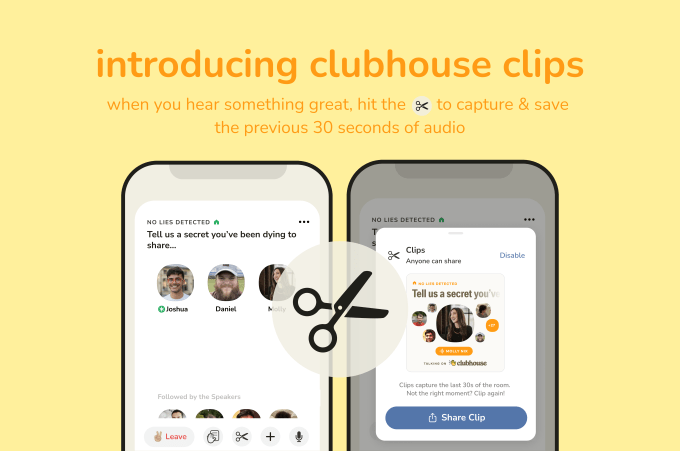
Clips will allow live listeners in public rooms to snip the most recent 30 seconds of audio and share it anywhere — so, if you’re listening to a speaker who says something particularly wise (or not), you can create a clip, which generates a shareable moment with a link to join the room. These can be shared on other social media platforms. Hosts can decide whether or not they want listeners to be able to make clips in their room — if clips are turned on, users will be able to tap a scissor icon to make one.

Clubhouse already acknowledges that there’s a danger in letting people share 30 second audio clips out of context. A bad actor could potentially clip audio to obscure what someone really meant (you might say “the museum is always free on Friday,” but the clip could stop at “the museum is always free” — of course, Clubhouse is concerned about more sinister examples than this). So, to begin, Clubhouse is rolling out clips in beta to a small group of creators. Clubhouse has struggled with content moderation in its short history, and recently, doctors have been reportedly forced off the app due to harassment from anti-vaxxers. In light of these challenges, it makes sense that Clubhouse is more slowly unveiling this feature.

Image Credits: Clubhouse

Universal Search improves discoverability on Clubhouse, so that when users type a keyword or name into the search bar, they can find relevant rooms (both live and scheduled), people, clubs, and bios. And Clubhouse says it’s bringing Spatial Audio to Android after positive feedback from iOS users. But even amid these feature updates, Clubhouse still has made itself inaccessible to Deaf and hard of hearing users by failing to add live captioning.

Of these new features, Replay could be the biggest game-changer for the app — it will allow creators to record a room, save it to their profile and club, or download the audio to share it externally, like on a podcast feed. Hosts and moderators can choose whether or not they want the room to be recorded.

Earlier this month, former PayPal COO David Sacks launched Callin, a “social podcasting” app that functions like a Clubhouse live audio room, but allows users to save and edit recordings into podcasts through the app. Then, Twitter said it would add recorded Spaces too. Now, Clubhouse’s Replay feature will make it more competitive.

Though Clubhouse has tried to appeal to live audio creators through its “Creator First” program, reports suggest that the endeavor fell short of expectations. But if Clubhouse wants to appeal to creators, this easier way of saving and sharing audio can help keep hosts on the platform. Though the appeal of apps like Clubhouse is the ability to have a shared, live experience, allowing for asynchronous listening can help people grow their audience.


South Korean internet service provider SK Broadband, a subsidiary of South Korean telco company SK Telecom, has filed a counterclaim against Netflix to demand payment for the bandwidth the streaming platform has used for the last three years.

This case comes in the wake of the South Korean court siding against Netflix in June in the case. Now SK Broadband is empowered to levy network usage fees on streaming platforms for consuming an excessive amount of bandwidth and causing heavy traffic on its network.

“We will review the claim that SK Broadband has filed against us. In the meantime, we continue to seek open dialogue and explore ways of working with SK Broadband in order to ensure a seamless streaming experience for our shared customers,” a Netflix spokesperson told TechCrunch.

The U.S. streaming giant lodged an appeal to a higher court against the court decision in July after it lost the first court case that the company filed in 2020. That case alleged that SK Broadband, which is responsible for managing its networks, has no right to demand fees for the bandwidth. Netflix has claimed that the ISP was trying to “double bill” — its subscribers already pay for broadband use, and now want to charge the streaming company for it, too.

SK Broadband plans to charge about $23 million per year for network use, as per local media reports.

Back in 2019, SK Broadband requested the Korea Communication Commission come to a settlement, but the two companies couldn’t find an agreement.

SK Broadband claims that Netflix’s traffic on the ISP network has exponentially increased about 24 times, from 50 Gigabits per second in May 2018 to 1,200 Gigabits in September 2021.

Netflix says on 28 September that its investment in content production in South Korea has brought socio-economic impact worth $4.7 billion, covering everything from publishing to consumer goods. It claims to have led to the creation of 16,000 jobs in the country since it opened in 2016, using figures from a Deloitte Consulting report. Netflix Korea has 3.8 million paid subscriptions in South Korea as of the end of 2020, while its global paid memberships were estimated at 200 million, as per the report by Deloitte Consulting.

The Netflix spokesperson said on a separate note that the Korean show “Squid Game” is now on track to be Netflix’s biggest show ever and it’s the first Korean show to ever be No. 1 on Netflix U.S.

Meanwhile, another global streaming giant, Disney Plus, is set to launch in South Korea in November. Disney Plus reportedly plans to use third-party content delivery networks (CDNs) instead of using ISP’s networks to avoid the bandwidth usage fees.


Last night, Facebook published two annotated slide decks in an attempt to contextualize the documents that the Wall Street Journal published this month, which reported evidence that the company is aware of its negative impact on teen mental health. These documents were released in anticipation of today’s Senate hearing on the mental health harms of Facebook and Instagram.

The Senate Committee on Commerce, Science, & Transportation questioned Facebook Global Head of Security Antigone Davis over two and a half hours, but lawmakers grew frustrated with Davis’ reticence to answer their questions directly, or provide much information that hasn’t been written in Facebook blog posts rebuking the WSJ reports.

“I congratulate you on a perfectly curated background,” Tennessee Senator Marsha Blackburn chided Davis. “It looks beautiful coming across the screen. I wish the messages that you were giving us were equally as attractive.”

Davis insisted that research from Facebook and Instagram has shown 8 out of 10 young people say they have a neutral positive experience on the app, and that her team wants 10 out of 10 young users to have a good experience. But Senators pushed back with other findings from Facebook’s own data, like the fact that among teenagers with suicidal thoughts, 13% of British users and 6% of American users said they could trace those thoughts to Instagram. Senator Richard Blumenthal (who serves as Chair of the Subcommittee on Consumer Protection, Product Safety, and Data Security) said that his office did their own research by creating an account pretending to be a thirteen-year-old girl. Senator Blumenthal said they followed “easily findable accounts associated with extreme dieting and eating disorders.” Within a day, he said, the account’s recommendations were solely composed of accounts promoting self-harm and disordered eating.

“That is the perfect storm that Instagram has fostered and created. Facebook has asked us to trust it. But after these evasions and these revelations, why should we?” Senator Blumenthal asked.

But in the midst of filibustering tactics that fit right in on the Senate floor (“We’re pretty good at filibustering in the Senate, too,” Senator Klobuchar told Davis), the Facebook Global Head of Safety did elaborate on some of the company’s plans to improve young users’ experience, which Head of Instagram Adam Mosseri previously mentioned on Twitter.

“Young people indicated that when they saw uplifting content or inspiring content, that could move them away from some other issues that they’re struggling with,” Davis said at the hearing. “So one of the things that we’re actually looking at is called ‘nudges,’ where we would actually nudge someone who we saw potentially rabbit holing down content towards more uplifting or inspiring content.”

In addition to a “nudges” feature, Davis said that the company is looking at a “take a break” feature, which would encourage users to stop looking at the app if they’ve been browsing certain content for too long. In 2018, Instagram introduced a “you’re all caught up” notice, which would appear when the user had scrolled through all posts from the last two days. This feature was introduced alongside “do not disturb” toggles, which helped users control when they wanted to receive notifications. These updates were part of “Time Well Spent” initiatives, designed to curb screen time and encourage healthier social media habits. But by 2020, the space beneath the “caught up” notice was turned into a feed of suggested posts and ads.

At the hearing, Massachusetts Senator Ed Markey (a social media star in his own right) announced that he would reintroduce legislation with Senator Blumenthal called the KIDS (Kids Internet Design and Safety) Act, which seeks to create new protections for online users under 16. The bill would prohibit platforms directed at children from leveraging follower and like counts, push alerts that encourage users to use the app more, auto-play settings, badges that award elevated levels of engagement, or any design feature that unfairly encourages a user (“due to their age or inexperience,” the bill specifies) to make purchases, submit content, or spend more time on a platform.

Previously introduced in March 2020, Facebook has known about the proposed legislation for almost a year and a half.

“I think our company has made its position really well known that we believe it’s time for the update of internet regulations, and we’d be happy to talk to and work with you on that,” Davis told Senator Markey.

But when Markey directly asked if Facebook would support the KIDS Act, Davis said that Facebook would follow up on the question later.

“Well, your company has had this legislation in your possession for months. And you’re testifying here today before the committee that would have to pass this legislation,” said Senator Markey. “I just feel that delay and obfuscation is the legislative strategy of Facebook, especially since Facebook has spent billions of dollars on a marketing campaign calling on Congress to pass internet regulations, and Facebook purports to be committed to children’s well being.”

At the end of the hearing, Davis said that she hopes the Senate will have hearings with companies that have kid-focused apps, like TikTok and YouTube. Currently, Facebook has a Messenger Kids app, but the company but its Instagram for kids product on hold in light of WSJ’s reporting. Though WSJ has published six leaked documents from Facebook, the company itself only annotated and re-published two of them.


Jeff Bezos just can’t get away from labor issues. The beleaguered billionaire, who has faced repeated and persistent criticism over working conditions at the company he formerly led, Amazon, is now facing allegations of a hostile work environment at his space company Blue Origin.

An essay jointly composed by 21 current and former employees paints a vivid picture of Blue Origin’s work culture as one marred by sexual harassment, in which professional disagreement is stifled, environmental concerns are left unaddressed and speed of execution takes precedence over human safety.

The sole named author of the essay is Alexandra Abrams, who worked at Blue Origin for two years and six months, according to her LinkedIn profile. Abrams eventually became the head of employee communications during her tenure at the company. “I would say to Jeff that I really wished he was the person we all thought he was, and that Blue Origin was the company we all thought it was going to be,” she said in an interview to CBS Morning on Thursday.

In a statement to TechCrunch, a Blue Origin spokesperson said that Abrams “was dismissed for cause two years ago after repeated warnings for issues involving federal export control regulations.”

“Blue Origin has no tolerance for discrimination or harassment of any kind,” the spokesperson added. “We provide numerous avenues for employees, including a 24/7 anonymous hotline, and will promptly investigate any new claims of misconduct.”

Federal export control regulations restrict the exportation of certain goods and technology outside the U.S. At the time of publication, Blue Origin did not specify any further details related to Abrams’ departure from the company.

The essay couldn’t have been published at a worse time for Blue Origin, which is currently mired in a lawsuit against NASA over the agency’s awarding of a sole lunar lander contract to SpaceX. Blue Origin, which submitted its own bid, has been on the offensive ever since, disputing the contract on social media and to a major government accountability office. That office dismissed Blue’s complaint.

The essay alleges that safety took a backseat to the so-called billionaire space race, marked this summer by two trips to orbit by Virgin Galactic’s Richard Branson and Bezos himself in July. The essay further claims that company leaders expressed a goal of hitting more than 40 launches of BO’s New Shepard spacecraft per year – a breakneck pace that the essay writers say did not match available staffing and resources.

“In the opinion of an engineer who has signed on to this essay, ‘Blue Origin has been lucky that nothing has happened so far,’” the essay says. “Many of this essay’s authors say they would not fly on a Blue Origin vehicle.”

A series of accusations detailed in the letter also allege a culture of sexism amongst numerous senior executives, including one in CEO Bob Smith’s “loyal inner circle” whom the essay claims was reported to Human Resources numerous times for sexual harassment.

The essay says that women at the company would warn new female hires regarding another senior executive’s inappropriate behavior, which included making inquiries into female employees’ dating lives and referring to them using diminutives like “sweetheart” or “baby girl.”

“It appeared to many of us that he was protected by his close personal relationship with Bezos—it took him physically groping a female subordinate for him to finally be let go,” the essay says.

It’s hard to imagine this essay not affecting Blue Origin’s bottom line. After the successful launch of New Shepard in August, in which Bezos and three others went to space during an eleven-minute flight, the company intends to start welcoming more paying customers on flights.

That the majority of the letter writers chose to stay anonymous could be explained, at least in part, by the stifling new contracts employees were requested to sign in 2019, which included non-disparagement clauses, according to the essay.

The letter appears to have caught the attention of the Federal Aviation Administration, who told TechCrunch, “The FAA takes every safety allegation seriously, and the agency is reviewing the information.”

TechCrunch has reached out to Blue Origin regarding the other allegations in the letter and will update the story if they respond.


TikTok this week presented its new plan to ramp up advertiser investment in its video platform with the expansion of e-commerce, a new promise of “brand safety,” and the launch of several new and interactive ad formats, ranging from clickable stickers to choose-your-own-adventure ads to “super likes” and more. The additions, the company says, will make TikTok’s advertising more interactive and creative, much like the TikTok experience itself.

The company demonstrated its new additions at an online conference aimed at the advertising and marketing community on Tuesday.

Here, TikTok also announced several new e-commerce partnerships beyond its pilot partner Shopify to make online shopping a more native experience, with the ability for users to go from product discovery to checkout without leaving the app. It noted it’s making live shopping available to brands and offered several ad products made just for e-commerce brands. And, in some markets, TikTok is offering to take on the responsibilities of shipping and fulfillment, as well.

Meanwhile, TikTok’s broader ads business is getting a jolt with the launch of several new products designed with the goal of making TikTok better differentiated from other social media rivals.

On this front, TikTok introduced a new product called “instant page,” which is a quick-loading landing page that the company claims will load 11 times faster than a typical mobile website. This allows a user who clicks through on an ad to be immediately taken to a page where they’ll be able to see more information from the brand, watch more videos, and swipe through other content — all without leaving the TikTok app. This could compete with Instagram’s Link Sticker which recently stepped in to replace the swipe-up gesture in its app.
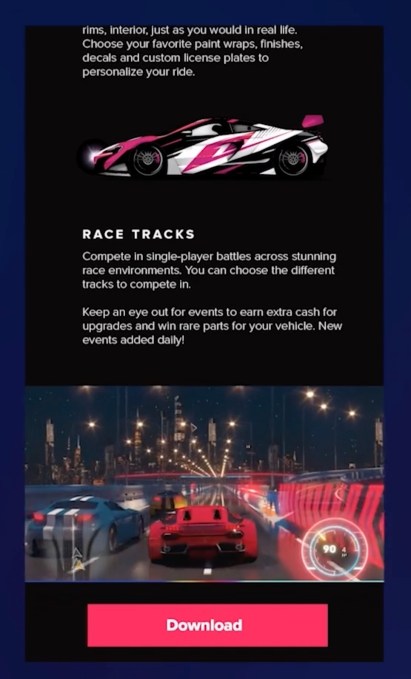
Image Credits: TikTok (instant page)

Another new product, “pop out showcase,” aims to make engaging with ads a more interactive experience.

With “pop out showcase,” advertisers can access a library of stickers and images that can be superimposed on top of their TikTok videos to illustrate the products they’re demonstrating or other key story elements. For instance, a beauty brand may add a sticker of a makeup brush to its content that, when tapped, takes the viewer to a page where they can buy a makeup brush from the brand.
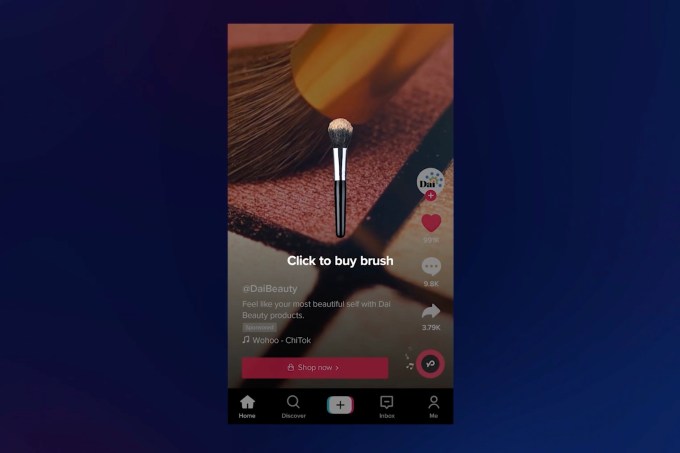
Image Credits: TikTok (pop out showcase)

Other new formats encourage TikTok users to tap on the ads themselves.

One of these is TikTok’s “super like.” This offers a way to make “liking” a video a more engaging experience. When users tap the like (heart) button on a TikTok video, the Super Like can display different types of icons that appear on viewers’ screens. Users are also invited to visit a landing page where they can learn more about the brand’s product or service being featured.
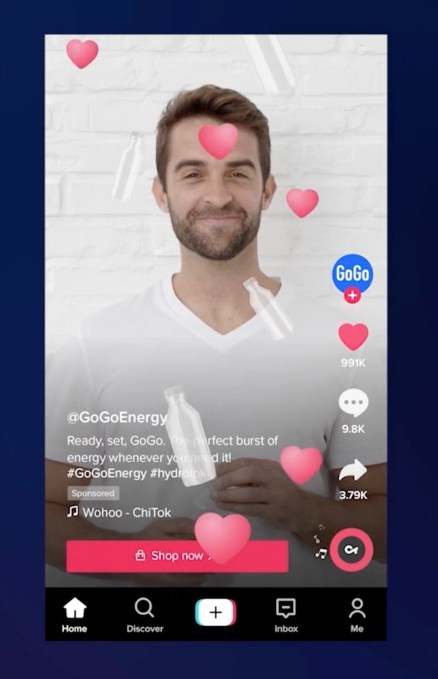
Image Credits: TikTok (super like)

There are also gesture ads that will reveal rewards or other information to users who either slide or tap on videos. Like the “pop out showcase: and “super like,” these ads play to the familiarity that TikTok users — particularly its young Gen Z and millennial demographic — have with how to navigate their smartphones. It’s second nature for younger people to know to tap, swipe, and drag, and these ads offer some form of immediate gratification for doing so, whether that’s an explosion of icons or even a real-life reward.
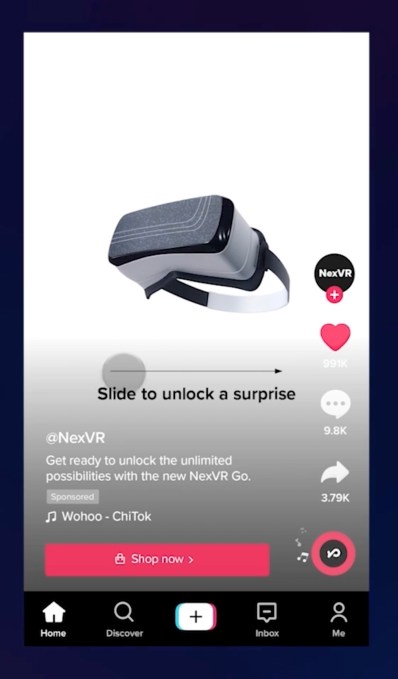
Image Credits: TikTok (gesture ads)

The final new product is TikTok’s “storytime tool,” which encourages users to become a part of the brand’s storytelling experience. Some streaming services, like Hulu, have experimented with ads that ask the users to play along — but not quite to the extent of controlling the story. Instead of just watching a TikTok ad, this choose-your-own-adventure style format lets users tap to direct the action in the video to shape the narrative and personalize the outcome.
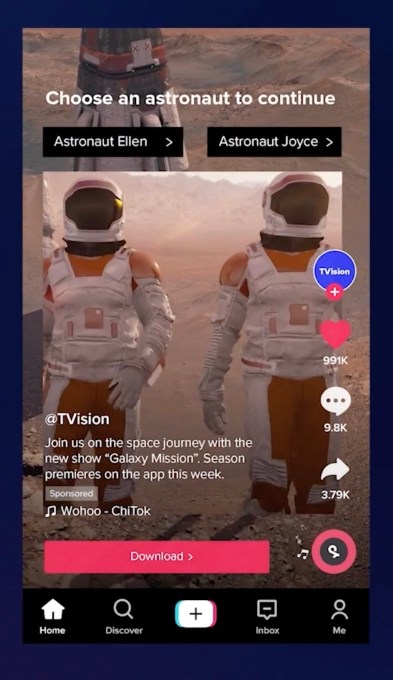
Image Credits: TikTok (storytime tool)

“All these solutions are a part of our goal to enable advertisers to create the most engaging ads in ways that taps into their creativity and fun that exists on the platform,” said Jaclyn Fitzpatrick, TikTok Product Strategist, Global Business Marketing, when introducing the new lineup.

Of course, performance and measurement capabilities are just as important to marketers as the ad creatives themselves. To address these concerns, the company touted its TikTok Ad Manager, editing suite, trends and insights, and other new tools for buying, scaling, and analyzing their campaigns. It launched a new buying type called Reach & Frequency, which allows advertisers to target a higher volume of users through extended reach, or get more impressions with the same number of users by opting into a higher frequency for their ad placements.

TikTok also made a commitment to brand safety — an issue that’s plagued YouTube in the past — with the launch of a proprietary brand safety inventory filter.

The solution leverages machine learning technology to classify a video’s risk based on the video’s content, text, audio, and more, so advertisers can make decisions about which kind of inventory they want to run adjacent to, the company explained. TikTok says the new filter is aligned with the Global Alliance for Responsible Media (GARM)’s industry framework and it partnered with Integrate Ad Science (IAS), Zefr, and OpenSlate to help it to ensure ads run next to brand-safe content.

The message to advertisers, clearly, is that TikTok should be considered not only because of its sizable audience — now 1 billion monthly actives, it says — but also because of its advertising toolset.

To date, marketers haven’t carved out as much of their spending for TikTok compared with other major platforms, like Facebook and Instagram. But TikTok parent company, ByteDance, has been making inroads in the global ad market, with annual revenue across its apps more than doubling in 2020 to reach $34.3 billion. In the U.S., TikTok was expected to bring in $500 million in 2020, up from $200-$300 million in the year prior, according to a report by The Information. (Some of that is from in-app purchases, of course.)

As TikTok has scaled its ad business, its ad prices have been steadily increasing, too. Bloomberg noted this summer it was jacking up home page takeover ads, its most valuable real estate, to more than $2 million on top days — like holidays. Reuters also noted that TikTok saw a 500% increase in the number of advertisers that were running campaigns in the U.S. from the start of 2020 to the end, though ad sales were still small compared with other major platforms.
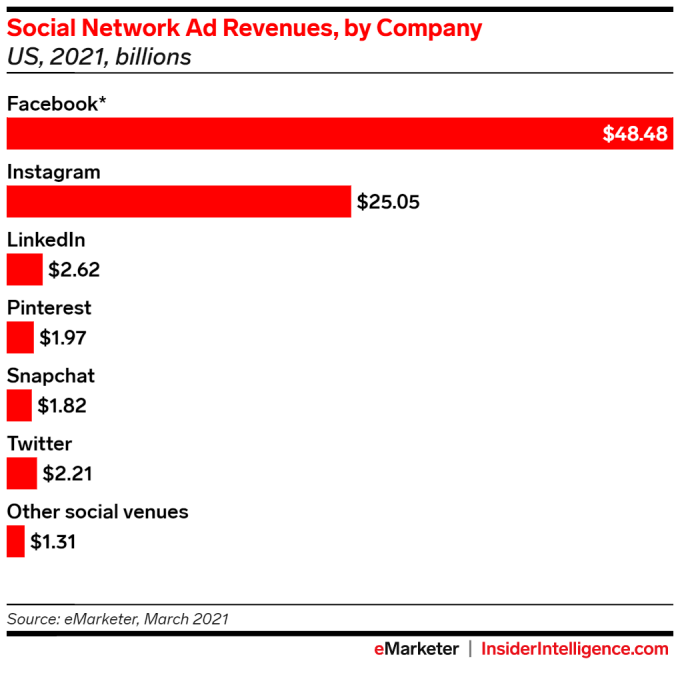
Image Credits: eMarketer

That continues to be the case in 2021, as TikTok’s U.S. ad revenues are dwarfed by other social brands. In fact, TikTok was not even broken out in eMarketer’s recent tabulation of U.S. ad revenues, where it’s instead lumped into an “Other” category with other, smaller social networks which, combined, are expected to reach $1.3 billion in 2021.


Facebook has quietly published internal research that was earlier obtained by the Wall Street Journal — and reported as evidence the tech giant knew about Instagram’s toxic impact on teenaged girls’ mental health.

The two slide decks can be found here and here.

The tech giant also said it provided the material to Congress earlier today.

However Facebook hasn’t simply released the slides — it has added its own running commentary which seeks to downplay the significance of the internal research following days of press commentary couching the Instagram teen girls’ mental health revelations as Facebook’s ‘Big Tobacco’ moment.

Last week the WSJ reported on internal documents its journalists had obtained, including slides from a presentation in which Facebook appeared to acknowledge that the service makes body image issues worse for one in three teen girls.

The tech giant’s crisis PR machine  swung into action — with a rebuttal blog post published on Sunday.

In a further addition now the tech giant has put two internal research slide decks online which appear to form at least a part of the WSJ’s source material. The reason it has taken the company days to publish this material appears to be that its crisis PR team was busy figuring out how best to reframe the contents.

The material has been published with some light redactions (removing the names of the researchers involved, for example) — but also with extensive ‘annotations’ in which Facebook can be seen attempting to reframe the significance of the research, saying it was part of wider, ongoing work to “ensure that our platform is having the most positive impact possible”.

It also tries to downplay the significant of specific negative observations — suggesting, for example, that the sample size of teens who had reported problems was very small.

“The methodology is not fit to provide statistical estimates for the correlation between Instagram and mental health or to evaluate causal claims between social media and health/well-being,” Facebook writes in an introduction annotation on one of the slide decks. Aka ‘nothing to see here’.

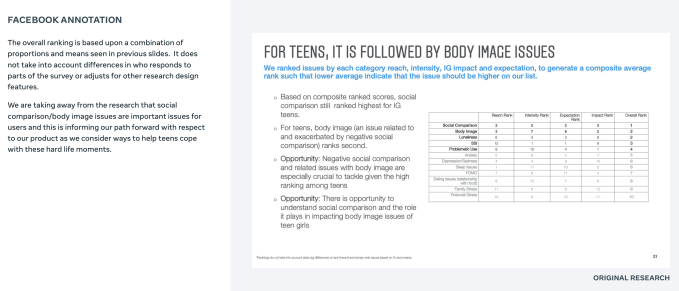
Later on, commenting on a slide entitled “mental health findings” (which is subtitled: “Deep dive into the Reach, Intensity, IG Impact, Expectation, Self Reported Usage and Support of mental health issues. Overall analysis and analysis split by age when relevant”), Facebook writes categorically that: “Nothing in this report is intended to reflect a clinical definition of mental health, a diagnosis of a mental health condition, or a grounding in academic and scientific literature.”

While on a slide that contains the striking observation that “Most wished Instagram had given them better control over what they saw”, Facebook nitpicks that the colors used by its researchers to shade the cells of the table which presents the data might have created a misleading interpretation — “because the different color shading represents very small difference within each row”. 

If the sight of Facebook publicly questioning the significance of internal work and quibbling with some of the decisions made by its own researchers seems unprepossessing, remember that the stakes of this particular crisis for the adtech giant are very high.

The WSJ’s reporting has already derailed a planned launch of a ‘tweens’ version of the photo sharing app.

While US lawmakers are also demanding answers.

More broadly, there are global moves put child protection at the center of digital regulations — such as the UK’s forthcoming Online Safety Act (while its Age Appropriate Design Code is already in force).

So there are — potentially — very serious ramifications for how Instagram will be able to operate in the future, certainly vis-a-vis children and teenagers, as regulations get drafted and passed.

Facebook’s plan to launch a version of Instagram for under 13s emerged earlier this year, also via investigative reporting — with Buzzfeed obtaining an internal memo which described “youth work” as a priority for Instagram.

But on Monday CEO Adam Mosseri said the company was “pausing” ‘Instagram kids’ to take more time to listen to the countless child safety experts screaming at it to stop in the name of all that is good and right (we paraphrase).

Whether the social media behemoth will voluntarily make that “pause” permanent looks doubtful — given how much effort it’s expending to try to reframe the significance of its own research.

Though regulators may ultimately step in and impose child safety guardrails.

“Contrary to how the objectives have been framed, this research was designed to understand user perceptions and not to provide measures of prevalence, statistical estimates for the correlation between Instagram and mental health or to evaluate causal claims between Instagram and health/well-being,” Facebook writes in another reframing notation, before going on to “clarify” that the 30% figure (relating to teenaged girls who felt its platform made their body image issues worse) “only” applied to the “subset of survey takers who first reported experiencing an issue in the past 30 days and not all users or all teen girls”. 

So, basically, Facebook wants you to know that Instagram “only” makes mental health problems worse for fewer teenage girls than you might have thought.

(In another annotation it goes on to claim that “fewer than 150 teen girls spread across… six countries answered questions about their experience of body image and Instagram”. As if to say, that’s totally okay then.)

The tech giant’s wider spin with the annotated slides is an attempt to imply that its research work shows proactive ‘customer care’ in action — as it claims the research is part of conscious efforts to explore problems experienced by Instagram users so that it can “develop products and experience for support”, as it puts it.

Yeah we lol’d too.

After all, this is the company that was previously caught running experiments on unwitting users to see if it could manipulate their emotions.

In that case Facebook succeeded in nudging a bunch of users who it showed more negative news feeds to to post more negative things themselves. Oh and that was back in 2014! So you could say emotional manipulation is Facebook’s DNA… 

But fast forward to 2021 and Facebook wants you the public, and concerned parents everywhere, as well as US and global lawmakers who are now sharpening their pens to apply controls to social media not to worry about teenagers’ mental health — because it can figure out how best to push their buttons to make them feel better, or something.

Turns out, when you’re in the ad sales business, everything your product does is an A/B test against some poor unwitting ‘user’…  

Screengrab from one of Facebook’s annotated slide decks released in response to the WSJ’s reporting about teen Instagram users’ mental health issues (Screengrab: Natasha Lomas/TechCrunch.)


MKRdezign

Contact Form

Name

Email *

Message *

Powered by Blogger.
Javascript DisablePlease Enable Javascript To See All Widget