Latest Post

An international team of astronomers led by scientists at the Center for Astrophysics | Harvard & Smithsonian who produced the first direct image of a black hole three years ago have now produced a portrait of a second, this time a much-anticipated glimpse of one at the heart of the Milky Way.

The new picture was captured by researchers from the Event Horizon Telescope (EHT) Collaboration who unveiled their first image in 2019. The group targeted both black holes at the outset but focused their attention on one at a time, owing to a difference in the complexity of the two projects.

“This is our supermassive black hole,” said Peter Galison, director of Harvard’s Black Hole Initiative, a member of the EHT team, and the Joseph Pellegrino University Professor in the History of Science and Physics. “This is at the center of where we live.”

The image of this object known as Sagittarius A-star, often referred to as Sgr A* (pronounced sadge-ay-star), shows the telltale sign of a black hole, as did the earlier one in the Messier 87 galaxy (M87): a bright ring of superhot glowing material circling a dark center so dense and bottomless that not even light can escape. The way the light bends around the dark center, known as the event horizon, shows the object’s powerful gravity, which is four million times that of our sun.

The new picture, described today in a special issue of The Astrophysical Journal Letters, provides the first direct visual evidence that the giant lurking 27,000 light-years away at the center of Earth’s galaxy is, in fact, a supermassive black hole. It also bolsters theories of where these cosmic monsters exist and may help to explain how galaxies are formed.

Simulations comparing M87 with SgrA* show how much faster material moving at the speed of light orbits SgrA* because of its smaller size.

Center for Astrophysics | Harvard & Smithsonian

“Having seen this bright ring around the darkness of a black hole once was astonishing, but having now seen it twice, we begin to really have confidence of what we’re seeing and that at the center of galaxies there are these enormous black holes that are millions or even billions of times the mass of the sun,” Galison said.

Members of the EHT project unveiled the picture at the National Press Club in Washington, D.C., shortly after 9 a.m. EST, in sync with six other news conferences in cities around the world.

At the press conference in D.C., Michael Johnson, an astrophysicist at the CfA and a leading member of the EHT said one of the key lessons from the project was that the black hole at the center of the Milky Way doesn’t appear to be pulling in as much material as others, making the environment more relatively stable.
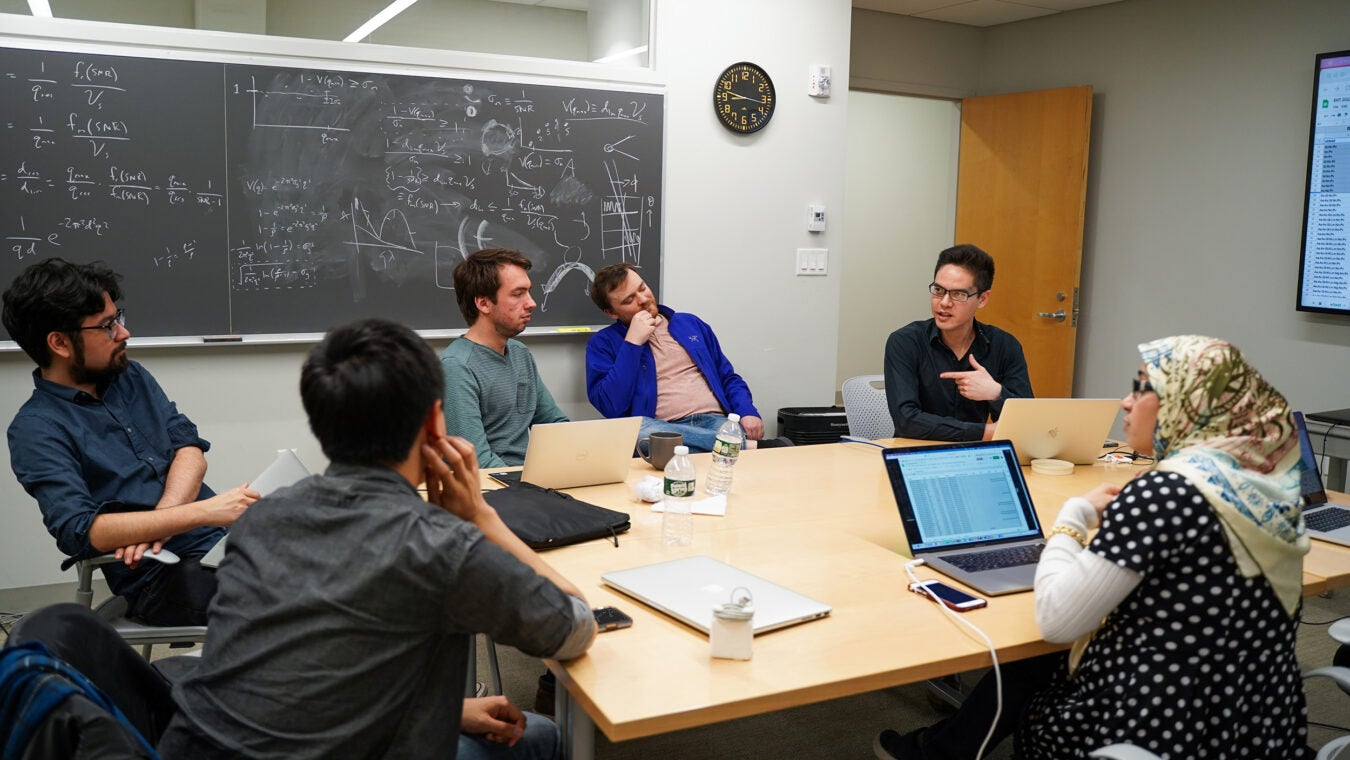
Members of Harvard's Black Hole initiative meet to discuss black hole images.

Members of Harvard’s Black Hole Initiative meet to discuss the first-ever image of Sagittarius A*.

Center for Astrophysics | Harvard & Smithsonian

“While M87 had one of the biggest black holes in the universe and it launches a jet that pierces its entire galaxy, Sgr A* is giving us a view into the much more standard state of black holes, quiet and quiescent,” said Johnson.

NASA Einstein Fellow at the CfA Sara Issaoun worked on observations and imaging for the EHT team and discussed the image at the European press conference in Germany. She said the new image reveals some key details about the black hole that were previously unknown, including that one side of the black hole is almost directly facing Earth.

“These properties, this knowledge of the fundamental properties of the black hole will help us study the astrophysics of the black hole in more detail later on,” Issaoun said.

Issaoun also pointed out that the new view further cements Einstein’s theories on gravity and relativity.

“The cool thing about Sgr A* is that we know its mass with great accuracy so we know exactly what Einstein’s theory of relativity should predict for how big the shadow in the center should be — around 50 micro-arcseconds in angular size or 60 million kilometers across,” Issaoun said. “That is what we’ve measured in our image.”

Event Horizon Telescope array in Hawaii.

The black hole images were captured with the Event Horizon Telescope, a worldwide network, including this array from Hilo, Hawaii, that link together to form a single Earth-sized virtual instrument.

Center for Astrophysics | Harvard & Smithsonian

The researchers produced the picture with observations from the Event Horizon Telescope, a worldwide network of radio telescopes that link together to form a single Earth-sized virtual instrument. In April 2017, eight radio observatories on six mountains on four continents stared on and off at a pair of black holes for 10 days — Sgr A* and a second that lies at the heart of the elliptical galaxy M87.

From that observation data, which was then crunched by supercomputer algorithms, came the image of the M87 black hole as well as the one just released.

The two images can now be compared to gain valuable insight on the inner workings of these supermassive giants and how they interact with their surroundings, a process thought to play a key role in shaping the formation and evolution of galaxies.

M87 is 55 million light-years away in the Virgo Galaxy cluster and has a mass about 6.5 billion times that of our sun. The bright circle of gas and dust that collects and swirls around it is known as an accretion disk. It takes many days to orbit around this gargantuan object. That means that when the EHT team shines their telescopes on it for hours — using a technique called very long baseline interferometry that works like taking a long exposure image on a camera — any change appears very gradually.

Sgr A*, on the other hand, is on the small side. If it was the size of a doughnut, M87 would be the size of a football stadium, Issaoun said at the press conference in Germany. This means superheated gas, which travels at near-light speed and takes days to orbit M87, only takes minutes to orbit Sgr A*, which is why there is so much motion blur in the image.

“The analogy would be if you have an adult getting their portrait taken with a long exposure, and they’re just sitting still. That’s M87,” Issaoun said. “For Sgr A*, you have a toddler running around and you’re trying to get their portrait with the long-exposure camera. You’re just going to get a bunch of blur everywhere.”

In addition, there is a giant cloud of ionized gas between Earth and the Galactic Center, which distorts the images the EHT takes of Sgr A,* which sits in central region of the Milky Way.

“We’re looking at our own Galactic Center through an interstellar soup of all the dust and gas between us,” said Daniel Palumbo, a Harvard graduate student at the CfA who worked on the data analysis. “This material scatters the light that we observe from Sgr A*. It’s like looking at something through frosted glass.”

Seeing all these difficulties, the Event Horizon team first focused on the M87 data before turning their full attention to that of Sgr A*.

In the end, the researchers were able to produce their final image, which isn’t just one picture but the average of thousands of images created using different computational methods to account for the movement of the gas.

The individual images showed many different structures that highlighted the uncertainty in the computational methods from the rapidly changing appearance of Sgr A*, including all the movement and plasma flares that go with it. The averaged image retains features more commonly seen in the varied images and suppresses features that appeared less frequently.

“We wanted to know how to measure the structure of the ring from all these possible images,” said Razieh Emami, a postdoctoral researcher at the CfA who made precise measurements of the ring and worked to combine data from multiple nights of observations into the single final image released Thursday.

That there now exist images of two black holes of very different sizes is particularly exciting to the astronomers, and they have already begun to use the new data to test theories and models of how gas behaves around supermassive black holes. It also marks a monumental collaborative achievement for the EHT, made up of more than 300 researchers from 80 institutes around the globe and 11 observatories.

Much of the work is based on the Harvard campus with dozens of astronomers, postdoctoral fellows, graduate students, and undergraduates at the Black Hole Initiative and CfA.

“With the interdisciplinary expertise at the Smithsonian, Harvard, and the Center for Astrophysics, our large group here has become the center of gravity for this visionary project, and an incubator for discoveries over the next decade,” said CfA scientist Sheperd Doeleman, founding director of the EHT and co-director of the Black Hole Initiative.

The work of studying these giants is far from finished. The members of the group say they are now looking at a next-generation EHT (ngEHT) project: capturing video of a black hole. The project will involve designing new ultra-high-speed instrumentation and a plan to double the number of radio dishes in the EHT array that will allow scientists “to create an Earth-sized motion picture camera” that “will bring black holes to vibrant life,” said Doeleman, who also leads the ngEHT project.

“We know that there’s more to see here,” Johnson said. “We know that there are sharp features that are that are tight predictions from general relativity. This is how we can push our theories further. We’re hoping to add these new telescopes around the world and be able to really dig into those sharp features and to be able to see these high-resolution movies.”

 A separate panel of CfA scientists will participate in a public Q&A panel at 3 p.m. EDT today which will be livestreamed on the CfA’s Facebook and YouTube pages. On Monday at 5:15 p.m. in the Harvard Science Center, Hall C, there will be a special public event with members of Harvard’s EHT team discussing the results.


This is a coming-of-age story — involving your brain.

That’s how W.A. Harris opened his virtual Harvard Science Book Talk on Monday. The talk, presented by the University’s Division of Science, Cabot Science Library, and Harvard Book Store, brought Harris together with old friend Joshua Sanes, the Jeff C. Tarr Professor of Molecular and Cellular Biology at Harvard and director of the Center for Brain Science. The neuroscientists discussed Harris’ new book, “Zero to Birth: How the Human Brain Is Built,” which elucidates how one cell develops into the complex operational centers that not only make us human, but also individuals, with entirely unique traits, behaviors, and, yes, malfunctions.

Harris presented the relevant evolutionary history, crediting the many pioneering neuroscientists who uncovered how the “Adams and Eves of our brains” were born. One, Santiago Ramón y Cajal, created the first drawings of intricate neuron trees, which are still widely studied. Another, Conrad Hal Waddington, likened the development of different neuron types to a ball rolling down an uneven hill.

“The neural stem cells are a bit unpredictable,” Harris explained. “We can’t predict exactly where they’ll land, but they will create the right amount of neuron types.”

Other 20th-century neuroscientists, including Roger Sperry, took a more hands-on approach, Harris said. Sperry removed, flipped, and reinserted a frog’s eye, leaving the amphibian with an upside-down world. And while the neurons adapted, rewiring to restore vision, the eye was not so nimble. To look up, the frog looked down — for the rest of its life.

Moving from amphibian to mammal, David Hubel and Torsten Wiesel deprived a kitten of vision in one eye to see how the limitation might affect a growing brain. When they restored vision after the kitten reached 3 months old, the duo discovered that the animal never gained sight in the closed eye.

Adult neurons survive for a lifetime and remain malleable for several years. This is one reason kids are especially adept at learning new languages, explained W.A. Harris (left), who was joined by Joshua Sanes, director of the Center for Brain Science at Harvard.

Jon Chase/Harvard Staff Photographer

As a brain develops, young neurons strike out, seeking to form synaptic connections across brain regions, Harris said. If they fail to make those connections, they “commit suicide by consuming themselves.” And even if they survive this first cutthroat wave, they can “get pruned, like plants.”

In the first trimester of pregnancy, neural growth is exponential: about 15 to 20 million cells are born every hour, Harris said. Only about 50 percent of these original cells survive. If, for example, there are too many of one type, causing an imbalance, the excess will die off. Or, if some seem to be serving a pointless task, like those attending a shut eye, they’ll move on. Why waste precious neurons?

After the early period of growth, suicide, and pruning comes to an end, adult neurons survive for a lifetime. And unlike those of a cat, they remain malleable for several years. This is one reason kids are especially adept at learning new languages, and why procedures to correct neurological dysfunctions, like a lazy eye, have higher chances of success early in life.

“Adult neurons seem to have lost some of the mojo of their youth,” Harris said. They get damaged, weaker, and a little less flexible over time. Plus, unlike those of fish, amphibians, and reptiles, human brains don’t regenerate much after injury because only a small number of neurons are born during adulthood.

“Fixing broken brains is one of the hardest challenges of medicine,” Harris said.

“This is a very good time to be a mouse with autism or Alzheimer’s because we can cure you,” Sanes said during the question-and-answer portion of the talk. But those cures don’t translate from mouse to human. Even though brains look remarkably similar across invertebrate species, “there are deep developmental differences between the brains of mice and humans,” Sanes said.

Today, scientists are growing mini-brains — or rather, collections of neural clusters formed in a Petri dish — to study neurological diseases, including opportunities for treatments and cures, and to inform the development of artificial intelligence. Of course, building a brain in the lab raises some ethical questions. Are they processing their world? Suffering? Human?

“We have to keep our eyes and ears and ethical antennae open to this,” Sanes said. And yet, he continued, there’s a moral imperative to seek treatments for brain disorders, which cause more suffering than any other class of disease.

“To understand human brains, you have to study human brains,” Harris added, “and that’s not easy.”


Soyeon Yi beat out 36,000 contestants to become South Korea’s first — and so far only — astronaut to fly into space. In 2008, she lifted off with a crew of Russia cosmonauts on a nine-day mission to the International Space Station (ISS), where she conducted 18 experiments and medical tests for the Korea Aerospace Research Institute.

Yi, who has a doctorate in biosystems, recently attended Space Week, an event hosted by the Space Consortium at Harvard & MIT and started by Alissa Haddaji, a lecturer in space law, policy, and ethics. This year’s event is dedicated to sustainability in space, including mission debris and national security.

Yi spoke with the Gazette about what the war in Ukraine could mean for American and Russian astronauts at the ISS. After the interview the head of Russia’s space agency announced the nation would pull out of the ISS due to economic sanctions over the war but did not set a date for the action. The interview was edited for clarity and length.

Q&A

Soyeon Yi

GAZETTE: There’s been growing tension between Russia and the West, especially regarding the International Space Station. How important is the war in Ukraine to the continuation of the ISS?

YI: The first idea that comes to my mind is how awkward the relationship is in the space station between Russian and U.S. astronauts because they cannot go anywhere. Maybe they might not have a strong opinion on the war or maybe they would love to avoid talking about that also, because they are not the person who can control or change something. Maybe some of them don’t agree with their own government. If I were either a Russian cosmonaut or American astronaut, I might do my best to not ruin our relationship as a friend or “comrade” because of this uncomfortable situation.

GAZETTE: You were at the International Space Station for about nine days. Could you provide some insight of the relationships between American and Russian astronauts?

YI: All those astronauts are selected from their countries after careful and sincere consideration. They are representatives of their own countries and not as politicians, but as heroes. We know what causes diplomatic problems with huge consequences, so we always do our best not to make a conflict among us. We can hate some country, but we know it doesn’t mean we hate every single citizen of that country. As astronauts, we are always doing our best to distinguish between those two. That’s the kind of essence of the collaboration at the ISS.

GAZETTE: As South Korea’s first and only astronaut, how important is it for you to be an inspiration for other Koreans who want to reach space?

YI: When I came to the U.S. for the very first time as an exchange student in 2003, it was a huge culture shock. A lot of my friends and colleagues, especially in the STEM field, were either “Star Trek” fans or “Star Wars” fans. I didn’t have any resources to think about sci-fi or STEM. When I came here, I felt a little bit jealous, because many friends of mine in the U.S. during their childhood daydreamed about space, watched crazy sci-fi movies, and dreamed about being an astronaut. During my childhood, I didn’t even know the vocabulary attributed to all that. Those movies and then real-life astronauts and space activities work together to inspire kids. Hopefully, I can inspire them to look up to the night sky and to dream about their future in space.

GAZETTE: Why is it so important to you to help nurture the next generation of women in STEM?

YI:  When I looked down to the Earth from space, it made me wonder: “Why on earth I was born in Korea?” There’s no specific reason, and there’s no specific effort I made to be born in that country and in that timeline. I was the first kid in my family to go to college full time, and until I went to the Space Station, I thought life was unfair because some kids had a much better situation than me. But once I got on the ISS, I realized that maybe someone feels jealous of me. Because I was lucky to be born in Korea. I think it’s really important to consider our next generation’s future. It’s in our hands; it’s our responsibility. I’m so honored to be the first, but I don’t want to be the last.

GAZETTE: What are some important conversations we should be having about space sustainability?

YI: ISS is the best test site to practice sustainability and a great example of how we can make sustainability work on Earth. Sometimes sustainability happens not because we really want to do it, but because of the situation. If you don’t have any clean water, you might be forced to recycle your urine. We definitely don’t want to make a situation like that on our Earth; we should be prepared before. We should preserve everything before we run out.


Scientists have long understood that plate tectonics, the drift of separate, rigid plates that make up the Earth’s crust, formed continents and mountains and was crucial to the evolution of the planet’s surface from one of molten lava and rock to an environment hospitable to life.

What’s been less clear is when it began.

A team of Harvard-led researchers have analyzed some very rare, ancient, and nearly indestructible crystals the size of small grains of sand called zircons for chemical clues about the onset of plate tectonics. The study, published in AGU Advances, suggests that 3.8 billion years ago there was a major transition in the geochemistry of these zircons that make them look much more like the zircons that are formed today in the red-hot environments where plate tectonics happen.

“Prior to 3.8 billion years ago, the planet doesn’t seem to be as dynamic,” said Nadja Drabon, a Harvard assistant professor of Earth and Planetary Sciences and the paper’s first author. “Today, there’s lots of crust that gets constantly destroyed in what are called subduction zones and new crust is created. Many [previous] zircons showed that back then once the early crust formed, it lived for a really long time — about 600 million years in this case. While there was some internal reworking, we never created new granitic crust. … Then 3.8 billion years ago, everything changes.”

Think of zircons as tiny time capsules that retain chemical clues of the Earth’s first 500 million years. Some were formed in the magma of the planet more than 4 billion years ago when the Earth, geologically speaking, was still in its infancy. It makes them the oldest known materials on Earth. Their secrets can be understood by zapping them with lasers, which is what the researchers did for their analysis.

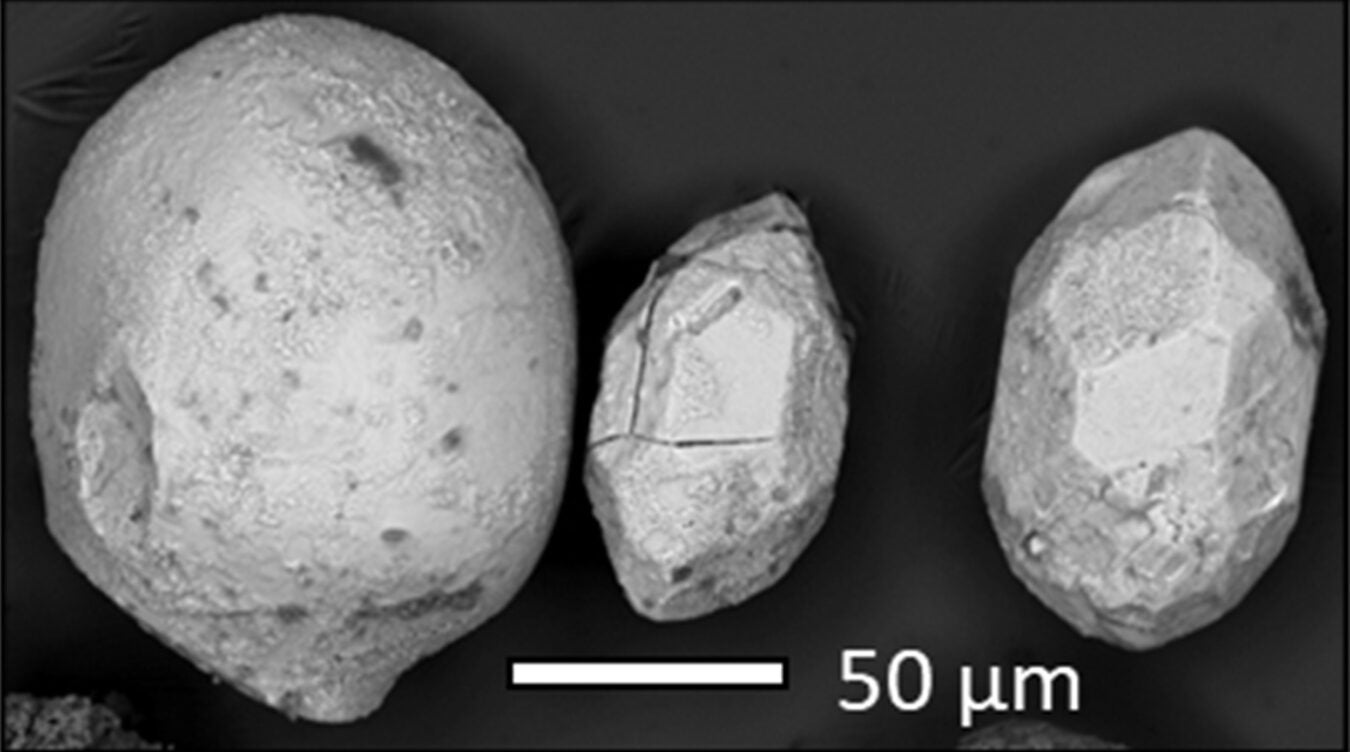
Three zircons researchers analyzed for the study

The three zircon crystals used in the study: the hafnium isotope, oxygen isotope, and trace element compositions. Zircons are like time capsules that retain chemical clues of the Earth’s first 500 million years.

The scientists saw that 3.8 billion years ago as the planet was cooling, a lot of new crust was suddenly being formed and that the geochemical signatures of zircons began to look like those generated in subduction zones, the places where two colliding tectonic plates meet and one slides under the other and into the mantle where it is recycled (code word for burned to a crisp).

The researchers say it’s not clear whether there were subduction zones 3.8 billion years ago, but what is known is that the new crust being formed was likely a result of some type of plate tectonics.

The study adds to growing research that tectonic movement occurred relatively early in Earth’s 4.5 billion-year history. It offers hints about how the planet became habitable and the conditions under which the earliest forms of life developed.

Today, the Earth’s outer shell consists of about 15 shifting blocks of crust, which hold the planet’s continents and oceans. The process was key to the evolution of life and the development of the planet because the process exposed new rocks to the atmosphere, which led to chemical reactions that stabilized Earth’s surface temperature over billions of years.

Evidence of when the change began is hard to come by because it’s so scarce. Only 5 percent of all rocks on Earth are older than 2.5 billion years old, and no rock is older than about 4 billion years.

This is where the zircons come in.

The team of researchers, which included geologists from Stanford and Louisiana State University, gathered 3,936 new zircons from a 2017 expedition in South Africa. Thirty-three of them were at least 4 billion years old. It was quite the haul, because zircons from that time period are difficult to find because of their size.

Researchers essentially have to get lucky after grinding down rocks they’ve collected into sand and separating the resulting finds. The South Africa zircons ranged from 4.1 billion to 3.3 billion years old. The team looked at three different geochemical features of the zircon crystals they found: the hafnium isotope, oxygen isotope, and trace element compositions. Each gave them a different piece of the puzzle.

For instance, the hafnium isotope offered hints about the formation and evolution of the Earth’s crust; the oxygen isotopes about whether there were oceans; and the trace elements about the composition of the crust. The data suggested that the rate of crust formation started picking up almost 4 billion years ago.

The researchers also looked at data from other studies on ancient zircons that have been found around the world to see whether there was evidence of a similar shift. They found it in the data on hafnium isotopes.

“All of them show this shift between 3.8 and 3.6 billion years ago,” Drabon said.

Drabon says there wasn’t much data on the other two geochemical features, and she hopes to focus on those next, including looking at when oceans started forming.

There’s so much to do, Drabon said. “I don’t even know where to start.”


Peter B. Kilian remembers leaving Logan Airport with Brittany Walsh in mid-February and having a single thought as he looked left and right at other drivers: “They don’t know our car is filled with piranhas.”

Known for their fearsome teeth and bloody B-movie feasts, the fish are illegal to own in Massachusetts. Kilian wasn’t aware of that when he decided that studying their predation behavior would be a “cool” project for the Bellono Lab, which investigates how molecular and cellular adaptations lead to unique behavioral functions in organisms.

But he didn’t let it stop him. And before too long, with the necessary local approvals and a piranha permit for the lab in hand, he and Walsh, a fellow research technician in the lab, found themselves scrambling on short notice to meet a freight plane at Logan. After they loaded multiple boxes containing 20 caribe piranha into Walsh’s Honda CR-V, it was time to plan the actual science.

Researchers will study the temperaments of two species native to the Amazon — caribe and red-bellied piranha, which the lab plans to add later this year. The group want to determine if one species is more aggressive than the other and if they can parse out this behavioral difference by looking at blood, hormone levels, and gene expression.

The work is just starting, but already, Kilian, who’s leading the research, can tell you that the fish aren’t as terrifying as their reputation.

“They’re not apex predators,” he said. “They’re not regularly hunting in packs taking down healthy large animals. They’re very skittish when we have to put our hands into the tanks. In terms of where they lie in the wild, they’re relatively low on the totem pole. They’re prey species.”

piranhas (

The fish usually range in size from 8 to 12 inches and rarely grow larger than 2 feet. They have saw-edged bellies, blunt heads, and razor-sharp teeth.

Kris Snibbe/Harvard Staff Photographer

Piranha predators include Amazon river dolphins, herons, and crocodile-like yacare caimans. The fish usually range in size from 8 to 12 inches and rarely grow larger than 2 feet. They have robust, narrow bodies, saw-edged bellies, blunt heads, and, of course, razor-sharp teeth. Despite the teeth, most piranha species are scavengers and some are even vegetarians. They have a preference for prey smaller or just slightly larger than they are.

The Bellono Lab’s work centers around feeding, specifically feeding frenzies, which is when the fish converge on a wounded animal and, well, feast. A frenzy involving hundreds of piranhas can reduce prey to bone in a matter of minutes.

Caribe piranha are thought to be more aggressive than their red-bellied counterparts. Kilian wants definitive proof. In experiments, he will be looking closely at how quickly the fish eat their prey, how many are involved in an attack, and how densely they group before making their initial strike.

The piranhas are fed a fatty, protein-rich fish called capelin. For regular feedings, researchers cut the frozen fish into small pieces and toss them into the tank. When they do behavior experiments, they thaw the whole fish and suspend it in the tank. Then they observe.

The piranha usually start with a few bites, targeting the eyes and tail to immobilize the capelin as if they were in the wild. This all looks pretty orderly and calm, if the piranha are well fed. When they are hungry, it quickly becomes a frenzy.

“What I’m interested in is if this group feeding happens because of social cues between the different fish or if there’s some sort of chemical signaling between the fish that cause it or if it’s purely a result of if they’re hungry,” Kilian said. “We’re hoping to be able to do some type of computer-aided tracking of the fish to really get at subtle differences in the frenzy in behavior.”

Besides the fact that she and Kilian are both animal lovers, this kind of project rewards the full-time effort of managing the logistics and animal care behind science, Walsh said.

“I have often thought about making a sign for the back of my car: Something like, ‘Please don’t tailgate me, I have splashing water in the back’ or ‘Fish Onboard.’”


As far as memos go, this one may go down as one of the most consequential of Amir Siraj’s career.

U.S. Space Command released a communication last month that confirmed earlier findings from Siraj ’22, a Harvard astrophysics concentrator, and Avi Loeb, Frank B. Baird Jr. Professor of Science, that a meteor from another solar system hit Earth in 2014.

“I’m not sure I’ve heard of many other scientific discoveries that have had to be confirmed by the U.S. Department of Defense, but that’s how this unusual story played out,” Siraj said.

The discovery predates Oumuamua, the oblong space rock that was until now considered the first-known interstellar meteor by three years.

Known as CNEOS 2014-01-08, the meteor measured only 1.5 feet wide and was hurtling toward Earth at about 45 kilometers per second, well over 100,000 mph, which is a clue that it’s not from this solar system. The meteor ignited into a fireball on Jan. 8, 2014, when it entered Earth’s atmosphere off the coast of Papua, New Guinea, with the energy equivalent to about 110 metric tons of TNT. It may have sprinkled fragments into the Pacific Ocean. CNEOS 2014-01-08 is now the third interstellar object that has been confirmed, along with Oumuamua and the comet 2I/Borisov.

The 2014 meteor was originally identified as an interstellar object by Siraj in 2019 when he and Loeb were studying Oumuamua. The pair posted their findings as a preprint and submitted their results to an astronomy journal, but the paper was not accepted for publication because they used data from a NASA database that used classified information that could not be verified.

The memo was signed by U.S. Space Force Lt. Gen. John Shaw and sent out in a tweet. It provides official verification of their findings. It states that Joel Mozer, chief scientist of Space Operations Command, reviewed the Siraj and Loeb’s analysis and confirmed the findings to NASA.

Siraj found the meteor as he combed through a database of fireballs kept by NASA’s Center for Near Earth Object Studies (CNEOS) on Loeb’s suggestion. He saw something that immediately grabbed his attention.

“It’s not that meteors of this size are unusual,” he said. “We actually get a couple dozen each year. But what was unusual about this meteor was that this object had a very high impact speed and the unusual direction at which it encountered our planet.”

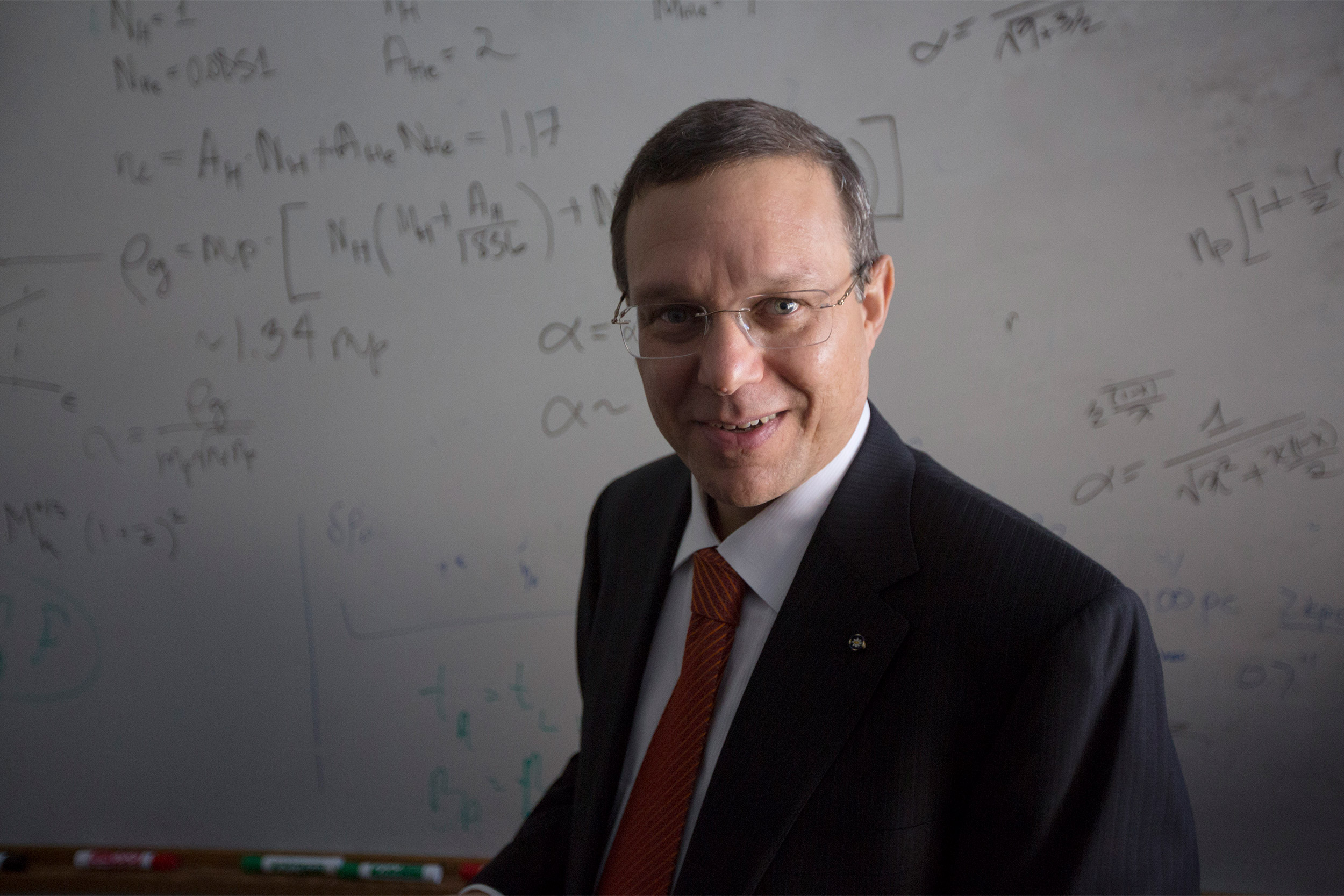
Abraham (Avi) Loeb.
Together, Amir Siraj and Professor Avi Loeb (pictured) worked through a bureaucratic logjam to receive government confirmation on their findings. Kris Snibbe/Harvard file photo

At Earth’s distance from the sun, any object moving faster than about 42 kilometers per second is too fast to be captured by the sun’s gravity, Siraj explained. Anything traveling over this speed limit likely comes from interstellar space because the gravity from our sun acts as a celestial speed bump to stop more local meteors from gaining that kind of speed. The 2014 meteor must have been ejected from another neighboring star and sent our way if it was traveling with such velocity.

Siraj and Loeb ran many calculations and found that the meteor had caught up to Earth from behind its orbit before entering the atmosphere and likely had a speed closer to 60 kilometers per second relative to the average velocity of nearby stars, or about 134,000 miles per hour at some point.

The problem that snarled the paper’s acceptance at peer review was that they couldn’t directly confirm the margin of error on the fireball’s velocity because the CNEOS database doesn’t have the information needed to confirm it.

The snag started a three-year process as Siraj and Loeb worked through a bureaucratic logjam to receive government confirmation on their findings, working with scientists and officials at NASA, Los Alamos National Laboratory, and other offices. They eventually connected with Matt Daniels, assistant director for space security at the White House’s Office of Science and Technology Policy, to get an analysis from Shaw and Mozer.

Siraj said the hard part is over, but there’s a lot more to do now, like getting the paper published in a peer-reviewed journal and doing follow-ups. For instance, the researchers are currently looking into an ocean expedition to search the ocean floor off the coast of Papua New Guinea for pieces of the 2014 meteor.

“If we were able to recover any fragments from this meteor, it would represent the first time that humanity has ever touched a rock from beyond our solar system,” Siraj said.


Building a plane while flying it isn’t typically a goal for most, but for a team of Harvard-led physicists that general idea might be a key to finally building large-scale quantum computers.

Described in a new paper in Nature, the research team, which includes collaborators from QuEra Computing, MIT, and the University of Innsbruck, developed a new approach for processing quantum information that allows them to dynamically change the layout of atoms in their system by moving and connecting them with each other in the midst of computation.

This ability to shuffle the qubits (the fundamental building blocks of quantum computers and the source of their massive processing power) during the computation process while preserving their quantum state dramatically expands processing capabilities and allows for self-correction of errors. Clearing this hurdle marks a major step toward building large-scale machines that leverage the bizarre characteristics of quantum mechanics and promise to bring about real-world breakthroughs in material science, communication technologies, finance, and many other fields.

“The reason why building large-scale quantum computers is hard is because eventually you have errors,” said Mikhail Lukin, the George Vasmer Leverett Professor of Physics, co-director of the Harvard Quantum Initiative, and one of the senior authors of the study. “One way to reduce these errors is to just make your qubits better and better, but another more systematic and ultimately practical way is to do something which is called quantum error correction. That means that even if you have some errors, you can correct these errors during your computation process with redundancy.”

The team developed a new method where any qubit can connect to any other qubit on demand. In this context, two atoms become linked and able to exchange information regardless of distance. This phenomenon is what makes quantum computers so powerful.

Credit: Lukin Group

In classical computing, error correction is done by simply copying information from a single binary digit or bit so it’s clear when and where it failed. For example, one single bit of 0 can be copied three times to read 000. When it suddenly reads 001, it’s clear where the error is and it can be corrected. A foundational limitation of quantum mechanics is that information can’t be copied, making error correction difficult.

The workaround the researchers implement creates a sort of backup system for the atoms and their information called a quantum error correction code. The researchers use their new technique to create many of these correction codes, including what’s known as a toric code, and it spreads them out throughout the system.

“The key idea is we want to take a single qubit of information and spread it as nonlocally as possible across many qubits, so that if any single one of these qubits fails it doesn’t actually affect the entire state that much,” said Dolev Bluvstein, a graduate student in the Physics Department from the Lukin group who led this work.

What makes this approach possible is that the team developed a new method where any qubit can connect to any other qubit on demand. This happens through entanglement or what Einstein called “spooky action at a distance.” In this context, two atoms become linked and able to exchange information no matter how far apart they are. This phenomenon is what makes quantum computers so powerful.

“This entanglement can store and process an exponentially large amount of information,” Bluvstein said.

The new work builds upon the programmable quantum simulator the lab has been developing since 2017. The researchers added new capabilities to it to allow them to move entangled atoms without losing their quantum state and while they are operating.

Previous research in quantum systems showed that once the computation process starts, the atoms, or qubits, are stuck in their positions and only interact with qubits nearby, limiting the kinds of quantum computations and simulations that can be done between them.

The key is that the researchers can create and store information in what are known as hyperfine qubits. The quantum state of these more robust qubits lasts significantly longer than regular qubits in their system (several seconds versus microseconds). It gives them the time they need to entangle them with other qubits, even far-away ones, so they can create complex states of entangled atoms.

The entire process looks like this: The researchers do an initial pairing of qubits, pulse a global laser from their system to create a quantum gate that entangles these pairs, and then stores the information of the pair in the hyperfine qubits. Then, using a two-dimensional array of individually focused laser beams called optical tweezers, they move these qubits into new pairs with other atoms in the system to entangle them as well. They repeat the steps in whatever pattern they want to create different kinds of quantum circuits to perform different algorithms. Eventually, the atoms all become connected in a so-called cluster state and are spread out enough to act as backups for each other in case of an error.

Already, Bluvstein and his colleagues have used this architecture to generate a programmable, error-correcting quantum computer operating at 24 qubits, and they plan to scale up from there. The system has become the basis for their vision of a quantum processor.

“In the very near term, we basically can start using this new method as a kind of sandbox where we will really start developing practical methods for error correction and exploring quantum algorithms,” Lukin said. “Right now [in terms of getting to large-scale, useful quantum computers], I would say we have climbed the mountain enough to see where the top is and can now actually see a path from where we are to the highest top.”

This work was supported by the Center for Ultracold Atoms, the National Science Foundation, the Vannevar Bush Faculty Fellowship, the U.S. Department of Energy Quantum Systems Accelerator, the Office of Naval Research, the Army Research Office MURI, and the DARPA ONISQ program.


MKRdezign

Contact Form

Name

Email *

Message *

Powered by Blogger.
Javascript DisablePlease Enable Javascript To See All Widget