Latest Post

Pharmaceutical giant Johnson & Johnson is partnering with the Biomedical Advanced Research and Development Authority of the U.S. Department of Health and Human Services to fund over $1 billion in COVID-19 vaccine and antiviral treatment research and development, the company said on Monday.

The partnership is an expansion of an existing agreement between BARDA and J&J’s Janssen Pharmaceutical Companies division.

With the agreement, the company is setting a goal of providing a global supply of more than one billion doses of the vaccine, which J&J expects to have in clinical trials by September 2020 at the latest. The first batches of the vaccine may be available for emergency use by early 2021, the company said.

BARDA’s partnership with J&J encompasses research and development of potential antiviral treatments in addition to the work that’s being done to develop a vaccine for the disease. Those efforts include development work J&J and BARDA are conducting with the Rega Institute for Medical Research in Belgium.

J&J said it had also committed to expanding its global manufacturing capacity, both in the U.S. and overseas. That additional production ability will help the company bring an affordable vaccine to the public on a not-for-profit basis for emergency pandemic use, the company said.

Working with teams at Beth Israel Deaconess Medical Center, a part of the Harvard Medical School, Janssen Pharmaceuticals began its research into potential vaccine candidates back in January. Those candidates were tested at several academic institutions, the company said, which led to the identification of a lead COVID-19 vaccine candidate — and two potential back-ups.

Last week, Moderna Health, another pharmaceutical company working on a vaccine, said that it could have an experimental treatment available to healthcare workers as soon as the fall.

The Moderna vaccine uses messenger RNA, rather than doses of the COVID-19 virus itself, to inoculate against the disease. The use of mRNA means that the inoculation doesn’t expose recipients to the disease itself, so they’re not at risk of contracting the disease.

Last Monday, Moderna made the vaccine available to volunteer participants as part of the company’s Phase 1 clinical trials conducted in Washington state.

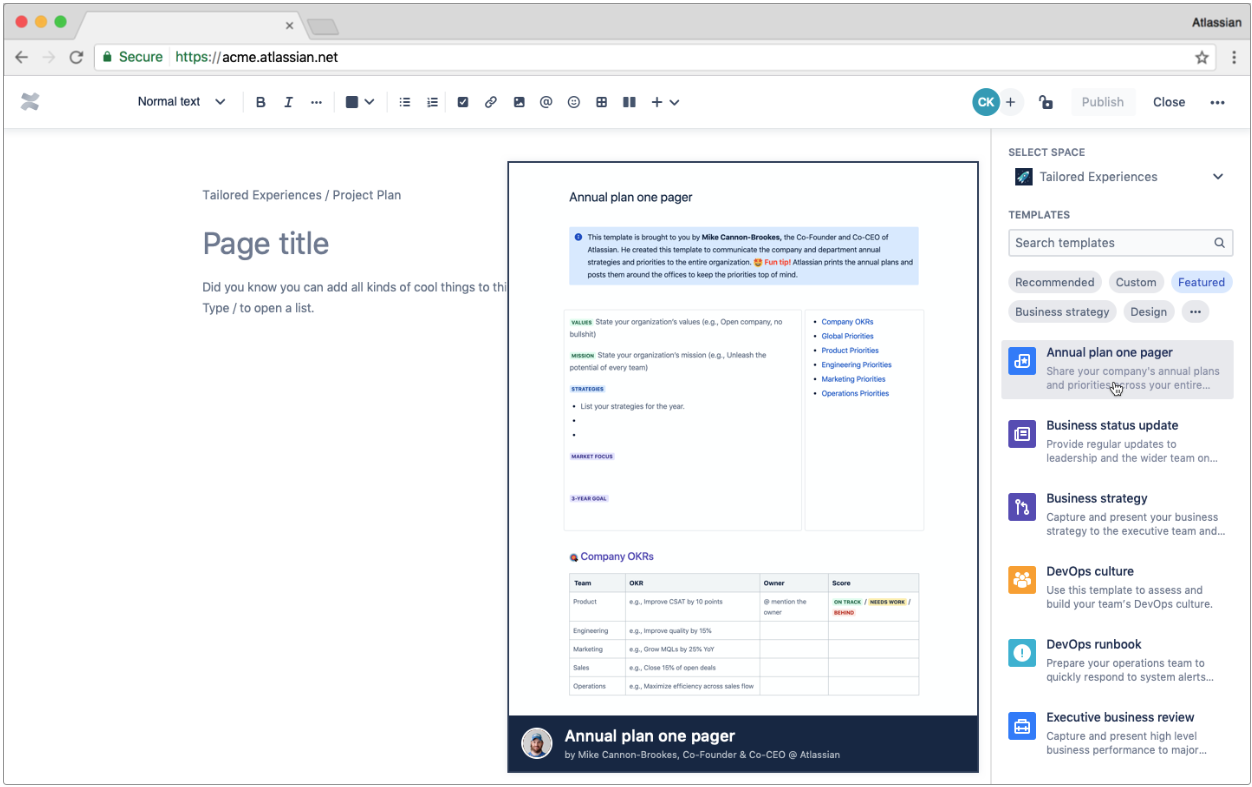

Confluence, Atlassian’s content-centric collaboration tool for teams, is making it easier for new users to get started with the launch of an updated template gallery and 75 new templates. They incorporate what the company has learned from its customers and partners since it first launched the service back in 2004.

About a year ago, Atlassian gave Confluence a major makeover, with an updated editor and advanced analytics. Today’s update isn’t quite as dramatic but goes to show that Confluence has evolved from a niche wiki for technical documentation teams to a tool that is often used across organizations today.

Today, about 60,000 customers are using Confluence daily and the new templates reflect the different needs of these companies. The new template gallery will make it easier to find the specific template that makes sense for your business, with new search tools, filters and previews that you can find in the right-hand panel of your Confluence site.

The updated gallery features new templates for design, marketing and HR teams, for example. Working with partners, Atlassian also added templates like a job description guide from Indeed and a design system template from InVision, as well as similar use case-specific templates from HubSpot, Optimizely and others. Since most tasks take more than one template, Atlassian is also launching collections of templates for accomplishing more complex tasks around developing marketing strategies, HR workflows, product development and more.


Ixigo, a 13-year-old travel and hotel booking service in India, said on Monday it is cutting the salary of its entire staff as the firm grapples with severe disruption in its business due to the coronavirus outbreak that has pushed New Delhi to issue a nationwide lockdown.

Aloke Bajpai, co-founder and chief executive of Ixigo, said the leadership at the firm has agreed to take a 60% pay cut while the rest of the staff, about 200 people, have agreed to have their salaries reduced between 20% to 50%. Bajpai and Rajnish Kumar, the other co-founder, have decided to forgo their entire salary until the business is back on track.

“We will reinstate the salaries as soon as the situation improves and we will also convert the accumulated salary deductions over the hardship period into equivalent ESOPs so that everyone benefits from future upside when the going gets better again,” said Bajpai.

The Indian government suspended all domestic flights and other public transportation services earlier this month and ordered a complete lockdown for three weeks to its 1.3 billion people in a bid to contain the spread of the coronavirus disease in the country.

Verteran industry executive Bajpai said the current situation is “the darkest hour for travel.” And it has hit the company at a time when it had just turned EBIDTA positive in the first two months of 2020.

Bajpai said Ixigo’s revenue surged by almost 50% in 2019 and burn rate dropped by almost 85% in the same year. The pay cut has enabled the company to not let go of any individual, he said.

“What the travel industry (and indeed any industry in our nation) faces today is no less than a war. India and the entire world are facing a catastrophe imposed by a microscopic adversary that has forced us to be confined to our homes, taken away our freedom to socialize with others, to roam and travel freely and forced us to give up all those things that help us experience the world and make us more human,” he said.

MakeMyTrip, another travel and stay booking service, announced last week that it was also cutting the salary of its top management level across the company, which includes flight ticketing service Goibibo and bus ticketing service redBus.

Indian news outlet Entrackr reported last week that MakeMyTrip may fire as many as 400 people if the business remains disruptive for long.


Another tech unicorn is feeling the pinch of doing business during the coronavirus pandemic. Today, Kabbage, the Softbank-backed lending startup that uses machine learning to provide speedy and more accurate evaluations of loan applications for small and medium businesses, is furloughing a “significant number” of its US team of 500 employees, according to a memo sent to staff and seen by TechCrunch, in the wake of drastically changed business conditions for the company. It is also completely closing down its office in Bangalore, India, and executive staff is taking a “considerable” pay cut.

The announcement is effective immediately and was made to staff earlier today by way of a video conference call, as the whole company is currently remote working in the current conditions.

Kabbage is not disclosing the full number of staff that are being affected by the news (if you know, you can contact us anonymously). It’s also not putting a timeframe on how long the furlough will last, but it’s going to continue providing benefits to affected employees. The intention is to bring them back on when things shift again.

“We realize this is a shock to everyone. No business in the world could have prepared for what has transpired these past few weeks and everyone has been impacted,” co-founder and CEO Rob Frohwein wrote in the memo. “The economic fallout of this virus has rattled the small business community to which Kabbage is directly linked. It’s painful to say goodbye to our friends and colleagues in Bangalore and to furlough a number of U.S. team members. While the duration of the furlough remains uncertain, please bear in mind that the full intention of furloughing is temporary. We simply have no clear idea of how long quarantining or its reverberations in the economy will last.”

Kabbage’s predicament underscores the complicated and stressful calculus that tech companies built around providing services to SMBs, or fintech (or both, as in the case of Kabbage) are currently facing.

SMBs are struggling right now in the US: many operate on very short terms when it comes to finances and closing their businesses (or seeing a drastic reduction in custom) means they will not have the cash to last 10 days without revenue, “and we’re already well past that window,” Frohwein noted in his memo.

In Kabbage’s case, that means not only are SMBs not able to be evaluated and approved for normal loans at the moment, but SMBs that already have loans out are likely facing delinquencies.

The decision to furlough is hard but in relative terms it’s actually good news: it was made at the eleventh hour after a period when Kabbage was considering layoffs instead.

The company has raised hundreds of millions of dollars in equity and debt, and it was in a healthy state before the coronavirus outbreak. The memo notes that the “board and our top investors are aware of the challenges we are facing and have committed to helping us through this period,” although it doesn’t specify what that means in terms of financial support for the business, and whether that support would have been there for the business as-is.

The shift to furlough from layoffs came in the wake of announcement yesterday by Steven Mnuchin, the US Secretary of the Treasury, who clarified that “any FDIC bank, any credit union, any fintech lender will be authorized” to make loans to small businesses as a part of the US government’s CARE Act, the giant stimulus package that included nearly $350 billion in loan guarantees for small businesses.

While that provides much-needed relief for these businesses, the implementation of it — the Small Business Administration has already received nearly 1 million claims for disaster-relief loans since the crisis started — has been and is going to be a challenge.

That effectively opens up an opportunity for Kabbage and companies like it to revive and reorient some of its business. Kabbage said it is in “deep discussions” with the Treasury Department, the White House, and the Small Business Administration to help expedite applications for aid.

While loans still make up the majority of Kabbage’s business, the company has been making a move to diversify its services, and in recent times it has made acquisitions and launched new services around market intelligence insights and payments services. While there has certainly been a jump in e-commerce, overall the tightening economy will have a chilling effect on the wider market, and it will be worth seeing what happens with other companies that focus on loans, as well as adjacent financial services.


Work-from-home policies, social distancing, and government lockdowns have increased the demand for video conferencing apps, for both business and personal use. According to a new report from App Annie, out on Monday, business conferencing apps have been experiencing record growth, as a result, and just hit their biggest week ever in March, when they topped 62 million downloads during the week of March 14-21. Meanwhile, social networking video app Houseparty has also seen phenomenal growth in Europe during lockdowns and home quarantines.

While such growth was to be expected, App Annie’s report provides real-world context about just how many new customers these apps are gaining during this time.

For example, the jump in business app downloads to 62 million across iOS and Google Play earlier in March, was up 45% from just the prior week. It was also the highest growth among any category across the app stores that week, the report said. And it was up 90% from the weekly average of business app downloads in 2019.

Much of the growth in the category is due to the increased adoption of apps like Google’s Hangouts Meet, Microsoft Teams, and Zoom Cloud Meetings.

Zoom topped the charts worldwide in February and March, and continues to see high numbers of downloads in the U.S., U.K., and elsewhere in Europe.

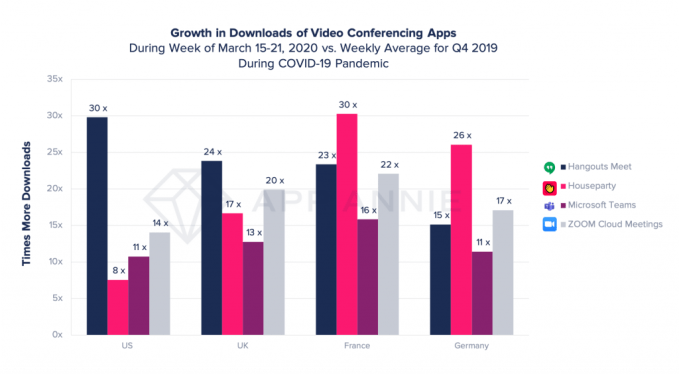
During the record week of downloads, Zoom was downloaded 14 times more than the weekly average during the fourth quarter of 2019 in the U.S. It was also downloaded more than 20 times Q4’s weekly average in the U.K., 22 times more in France, 17 times more in Germany, 27 times more in Spain, and an even larger 55 times more in Italy.

A related report from the app store intelligence firm Sensor Tower saw Zoom’s U.S. downloads somewhat higher in mid-March, but noted that the term “Zoom” wasn’t a top 100 search term in the U.S. App Store before the week of March 9. That meant many new users were being sent the app’s installation page directly — such as via a link shared in a work email, calendar invite, or an intranet site, perhaps.

At the same time in March, Google’s Hangouts Meet was seeing strong downloads in the U.K., U.S., Spain, and Italy, in particular, with 24x, 30x, 64x, and 140x the average weekly downloads in Q4, respectively.

Microsoft Teams saw significant — though not quite as strong — growth in Spain, France, and Italy, at 15x, 16x, and 30x the weekly levels of downloads in Q4, respectively.

In terms of consumer apps, social video conferencing app Houseparty, popular among Gen Z, has been rapidly growing in Europe and elsewhere. The app benefits from network effects — meaning as more friends and family join Houseparty, the app becomes more useful. It then gets launched and used more often, too. In Italy, the week ending on March 21 saw Houseparty downloads surge at 423 times the average weekly number of downloads in Q4 2019.

In Spain, Houseparty skyrocketed with 2360 times the number of downloads in the week ending March 21, compared with Q4. Also notable is that Spain was a market where, before, Houseparty didn’t have any wide-scale penetration. Because of the COVID-19 outbreak, it now has a base in a region where it otherwise may have never reached.

Unlike the business conferencing apps, Houseparty aims to make video chat a more personal and social experience. When you launch the app, it shows you’re free to talk and whose else is online — similar to other messaging apps. But there are also live parties to join and in-app games to play, which signals the app is not meant for your virtual office meetings.

Business apps aren’t the only ones booming at this time, of course.

Educational apps, including Google Classroom and ABCmouse, have also spiked in March as have grocery delivery apps, like Instacart.

“As people face uncertain timelines for the length of social isolation, video conferencing apps have the potential to vastly influence our daily habits — breaking down geological barriers and fostering the ability to work and socialize relatively seamlessly,” noted App Annie, in its report. “It is an unprecedented time for the world and an incredibly dynamic time for mobile — we are seeing shifts in consumer behavior surface daily across virtually every sector,” the firm concluded.


The U.S. Space Force is a relatively young arm of the U.S. armed forces, but that doesn’t mean it isn’t already operating assets. The USSF announced late last week that its Space Fence radar system is now officially operational, for instance. First: Yes it is actually called that. Second, the Space Fence is actually a radar system that aims to provide advanced tracking of on-orbit objects, including, but not limited to, commercial and military satellites.

The Space Fence ground infrastructure is located in the Marshall Islands, and currently, in the “initial operational capability and operational acceptance” phase, the program will track the existing 26,000 orbital objects already accounted for in the existing Space Surveillance Network (SSN), but Space Force said via an update on the new operational phase that it expects to grow that list quickly with its own additions.

To support detailed tracking of objects in this orbital range, the radar observation technology developed by Lockheed Martin on behalf of Space Force can pick up items roughly the size of a marble in low Earth orbit. With that level of fine-grained observational power, it seems pretty likely that eventually the catalog should contain just about every active and passive potential observation, communication and potentially militarized in-space assets operated by just about anyone.

Knowing the terrain is a key part of any military operation’s ability to succeed, so officially brining the Space Fence online marks a big milestone for the Space Force. It also recently launched its first dedicated payload: A high-frequency secure communication satellite to join an existing constellation in space that provides communication services for military operations on Earth on land, at sea and in the air.


The FDA approves a new procedure that could allow healthcare workers to reuse N95 respirator masks, Microsoft divests from a facial recognition startup and Saudi spies have been taking advantage of a network security flaw. Here’s your Daily Crunch for March 30, 2020.

1. FDA grants emergency authorization to system that decontaminates N95 respirator masks for reuse

Research, development and lab management company Battelle has received special emergency authorization from the U.S. healthcare regulator to put into use a system it developed to decontaminate used N95 respirator masks using concentrated hydrogen peroxide.

The system is able to turn single use respirators into masks that can be used up to 20 times, with a 2.5-hour decontamination process between each use. And it’s already in operation at Battelle’s Ohio facility, with a decontamination capacity of up to 80,000 masks per day.

2. Divesting from one facial recognition startup, Microsoft ends outside investments in the tech

Microsoft’s decision to withdraw its investment from AnyVision, an Israeli company developing facial recognition software, came as a result of an investigation into reports that AnyVision’s technology was being used by the Israeli government to surveil residents in the West Bank.

3. Saudi spies tracked phones using flaws the FCC failed to fix for years

Lawmakers and security experts have long warned of security flaws in the underbelly of the world’s cell networks. Now a whistleblower says the Saudi government is exploiting those flaws to track its citizens across the U.S. as part of a “systematic” surveillance campaign.

4. Test and trace with Apple and Google

Jon Evans looks at what Apple and Google can learn from Singapore, where they use a “TraceTogether” app. The app uses Bluetooth to track nearby phones (without location tracking), keeps local logs of those contacts, and only uploads them to the Ministry of Health when the user chooses to do — presumably after a diagnosis — so those contacts can be alerted.

5. Attract, engage and retain employees in the new remote-work era

Having the right technology in place to sustain work-from-home practices is more important now than ever before. There are four steps that employers can take to successfully integrate and adapt successful virtual hiring technologies into their business continuity plans. (Extra Crunch membership required.)

6. Online tutoring marketplace Preply banks $10M to fuel growth in North America, Europe

The startup said it has seen a record number of daily hours booked on its platform this past week. It also reports a spike in the number of tutors registering in markets including the U.S., U.K., Germany, France, Italy and Spain — which are among the regions where schools have been closed as a coronavirus response measure.

7. This week’s TechCrunch podcasts

The latest full-length Equity episode discusses Stripe’s investment into login/checkout startup Fast, while the Monday news recap covers three funding rounds and a downturn. Meanwhile, Original Content reviews Hulu’s star-studded “Little Fires Everywhere” and the bonkers Netflix documentary “Tiger King.”

The Daily Crunch is TechCrunch’s roundup of our biggest and most important stories. If you’d like to get this delivered to your inbox every day at around 9am Pacific, you can subscribe here.


MKRdezign

Contact Form

Name

Email *

Message *

Powered by Blogger.
Javascript DisablePlease Enable Javascript To See All Widget