Latest Post

Uber has reportedly made an offer to buy food delivery service Postmates, according to The New York Times.

According to the Times, the talks are still ongoing and the deal could fall through.

For those that have been paying attention to Uber, this appetite is not new, albeit consistent. A little over a month ago, the ride-hailing company was reportedly pursuing an acquisition of Grubhub,  another food delivery company. Grubhub was ultimately acquired by Just Eat Takeaway in a $7.3 billion deal, but only after the deal with Uber fell through over a variety of concerns.

Food delivery market has set to benefit largely from the COVID-19 pandemic, as stores remain shuttered or switch operations to takeout only. Latest earnings from the public ride-hailing company show that its ride-hailing business is slowing while its food delivery service is growing like hell. Gross bookings for Uber Eats last quarter were $4.68 billion.

So even though Uber still loses a ton of money ($2.94 billion including all costs), its Uber Eats growth is staggering. And the green shoots might be fueling some of this interest in other competitors.

Sources close to Uber told TechCrunch that regulatory concerns scuttled the company’s bid for GrubHub, but its chief executive later said the JustEat deal was better.

If regulatory concerns were an issue, Postmates may make a better fit.

With a valuation of $2.4 billion, Postmates is significantly smaller than Grubhub. And while the company filed to go public nearly 16 months ago, it held off eventually citing “choppy market” conditions.

So if Uber Eats and Postmates combined, the result would still be smaller than Doordash’s market hold, but would be competitive nonetheless. DoorDash, last valued at $13 billion, confidentially filed for an IPO nearly four months ago. 

Also, Postmates delivers more than just food.

If the merger goes through, the food delivery race would get refueled in an interesting way: Uber Eats and Postmates versus Grubhub and Takeaway versus DoorDash .

Postmates declined to comment on rumors or speculation. Uber did not immediately respond to a request for comment.



The United States government began measures today to end its special status with Hong Kong, one month after Secretary of State Michael Pompeo told Congress that Hong Kong should no longer be considered autonomous from China. The new actions include suspending export license exceptions for sensitive U.S. technology and ending the export of defense equipment to Hong Kong. Both the Commerce and State Departments also said further restrictions are being evaluated.

The U.S. government’s announcements were made a few hours before news broke that China had passed a new national security law that will give it greater control over Hong Kong. It is expected to take effect on July 1, according to the South China Morning Post.

The term “special status” refers to arrangements that recognized the difference between Hong Kong and mainland China under the “one country, two systems” policy put into place when the United Kingdom handed control of Hong Kong back to Beijing in 1997. These included different export controls, immigration policies and lower tariffs. But that preferential treatment was put into jeopardy after China proposed the new national security law, which many Hong Kong residents fear will end the region’s judicial independence from Beijing.

The U.S Commerce Department and State Department issued separate statements today detailing the new restrictions on Hong Kong. Secretary of Commerce Wilbur Ross said the Commerce Department will suspend export license exceptions for sensitive U.S. technology, and that “further actions to eliminate differential treatment are also being evaluated.”

The State Department said that it will end exports of U.S. defense equipment and also “take steps toward imposing the same restrictions on U.S. defense and dual-use technologies to Hong Kong as it does for China.”

In a statement to Reuters, Kurt Tong, a former U.S. consul general in Hong Kong, said that the U.S. government’s decisions today would not impact a large amount of trade between the U.S. and Hong Kong because the territory is not a major manufacturing center and its economy is mostly services.

According to figures from the Office of the United States Trade Representative, Hong Kong accounted for 2.2% of overall U.S. exports in 2018, totaling $37.3 billion, with the top export categories being electrical machinery, precious metal and stones, art and antiques, and beef. But the new restrictions could make more difficult for U.S. semiconductor and other technology companies to do business with Hong Kong clients.

Other restrictions proposed by the United States including ending its extradition treaty with Hong Kong.

Both the State and Commerce departments said that the restrictions were put into place for national security reasons. “We can no longer distinguish between the export of controlled items to Hong Kong or to mainland China,” Pompeo wrote. “We cannot risk these items falling into the hands of the People’s Liberation Army, whose primary purpose is to uphold the dictatorship of the CCP by any means necessary.”

In his statement, Ross said, “With the Chinese Communist Party’s imposition of new security measures on Hong Kong, the risk that sensitive U.S. technology will be diverted to the People’s Liberation Army or Ministry of State Security has increased, all while undermining the territory’s autonomy.”


Despite the Wirecard fallout, German fintech startup solarisBank has raised a Series C funding round of $67.5 million (€60 million). Following today’s funding round, solarisBank is now valued at $360 million (€320 million). solarisBank doesn't have any consumer product directly. Instead, it offers financial services to other fintech companies through a set of APIs.

With solarisBank, you can build a fintech startup and leverage solarisBank’s line of products to do the heavy lifting. It’s an infrastructure company in the banking space.

While solarisBank might not be a familiar name, some of its clients have become quite popular. They include challenger banks, such as Tomorrow, Insha and a newcomer called Vivid, business banking startups, such as Penta and Kontist, trading app Trade Republic, cryptocurrency startups Bison and Bitwala, etc.

Overall, solarisBank works with 70 companies that have attracted 400,000 clients in total.

HV Holtzbrinck Ventures is leading the round with existing investor yabeo committing a substantial follow-on investment. Other new investors include Vulcan Capital, Samsung Catalyst Fund and Storm Ventures. Existing investors BBVA, SBI Group, ABN AMRO Ventures, Global Brain, Hegus and Lakestar are investing again.

The company started the fundraising process back in December. Due to the economic prospects, it has been a mixed process. “A lot of investors looked at their portfolio companies and the appetite to look at something new was not there,” solarisBank CEO Roland Folz told me. But everything worked out eventually as around half of the funding comes from existing investors.

“We originally were looking for €40 million but we were overwhelmed by the interest of investors in spite of Covid,” solarisBank Head of Strategy and Shareholder Relations Layla Qassim told me.

solarisBank’s vision could be summed up in two words — regulation and modularity. The company is a fully licensed bank, which means that its clients don’t have to apply to a banking license themselves.

And the startup lets you pick the modules that you want to use for your product. Maybe you’re building a mobile cryptocurrency wallet and you just want to be able to give an IBAN and a debit card to your users. Maybe you’re building a used car marketplace like CarNext and you want to offer credit. Maybe you want to build a challenger bank but address a specific vertical.

With solarisBank, you can open bank accounts and issue payment cards attached to those accounts. You can also issue cards and attach them to a different account in case you’re integrating with existing bank accounts. The startup also offers various services around payments, vouchers, cross-border transactions and more.

More recently, the company launched a new feature called Splitpay with American Express. When customers check out on an e-commerce platform in Germany, American Express customers will be able to choose a repayment plan to pay over multiple months.

solarisBank generates revenue from its clients as they pay to use the company’s APIs and enable accounts and cards. solarisBank also collects the interchange fees on card transactions and share revenue with its clients. Similarly, solarisBank can offer to share revenue on credit interests with its clients.

In the future, solarisBank plans to make its portfolio of financial services even more compelling by introducing local IBANs in the most important European markets. It should make it easier to convince potential clients outside of Germany to use solarisBank as their banking infrastructure.


Facebook takes (small) steps to improve its content policies as advertisers join a broad boycott, founder Alexis Ohanian is leaving Initialized Capital and Waze gets a new look.

Here’s your Daily Crunch for June 29, 2020.

1. As advertisers revolt, Facebook commits to flagging ‘newsworthy’ political speech that violates policy

In a live-streamed segment of the company’s weekly all-hands meeting, CEO Mark Zuckerberg announced new measures to fight voter suppression and misinformation. At the heart of the policy changes is an admission that the company will continue to allow politicians and public figures to disseminate hate speech that does, in fact, violate Facebook’s own guidelines — but it will add a label to denote they’re remaining on the platform because of their “newsworthy” nature.

This announcement comes as advertiser momentum against the social network’s content and monetization policies continues to grow, with Unilever and Verizon (which owns TechCrunch) both committing to pull advertising from Facebook.

2. Alexis Ohanian is leaving Initialized Capital

Ohanian is leaving Initialized Capital to work on “a new project that will support a generation of founders in tech and beyond,” the firm said in a statement to TechCrunch. According to Axios, Ohanian is leaving Initialized to work more closely on pre-seed efforts.

3. Waze gets a big visual update with a focus on driver emotions

The new look is much more colorful, and also foregrounds the ability for individual drivers to share their current emotions with Moods, a set of user-selectable icons (with an initial group of 30) that can reflect how you’re feeling as you’re driving.

4. Amazon warehouse workers strike in Germany over COVID-19 conditions

Amazon warehouse workers in Germany are striking for 48 hours this week, to protest conditions that have led to COVID-19 infections among fellow employees. Strikes began today at six warehouses and are set to continue through the end of day Tuesday.

5. Four views: How will the work visa ban affect tech and which changes will last?

Normally, the government would process tens of thousands of visa applications and renewals in October at the start of its fiscal year, but President Trump’s executive order all but guarantees new visas won’t be granted until 2021. Four TechCrunch staffers analyzed the president’s move in an attempt to see what it portends for the tech industry, the U.S. economy and our national image. (Extra Crunch membership required.)

6. Apple began work on the Watch’s handwashing feature years before COVID-19

Unlike other rush initiatives undertaken by the company once the virus hit, however, the forthcoming Apple Watch handwashing app wasn’t built overnight. The feature was the result of “years of work,” VP of Technology Kevin Lynch told TechCrunch.

7. This week’s TechCrunch podcasts

The latest full-length Equity episode discusses new funding rounds for Away and Sonder, while the Monday news roundup has the latest on the Rothenberg VC Scandal. And Original Content has a review of the second season of “The Politician” on Netflix.

The Daily Crunch is TechCrunch’s roundup of our biggest and most important stories. If you’d like to get this delivered to your inbox every day at around 9am Pacific, you can subscribe here.


A new paper published by Disney Research in partnership with ETH Zurich describes a fully automated, neural network-based method for swapping faces in photos and videos – the first such method that results in high-resolution, megapixel resolution final results according to the researchers. That could make it suited for use in film and TV, where high resolution results are key to ensuring that the final product is good enough to reliably convince viewers as to their reality.

The researchers specifically intend this tech for use in replacing an existing actor’s performance with a substitute actor’s face, for instance when de-aging or increasing the age of someone, or potentially when portraying an actor who has passed away. They also suggest it could be used for replacing the faces of stunt doubles in cases where the conditions of a scene call for them to be used.

This new method is unique from other approaches in a number of ways, including that any face used in the set can be swapped with any recorded performance, making it possible to relatively easily re-image the actors on demand. The other is that it kindles contrast- and light conditions in a compositing step to ensure the actor looks like they were actually present in the same conditions as the scene.

You can check out the results for yourself in the video below (as the researchers point out, the effect is actually much better in moving video than in still images). There’s still a hint of ‘uncanny valley’ effect going on here, but the researchers also acknowledge that, calling this “a major step toward photo-realistic face swapping that can successfully bridge the uncanny valley” in their paper. Basically it’s a lot less nightmare fuel than other attempts I’ve seen, especially when you’ve seen the side-by-side comparisons with other techniques in the sample video. And, most notably, it works at much higher resolution, which is key for actual entertainment industry use.

The examples presented are a super small sample, so it remains to be seen how broadly this can be applied. The subjects used appear to be primarily white, for instance. Also, there’s always the question of the ethical implication of any use of face-swapping technology, especially in video, since it could be used to fabricate credible video or photographic ‘evidence’ of something that didn’t actually happen.

Given, however, that the technology is now in development from multiple quarters, it’s essentially long past the time for debate about the ethics of its development and exploration. Instead, it’s welcome that organizations like Disney Research are following the academic path and sharing the results of their work, so that others concerned about its potential malicious use can determine ways to flag, identify and protect against any bad actors.


Since World War I, the vast majority of American combat casualties has come not from gunshot wounds but from explosions. Today, most soldiers wear a heavy, bullet-proof vest to protect their torso but much of their body remains exposed to the indiscriminate aim of explosive fragments and shrapnel.

Designing equipment to protect extremities against the extreme temperatures and deadly projectiles that accompany an explosion has been difficult because of a fundamental property of materials. Materials that are strong enough to protect against ballistic threats can’t protect against extreme temperatures and vice versa. As a result, much of today’s protective equipment is composed of multiple layers of different materials, leading to bulky, heavy gear that, if worn on the arms and legs, would severely limit a soldier’s mobility.

Now, Harvard University researchers, in collaboration with the U.S. Army Combat Capabilities Development Command Soldier Center (CCDC SC) and West Point, have developed a lightweight, multifunctional nanofiber material that can protect wearers from both extreme temperatures and ballistic threats.

The research is published in the journal Matter.

“When I was in combat in Afghanistan, I saw firsthand how body armor could save lives,” said senior author Kit Parker, the Tarr Family Professor of Bioengineering and Applied Physics at the Harvard John A. Paulson School of Engineering and Applied Sciences (SEAS) and a lieutenant colonel in the United States Army Reserve. “I also saw how heavy body armor could limit mobility. As soldiers on the battlefield, the three primary tasks are to move, shoot, and communicate. If you limit one of those, you decrease survivability and you endanger mission success.”

“Our goal was to design a multifunctional material that could protect someone working in an extreme environment, such as an astronaut, firefighter or soldier, from the many different threats they face,” said Grant M. Gonzalez, a postdoctoral fellow at SEAS and first author of the paper.

Flame testing with just Twaron between a flame torch and a gelatin astronaut model.

In order to achieve this practical goal, the researchers needed to explore the trade-off between mechanical protection and thermal insulation, properties rooted in a material’s molecular structure and orientation.

Materials with strong mechanical protection, such as metals and ceramics, have a highly ordered and aligned molecular structure. This structure allows them to withstand and distribute the energy of a direct blow. Insulating materials, on the other hand, have a much less ordered structure, which prevents the transmission of heat through the material.

Kevlar and Twaron are commercial products used extensively in protective equipment and can provide either ballistic or thermal protection, depending on how they are manufactured. Woven Kevlar, for example, has a highly aligned crystalline structure and is used in protective bulletproof vests. Porous Kevlar aerogels, on the other hand, have been shown to have high thermal insulation.

“Our idea was to use this Kevlar polymer to combine the woven, ordered structure of fibers with the porosity of aerogels to make long, continuous fibers with porous spacing in between,” said Gonzalez. “In this system, the long fibers could resist a mechanical impact while the pores would limit heat diffusion.”

The research team used immersion Rotary Jet-Spinning (iRJS), a technique developed by Parker’s Disease Biophysics Group, to manufacture the fibers. In this technique, a liquid polymer solution is loaded into a reservoir and pushed out through a tiny opening by centrifugal force as the device spins. When the polymer solution shoots out of the reservoir, it first passes through an area of open air, where the polymers elongate and the chains align. Then the solution hits a liquid bath that removes the solvent and precipitates the polymers to form solid fibers. Since the bath is also spinning — like water in a salad spinner — the nanofibers follow the stream of the vortex and wrap around a rotating collector at the base of the device.

Para-aramid nanofiber sheets atop Twaron sheets.
Para-aramid nanofibers.

Para-aramid nanofiber sheets atop Twaron sheets after fragment simulation projectile testing. Para-aramid nanofibers provide mechanical strength with void or empty space limit heat diffusion.

By tuning the viscosity of the liquid polymer solution, the researchers were able to spin long, aligned nanofibers into porous sheets — providing enough order to protect against projectiles but enough disorder to protect against heat. In about 10 minutes, the team could spin sheets about 10 by 30 centimeters in size.

To test the sheets, the Harvard team turned to their collaborators to perform ballistic tests. Researchers at CCDC SC in Natick, Mass., simulated shrapnel impact by shooting large, BB-like projectiles at the sample. The team performed tests by sandwiching the nanofiber sheets between sheets of woven Twaron. They observed little difference in protection between a stack of all woven Twaron sheets and a combined stack of woven Twaron and spun nanofibers.

“The capabilities of the CCDC SC allow us to quantify the successes of our fibers from the perspective of protective equipment for warfighters, specifically,” said Gonzalez.

“Academic collaborations, especially those with distinguished local universities such as Harvard, provide CCDC SC the opportunity to leverage cutting-edge expertise and facilities to augment our own R&D capabilities,” said Kathleen Swana, a researcher at CCDC SC and one of the paper’s authors. “CCDC SC, in return, provides valuable scientific and soldier-centric expertise and testing capabilities to help drive the research forward.”

In testing for thermal protection, the researchers found that the nanofibers provided 20 times the heat insulation capability of commercial Twaron and Kevlar.

“While there are improvements that could be made, we have pushed the boundaries of what’s possible and started moving the field towards this kind of multifunctional material,” said Gonzalez.

“We’ve shown that you can develop highly protective textiles for people that work in harm’s way,” said Parker. “Our challenge now is to evolve the scientific advances to innovative products for my brothers and sisters in arms.”

Harvard’s Office of Technology Development has filed a patent application for the technology and is actively seeking commercialization opportunities.

This paper was co-authored by Janet Ward, John Song , Kathleen Swana, Stephen A. Fossey, Jesse L. Palmer, Felita W. Zhang, Veronica M. Lucian, Luca Cera,  John F. Zimmerman and F. John Burpo.

The research was supported by the Harvard Materials Research Science and Engineering Center under the National Science Foundation Award Number DMR-1420570.


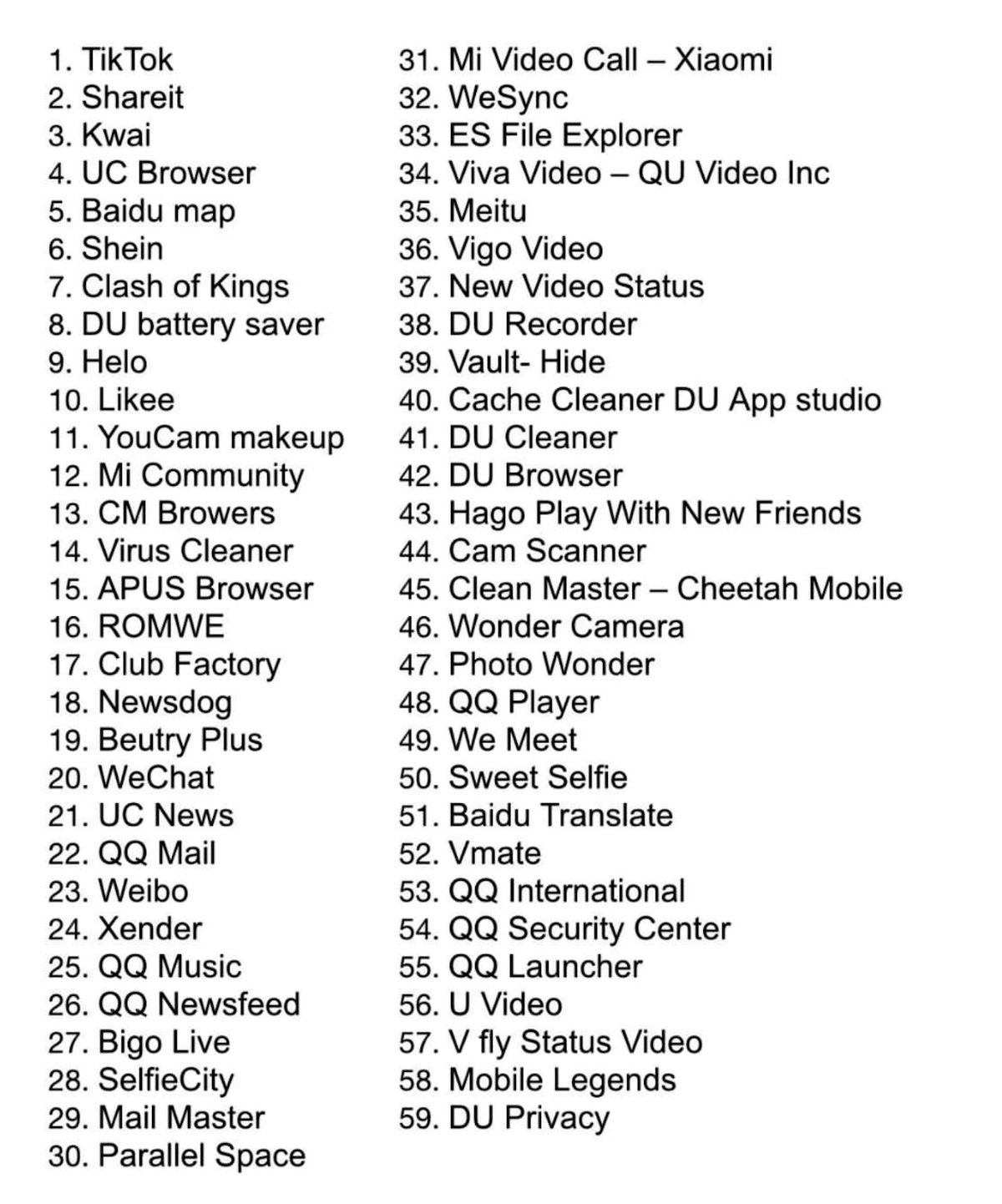
The Indian government on Monday evening said it was banning 59 apps developed by Chinese firms over concerns that these apps were “engaged in activities which is prejudicial to sovereignty and integrity of India, defence of India, and security of state and public order” in what is the latest standoff between the two most populated nations in the world.

ByteDance’s TikTok, which counts India as its biggest market, Community and Video Call apps from Xiaomi, which is the top smartphone vendor in India, UC Browser, UC News, Shareit, CM Browser, Club Factory, ES File Explorer are among the 59 apps that India’s Ministry of Electronics and IT have ordered to ban.

“The Computer Emergency Response Team (CERT-IN) has also received many representations from citizens regarding security of data and breach of privacy impacting upon public order issues,” the Indian government agency said.

The apps India is banning

All of the aforementioned apps are currently live on Google Play Store and Apple’s App Store in India.

More to follow…


MKRdezign

Contact Form

Name

Email *

Message *

Powered by Blogger.
Javascript DisablePlease Enable Javascript To See All Widget