Latest Post

Twitch announced today that it will add new channel-level security features to help curb harassment on the platform. Now, creators and moderators can enable verified chat, requiring chatters to validate their phone and/or email before they can send messages. These settings can be toggled to enable verified chat for all accounts, first-time chatters, those under a certain account age or ones that haven’t been following the streamer for a chosen amount of time. These settings will be turned off by default until the channel opts in, and there are also settings to ensure that VIPs, subscribers and moderators can bypass verification. Unlike two-factor authentication, a user only needs to verify their phone or email once before they’re considered verified across all channels.

Twitch users can link up to five accounts to the same phone number, but if one is banned from a channel, all accounts verified with that phone number or email address will be banned too. The intention is to prevent people from creating multiple hate accounts under one phone number or email, so the streamer just has to block someone once, rather than five times. On a sitewide level, if a phone-verified account is suspended, linked accounts will also be suspended. While it’s possible to simply use another phone number, like a Google Voice account, this adds an extra layer of difficulty for bad actors.

Tensions are high in the Twitch community as underrepresented creators, particularly those who are Black or LGTBQ+, are facing targeted harassment through Twitch’s raid system. Sometimes, when a streamer goes offline, they’ll surprise another streamer by sending their fans over to check out their channel in a “raid.” This feature is designed to help established streamers support up-and-comers. But over the past several months, bad actors have used the raid feature to send bots that spew targeted harassment at creators during their streams. 

In May, Twitch launched 350 new channel tags related to gender, sexual orientation, race and ability, which users requested to discover more representative creators. But some people weaponized tags to target marginalized streamers, and Twitch didn’t have comprehensive enough tools to curb this harassment — some creators even developed their own home-brewed safety tools, like a “panic button” that launches a series of chat commands. These streamers prompted Twitch to take action with the hashtag #TwitchDoBetter. Then, earlier this month, streamers like LuciaEverblack, ShineyPen and RekItRaven (who started the tag), launched #ADayOffTwitch, a day-long boycott of the site.

The #ADayOffTwitch action came with demands.

The #ADayOffTwitch action came with demands. Participating streamers wanted the ability to control incoming raids and asked Twitch to implement age restrictions, email signup limits and share a time frame for when comprehensive anti-harassment tools will be implemented. Soon after, the platform pursued legal action against two users linked to thousands of bot accounts used for hate raids.

Today’s announcement helps address one of these demands, but in an email to TechCrunch, Twitch said that it has been developing, testing and refining phone-verified chat long before the hate raids became so frequent. Still, community feedback from UserVoice and its Ambassadors Discord also helped inspire these additions, and Twitch said in a blog post that it will roll out other channel-level ban-evasion tools soon. It also noted that streamers already have the option to only accept raids from friends, teammates and followed channels. The service hasn’t made public its timelines for rolling out safety features, possibly because it can give bad actors more information about what Twitch is planning and how to evade it.

Creators can access these new settings by navigating to Dashboard → Settings → Moderation. Moderators can do so via “Manage Moderation Settings” in Chat.


Google today introduced new ways to shop through its platform, including both online and via its Google Search mobile app. In an update coming soon to the Google Search app for iPhone, the company will begin to leverage a new machine learning model using on-device processing to recognize the products found in images on a website to make them instantly “shoppable.” It will also make it easier for online shoppers to browse for clothing and accessories from the search results and check for in-stock items at local stores.

On the Google mobile app for iOS, users will soon see a new button that turns the images on a website into shoppable products through Google Lens. That means, if you’re browsing a website and something catches your eye in a photograph, you can click to see where to buy the item in question. This sort of feature is an expansion of the existing Google Lens technology, which can already identify products in images. It’s just adding it to a new context.

Image Credits: Google

Google Lens will also come to Chrome on the desktop, Google says, allowing users to select the images, video, and text content on a website with Lens to see the search results in the same tab.

In another update, when you’re browsing for clothing, shoes, and accessories on mobile, Google will make it easier to shop from its Search results.

Here, it will display a visual feed of products matching your query — like “cropped jackets,” for example — in multiple colors and styles. And it will show you style guides, videos, and details on where you can buy the items locally. You can also filter the results by style, department, brand, and more, plus check ratings, reviews, and compare prices.

Image Credits: Google

Google notes this experience is powered by its “Shopping Graph,” a real-time dataset of product inventory that today consists of over 24 billion listings.

This will also help shoppers when they’re looking to buy in-person, as you can select an “in stock” filter to see which nearby stores have your item available right now. This could be particularly useful ahead of the busy holiday shopping season to help people shop for gifts and children’s toys.

The updates were announced today at Google’s Search On event, where the company also detailed other product updates to Maps, Lens, and Search, including those that leverage new A.I. enhancements.


Folks in the UK looking for a show or movie to stream have even more options at their disposal. IMDb TV is now available in the country.

The free, ad-supported service offers a mix of originals and popular movies and shows from elsewhere, as Variety notes. Alongside IMDB TV’s own projects such as Luke Bryan: My Dirt Road Diary, Moment of Truth and Top Class: The Life and Times of the Sierra Canyon Trailblazers, you can watch the likes of Pulp Fiction, Anger Management, The English Patient, Person of Interest, Communityand 2 Broke Girls.

You can access IMDb TV through the Prime Video app, even if you aren’t an Amazon Prime member. A Fire TV app is on the way in the coming weeks. Standalone IMDb TV apps for Android and iOS hit the US last month, so perhaps they’ll be available in the UK later as well.

Editor’s note: This article originally appeared on Engadget.


Google is making a change to its search results with the goal of improving the media literacy of online users. The company is expanding the capabilities of its “About this Result” feature, launched earlier this year, to also now include information about the source itself, including its description from Wikipedia and what the site says about itself, as well as news, reviews, and other context that can help people better evaluate unfamiliar or new sources. It will also point users to other information about the same topic, to point users to other sources of information that may be related to the user’s original query.

The company introduced “About this Result” in February to its search results in English in the U.S., with a short description pulled from Wikipedia, if available, when the site first came online, and if your connection to the website was secure, among other things.

It will soon update this panel with more details. Instead of just a description of the site from Wikipedia, it will now also include what a website says about itself, in its own words. This information is pulled directly from the website, when available. Often, a site includes details about its authors, publishers or its purpose in an “about section” that introduces the website to new visitors. This information will now be extracted to enhance the “About the Source” panel with more details.

Below this, Google will display when the site first came online — a piece of information that could help users to identify websites that have sustained themselves over a longer period of time, versus newcomers that may have popped up more recently as part of recent misinformation or propaganda campaign.

Google will also connect users to more information about the source itself, as indexed across the web. Here, people can analyze what others are saying about the site in question, whether that’s news outlets, reviews, trusted organizations like the Better Business Bureau, and more. This could help people learn what sort of reputation the website has online, as documented by other sources.

The company clarifies this section of “others” will be based on Google Results from the open web, which identify pages that may give you context about the website. Google also attempts to prioritize the helpful results which are not created or controlled by the source website in order to provide independent perspectives, it says.

In addition, Google will add an “About the Topic” feature that will point web searchers to more information about their original query, including top news coverage or other search results about that same subject. This could help people to learn more about something they’re interested in. But it could also potentially prevent people from isolating themselves inside a so-called “filter bubble” — something that has become a significant complication of the social media era, where people aren’t exposed to other sources of information as their preferred social platforms learn their preferences, then feeds them more of the same to boost engagement.

The updates were announced today by Danielle Romain, Google’s VP of Trust, who was speaking today at Google’s Search On live event.

The feature is not immediately available but will roll out in the “coming weeks” in English in the United States. Google says it working to bring “About this Result” to more countries in the future.


Google has updates for a handful of tools aimed at helping people use Maps for more, or get on them in the first place. The company is improving wildfire tracking, expanding a tool for calculating tree canopy cover in cities, and further automating virtual address creation with Plus Codes.

The wildfires will be of the most immediate use to most users, since the once rare disaster has evolved into its own recurring season. Google put out a wildfire tracking tool last year for people searching for those fires — so when you looked for “camp fire” or the like, it wouldn’t just serve news but a frequently updated info center complete with fire authorities’ best guess at a live outline.

Now that information is coming to the Maps app as a layer like traffic or bike paths. When you turn it on, any nearby fires will be marked on the map, and tapping one will bring up its live outline as of an hour or so ago. Areas at risk are also marked, so you know if somewhere is safe to drive through or stay in. Helpful stuff, considering wildfires are so numerous and dangerous that it’s hard to keep track of them now.

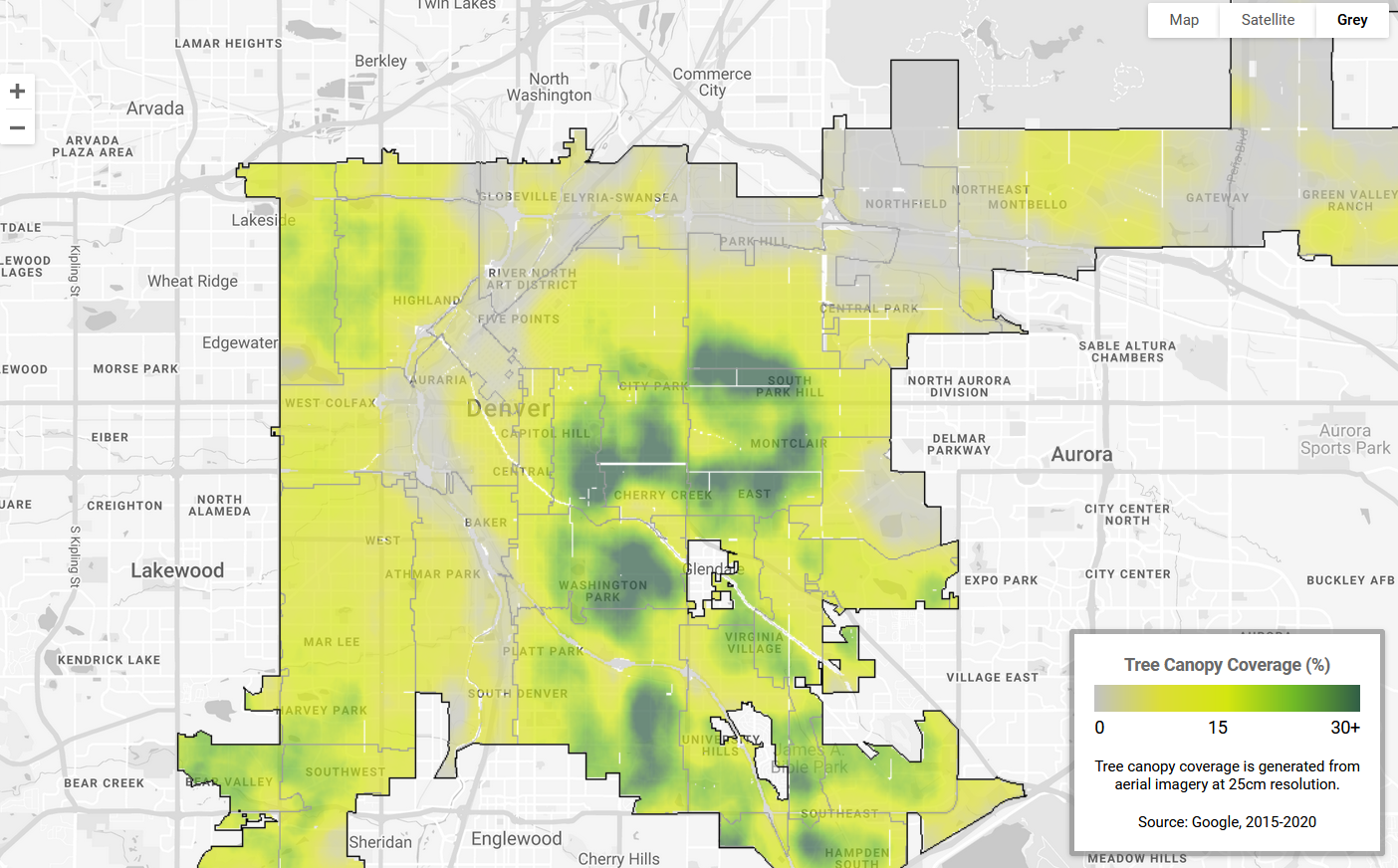
Map of Denver with an overlay showing areas with high and low tree cover.

Image Credits: Google

In cities, Google has provided its “Environmental Insights Explorer Tree Canopy tool” to 15 U.S. cities, using aerial imagery to identify heat islands and other risk areas. Municipalities can use this to plan where to plant new trees or otherwise dedicate resources. First tested in LA, the tool will now expand to 100 cities around the globe, including Guadalajara, London, Sydney, Toronto, and Tokyo.

Another kind of data municipal authorities sometimes don’t have, especially in sparsely populated rural or fast-changing urban environments, is addresses. It sounds odd that a place might just not have an address, but streets and numbers do after all have to be assigned, registered, tracked, and used in order for things like mail and deliveries to arrive. Poorer and rural areas are often at risk of having to just use a nearby official address and rely on extra instructions or a knowledgeable delivery person to get mail reliably.

Several years back Google introduced “Plus Codes,” which are basically GPS coordinates tied to a short series of letters and numbers that can be entered into lots of online address services, including of course Google Maps. Even if you don’t have an actual street address, you can have a Plus Code and it ought to be enough to get someone to your door.

A remote cabin with a popup above it showing a Google "plus code" that acts as an address.

Image Credits: Google

Now they’ve partnered with several local governments struggling to assign addresses in a regular way, integrating Plus Codes with the official machinery of governance. In The Gambia and Kenya, for instance, the Plus Codes will work for national ID cards and other purposes that would normally require a government-verified address. To be clear, the information is owned and administrated by the government, not Google, which just helps generate the codes and integrate them with existing online infrastructure. (There’s a new bulk creation tool that helps generate street directions as well.)

All these tools emphasize Google’s interest in public-private partnerships — a cynic may think that they simply want to get their hooks in every aspect of life, but really the company, despite its advertising and surveillance business model, has always pushed projects like this. It genuinely hopes to transform industries and governments, and occasionally has some success doing it. At the very least these projects seem to lack much in the way of self-interest and could be quite useful to people around the world.


Joyned, formerly known as Gamitee, announced Wednesday that it raised $4 million in seed funding to continue developing its e-commerce platform that puts merchants in the driver’s seat of social engagement.

CEO Jonathan Abraham explained that Gamitee means “joined” in Hebrew, but the Jerusalem-based SaaS company decided to spell it “joy” because it aims to “spark joy in its customers’ experiences.”

Leading the round is Arthur Stark, former president of Bed Bath & Beyond, Yair Goldfinger, founder of Dotomi and ICQ, and Rafael Ashkenazi, managing director and executive chairman at Hard Rock Digital.

“Arthur is a legend in retail, and he is helping us a lot in the U.S. market,” Abraham said. “Yari was the first to build a messaging app, and with Rafael we will penetrate the U.S. market and build our brand there.”

Rather than helping e-commerce companies do a better job advertising on social media, Joyned enables retailers to offer a collaborative shopping platform experience right from their websites without having to rely on the social media platforms, Abraham said. Now shoppers can stay on a retailer site and bring in friends to check out products with the click of a button.

Interestingly enough, Abraham came up with the idea for the company four years ago while planning his wedding. He had to pick out a suit to wear, and after appointing family members to help, his life became inundated with suit options and his computer had hundreds of tabs open. That’s when he had the idea for co-browsing and began developing the company with co-founder Michael Levinson.

Though co-browsing is not a new concept — Abraham said Netscape, Google and Zoom all attempted or did something similar to create collaboration on the web — Joyned is doing something more specific.

Using the company’s technology, a merchant can inject some Javascript into their website, essentially a plug-and-play for Shopify and other websites, and it will put a “shop with me” button on the website where the shopper can invite friends to a shared shopping cart, mood board and speak with the merchants.

“The essence of joy is to empower merchants to own their shopping experience and let people shop together,” he added. “Joyned puts the social part into online shopping and narrows the gap between online and offline.”

Using Joyned, retailers are able to lower customer acquisition costs, optimize conversion rates and build loyalty. On average, retailers can expect overall sales increases of between 6% and 15% after users invite friends to join them, while also experiencing up to 250% in retention rates and a 40% increase in traffic, according to Abraham.

The new capital will lay the foundation for Joyned’s large-scale U.S. expansion, where the company is already seeing impact. The company wants to build on its marketing team in Florida and add sales and support functions.

Over the last year, the company launched its platform and saw sales grow rapidly, close to $500,000 and is on target to hit $1 million in sales, Abraham said.

Looking forward, Joyned will be going after a Series A as it closes three or four major brands in the U.S. to begin using the platform.

“Today, social media marketing is making big companies exist, but merchants are dependent on it,” Abraham added. “Instead of having a blackbox of engagements, we are bringing a new perspective that gives merchants the ability to go into the black box, and that gives them a huge competitive advantage.”


European Union lawmakers are consulting on how to regulate the short term rental market across the bloc — asking whether a single set of pan-EU rules or something more locally flavored is needed to rule over platforms like Airbnb.

The Commission says it wants to support an expansion of competition and players in the sector but also respect EU law which allows for Member States to apply local rules based on concerns that are in the public interest.

As it stands, a patchwork of rules and regulations has grown up around short term rental platforms across Europe as cities grapple with the impact of over-tourism from uncontrolled growth of Airbnb et al — and also struggle to extract useful data from platforms whose business model benefits from flipping local housing stock to drive short term rental gains.

This dynamic is triggering the Commission’s customary anxiety around fragmentation of the Single Market. So it’s now asking for views from the industry and interested citizens as it considers whether a sector-specific regulation is needed.

In a summary of its intention for the forthcoming short term rental (STR) initiative, which will be fed by responses to the public consultation, the Commission writes that its aim is “to develop responsible, fair and trusted growth in short-term rentals, as part of a well-balanced tourist ecosystem” — and “ensure a level playing field for all accommodation service providers and to respond to the many requests from interested parties for EU-wide action in this area”.

“This will involve offering balanced solutions for cities, peer and professional short-term rental providers and platforms, while benefiting in particular small and medium-sized firms,” it adds.

The Commission proposed broad rules for the digital sector at the back end of last year — under the Digital Services Act (DSA) — which it has said will level the playing fields between online and offline business in areas such as illegal content and goods.

However the regulation has been criticized for not going far enough to tackle illegal holiday rentals.

In a position paper earlier this year, for example, the holiday accommodation booking platform, Booking.com, wrote that the Commission’s proposal could be more “ambitious” — saying it “insufficiently addresses illegal short term holiday rentals”.

“The powers for national (or local) authorities to order platforms to remove illegal content (Article 8) and to share information (Article 9) are a step in the right direction. However, enforcement loopholes remain,” it added. “Where short term vacation rentals are subject to an authorization /registration scheme, platforms should be required to ensure that only properly registered / authorized properties are listed. This is in line with the duty of care incumbent upon platforms.”

The Commission is also facing vocal pressure on the issue from heavily touristed cities across Europe — which have been trying to impose limits on the growth of holiday rentals, with mixed success.

Earlier this year, for example, a court in Amsterdam overturned a three-district ban on rentals on platforms like Airbnb which the city authorities had brought in after polling local residents over the impacts on their communities.

But this summer city authorities in Paris trumpeted winning a major case against Airbnb — which was ordered to pay $9.6M for illegal listings.

Governments in Europe have also been pressing the Commission to regulate for data access to vacation rental platforms, with the Dutch suggesting last year that it should embed such provisions in the DSA.

The European Parliament has also warned that the “expansive growth of short-term holiday rental in cities and popular tourist destinations is extracting housing from the market, driving up prices and has a negative impact on liveability”. And in a report last year MEPs also said: “We want to give cities more control over rentals short term accommodation platforms and ensure that these platforms share information with the cities, respecting data protection rules.”

Also last year the Commission inked a voluntary agreement with a handful of major platforms to push some aggregated data. However the agreement goes considerably less far than requirements that some individual European cities have imposed on STR platforms operating locally in a bid to control their impacts on communities.

In its consultation on the STR issue, the Commission notes that a number of authorities across the EU have taken steps to try to regulate short term rentals (STRs) — such as by imposing registration requirements and authorisation schemes on hosts, and by putting limits on the number of nights per year properties can be rented out.

“Whilst doing so, some national rules make a difference between so-called ‘peers’ offering STRs in a private capacity occasionally, and those offering STRs in a more professional capacity,” it goes on. “Criteria differ however and not everywhere a distinction is made between peers and professionals. Authorities have also taken a variety of measures to obtain better data from platforms, with a view to better assessing the volume of STRs and facilitating law enforcement.

“The foregoing has resulted in a patchwork of varying rules and regulations.”

“Under EU law, imposing restrictions and conditions on the provision of a service can be justified if necessary to pursue a legitimate public interest objective and proportionate to achieve that end. In spite of important clarifications offered by EU case law, there is still much uncertainty regarding the measures authorities may adopt and enforce as regards hosts and other service providers such as platforms,” the Commission adds.

“EU horizontal regulatory initiatives such as the Digital Services Act aim to impose harmonised obligations on online platforms, including collaborative economy platforms in the area of STRs. However, in order to foster a balanced development of the STR segment in the EU and to address the sector-specific aspects, a dedicated sector-specific initiative may be needed.”

It’s not clear exactly where the Commission will plant its flag on this contentious issue — but its consultation poses a number of questions for stakeholders to respond to in areas such as transparency and data access, as well as asking for views on the benefits and drawbacks of STRs.

The Commission is also seeking suggestions for specific rules and regulations that might be applied to STRs to achieve the sought for balance between supporting tourism and respecting local public interest — including asking for views on how best to ascertain whether an STR host is a ‘peer’ or a professional operator.

The marketing of platforms like Airbnb typically spins the promise that you’re renting unique and characterful spaces from locals — which differentiates the holiday rental platform business from more traditional tourist fare like hotels.

However the reality of such ‘p2p’ platforms is they quickly attracted a swathe of professional landlords — who could lucratively list and rent entire apartments to tourists, instead of renting the housing at a lower rate to locals on long term contracts. Hence the criticism that STRs hollow out local communities and make city living less affordable for locals. 

In one question from the Commission’s public consultation — which is asking for views on the type of rules and requirements for STRs that “could be acceptable” — it suggests a number of responses, including registration and authorization obligations on all hosts or only on professional hosts; and limits on the number of nights, amount of income generated and number of rooms that can be rented by peers.

At the end of this list it also asks for a response to the suggestion of a “total ban on STRs”.

Elsewhere, the consultation asks for views on whether rules for STRs should be imposed from the top (a “harmonized EU approach) — or allowed to be entirely bottom up (left to local authorities to define) or some vaguely defined combination of the two.

It is also concerned with whether there should be different rules for peers and professional hosts — and if so how best to define who is a peer and who a professional?

Other questions in the consultation ask for views on measures “that you think could support innovation in the STR and the development of new business models”. 

The Commission’s consultation runs until December 13, with the EU’s executive slated to publish a legislative proposal for vacation rentals in the first half of next year.




MKRdezign

Contact Form

Name

Email *

Message *

Powered by Blogger.
Javascript DisablePlease Enable Javascript To See All Widget