Latest Post

Through his close relationship with the woods of Walden Pond in Concord, Massachusetts, Henry David Thoreau observed the ebb and flow of the natural world first-hand. Prolific in his practice of collecting botanical samples, Thoreau’s journals reveal detailed observations on local flora.

Six hundred forty-eight specimens, long preserved in the Harvard University Herbaria, now serve as the foundation of a new exhibition, “In Search of Thoreau’s Flowers: An Exploration of Change and Loss,” at the Harvard Museum of Natural History.

The exhibition is an immersive multidisciplinary experience that marries art and science through a modern artistic interpretation of Thoreau’s preserved plants. It invites visitors to ask, “What do Thoreau’s findings tell us about what plants are winning, and what plants are losing, in the face of climate change today?”

visitor looking at display

The gallery theater offers "an immersive experience."

Visitors gain a deeper understanding of how different plant species respond to environmental factors, within and between species. For instance, some plants are sensitive to temperature, while others show less or no sensitivity. This type of data drives the exhibition’s animations and directly impacts our daily lives in the context of agriculture and food production.

Harvard Museums of Science & Culture Executive Director Brenda Tindal underscores the significance of Thoreau’s observations and his indelible impact on society: “philosopher, naturalist, and Massachusetts’ own native son Henry David Thoreau urges us to ‘spend one day as deliberately as Nature.’ Thoreau’s clarion call compels us to intentionally lean into our surroundings and learn from nature — and by extension, the global community to which we all belong.”

Flowers
Exhibit space at the Harvard Museum of Natural History.

A luminous series of large-scale plant portraits using cyanotype on glass are featured. Artist Leah Sobsey utilized all 648 digitized Thoreau samples.

Those behind the exhibition

Robin Vuchnich, a new media artist, user experience designer, and an assistant professor of the practice at North Carolina State University, leveraged the digitized specimens to craft an immersive experience in the gallery theater. Animations of the herbarium images and soundscapes recorded at Walden Pond offer a compelling visual experience that features scientific data about species in decline.

Leah Sobsey, artist, curator, associate professor of photography, and director of the Gatewood Gallery at the University of North Carolina, Greensboro, created a luminous series of large-scale plant portraits using cyanotype on glass backed with 23k gold, a 19th-century photographic process that relies on UV light to create a distinctive Prussian blue tone. Additionally, Sobsey utilized all 648 digitized Thoreau samples, creating a stunning wallpaper consisting of original cyanotypes and digital imagery that tells a story of the survival and decline of plant specimens.

Preeminent scholars Charles Davis, curator of vascular plants, Harvard University Herbaria, Marsha Gordon, professor, North Carolina State University, and Emily Meineke, assistant professor, University of California, Davis, inform the exhibition’s scientific dimensions and intellectual framework.

To ensure a streamlined admission process, read more about the museum protocols and hours. 


Wondering is a series of random questions answered by Harvard experts. For the latest installment, we asked Deirdre Leigh Barrett, a psychology lecturer at Harvard Medical School and the author of “The Committee of Sleep,” what language a bilingual or multilingual person is most likely to dream in and why.


There have been very few studies on bilingualism and multilingualism and how they affect dreams. These are small studies, but they certainly find that people who speak any second language, even without good proficiency, at least occasionally dream in the second language. One study asked the subjects what they thought made the difference, and they said that it was determined by the people and or the setting that was being dreamed about. If you thought of your family back in your country of origin, it’d likely be in that language regardless of whether it was now your dominant language. And if you were dreaming about people you’ve known as a young adult, living in another setting where you spoke a different language, you’d be dreaming in that language. It was combination of where the dream was set, what language was associated with that, and what people were in the dream — that’s what they said determined it.

But I’ve heard others say that if they were dreaming about important emotional issues, they would dream in their original language, and if they were dreaming about practical, abstract, or work-related things, they would dream in their newer language. I heard something different from the most multilingual person I’ve ever talked to. He was a high-level Swedish economist, and he said that he was fluent in about 15 languages. He said that he dreamed in whatever language he was speaking that day, even if the dreams were about his family of origin in Sweden.

There is something that I have never seen mentioned in any of the published studies on this, which is that there are some people who say they are never aware of language in dreams — that they don’t dream in any particular language. I very much identify with that. Most of the time, I don’t hear language in my dreams. I have only a handful of times dreamed in a language other than English, which fits the findings of some studies that say that your degree of proficiency in a second language determines how often you will dream in it. I studied French in school, but I am not a proficient speaker. I’ve dreamed in French at least twice.

People who are not proficient in a foreign language sometimes say that they have once or more dreamed in the rudimentary second language, and in the dream, they believed they were very proficient in it. When people discuss it, it’s usually along the lines of “Why is it that we can be so much more fluent in our dreams?” Dream psychologists, especially neuroscientists, say that it’s likely because the prefrontal area that is responsible for reality checks is shut down. It is possible that they are more proficient in the dream, but it’s also possible that they feel more proficient in the dream because they’re not doing the usual self-judgment.

I think that dreams are best thought of as just thinking in a different biological state, where areas associated with visualization and emotion are more active than usual intuition, and that is why we’re less verbal and less logical when we dream. There are a few theories that say dreams are there for memory consolidation, for threat simulation, and for wish fulfillment. And yes, they’re for all of that, and a million other things, just like our waking thought.


Harvard faculty and students are advancing solutions to climate change and its wide-ranging impacts through new scientific, technological, legal, behavioral, public health, policy, and artistic innovations. Ten research teams will share $1.3 million in the eighth round of the Climate Change Solutions Fund (CCSF) awards. Aiming for impact at both the local and global level, these projects will seek to reduce the risks of climate change, hasten the transition to renewable energy, diminish the impact of existing fossil fuels on the climate, understand and prepare for the effects of climate change, and propel innovations needed to accelerate progress toward a healthier, more sustainable future.

“Full engagement in the critical work of confronting climate change requires that Harvard advance on as many fronts as we have at our disposal,” said Harvard President Larry Bacow. “The Climate Change Solutions Fund is one of the ways in which we support faculty and students in their important work, and the diversity of this year’s projects is a testament to the variety of tools we have at our disposal to address humanity’s greatest challenge.”

The fund review committee, chaired by Vice Provost for Climate and Sustainability James Stock, selected research projects from across the University’s 12 Schools. Proposals that demonstrated imaginative and promising collaboration among faculty and students received special consideration, as did projects designed to use the campus as a testbed to study climate change solutions at an institutional scale, which connects with the priorities of the Presidential Committee on Sustainability. As of 2022, nearly 70 CCSF projects have received more than $8 million in funding.

“We had a very strong set of proposals this year. The breadth across Schools and the substantive strength of the proposals illustrates how so many Harvard scholars are engaging in climate-related research,” said Stock. “I’m also grateful to the members of the proposal review committee for the time and thought that they put into selecting the winning proposals.”

This year’s projects range from designing strategies for extreme heat adaptation and helping students explore the consequences of their consumption on Harvard’s campus, to studying the health impacts of wildfires on vulnerable populations and building data infrastructure to understand climate change migration around the world.

The fund was established in 2014 by President Emerita Drew Faust and is supported by the Office of the President and donations from alumni and others. CCSF is managed by the Office of the Vice Provost for Climate and Sustainability at Harvard.

This year’s winning projects:

Dryscreen: Creating Human-Centered Comfort in Buildings

 Joanna Aizenberg, Amy Smith Berylson Professor of Materials Science and Professor of Chemistry and Chemical Biology, Harvard John A. Paulson School of Engineering and Applied Sciences (SEAS); Jonathan Grinham, Assistant Professor of Architecture, Harvard Graduate School of Design (GSD) and Harvard Center for Green Buildings and Cities

This project seeks to reduce the energy consumption and the use of harmful refrigerants in air conditioning by using a technology that decouples air cooling from humidity reduction — two functions performed simultaneously by conventional air conditioners in buildings. Doing so can lead to significant energy savings by separately tuning dehumidification and cooling to reflect ambient conditions. The new technology — Dryscreen — is a water-selective membrane vacuum system that has been designed and fabricated with support from the U.S. Department of Energy. Funding through the CCSF will enable the on-campus field testing of the Dryscreen prototype, using the Center for Green Buildings and Cities’ HouseZero LiveLab.


Realizing Low-Cost Direct Air CO2 Capture Using Oxygen Resistant Proton-Coupled Electrochemistry

Michael Aziz, Gene and Tracy Sykes Professor of Materials and Energy Technologies, SEAS

Aziz and his team are developing a new way to remove carbon dioxide from the air through the use of electrochemistry. So-called direct air carbon dioxide (DAC) capture represents a crucial solution if the world is to limit global warming to within to 2° Celsius. But conventional DAC technologies are both energy intensive and expensive. Using electrochemistry of water-soluble organic molecules allows for a scalable, low energy cost, and safe way to capture carbon. In the current electrochemical system developed in the PI’s lab, however, atmospheric oxygen (O2) renders the system inoperable. Funding will help the researchers develop a new electrochemical cell structure, with distinct compartments for electrochemistry and carbon capture, which would make the carbon capture process resistant to oxygen or any harmful component in the inlet gas.


Using Satellite Observations of Atmospheric Methane to Support Effective Global Climate Policy

Daniel Jacob, Vasco McCoy Family Professor of Atmospheric Chemistry and Environmental Engineering, SEAS, Faculty of Arts and Sciences (FAS) Department of Earth and Planetary Sciences; Robert Stavins, A. J. Meyer Professor of Energy & Economic Development, Harvard Kennedy School (HKS)

Methane is a potent greenhouse gas. Decreasing methane emissions represents a significant way to mitigate climate change and is an essential element of achieving the objectives of the Paris Agreement. However, the national accounting of methane can be inaccurate because of the variety of methane sources and the complexity associated with them. Using high-resolution satellite observations, this project will deploy a new, publicly accessible system for quantifying methane emissions from top-emitting countries. The project will engage stakeholders to validate and to improve national emissions inventories in support of the Paris Agreement and the Global Methane Pledge.


Building Data Infrastructure to Understand Climate Change Migration

Tarun Khanna, Jorge Paulo Lemann Professor, Harvard Business School (HBS), Faculty Director of The Lakshmi Mittal and Family South Asia Institute; Satchit Balsari, Assistant Professor in Emergency Medicine, Harvard Medical School (HMS) and Beth Israel Deaconess Medical Center; Caroline Buckee, Professor of Epidemiology, Harvard T.H. Chan School of Public Health; Jennifer Leaning, Senior Research Fellow, FXB Center for Health and Human Rights; Professor of the Practice, Harvard T.H Chan School of Public Health; Rahul Mehrotra, John T. Dunlop Professor in Housing and Urbanization, GSD; Neha B. Joseph, Research Fellow, The Lakshmi Mittal and Family South Asia Institute at Harvard

The aim of this project is to develop a transformative, open-access climate and population health data-monitoring ecosystem in South Asia. More than 700 million people in South Asia have been affected by at least one climate-related disaster in the last decade. Yet, there is only a vague understanding of how climate change affects who moves, when, and why; how such distress migration in South Asia affects host communities; and the impact that large population fluxes have on access to food, shelter, jobs, and population health. Understanding these forces requires micro data on individual mobility, health, and related measures. Funding will allow the researchers to develop a prototype open-source data repository of traditional and novel data streams from public and private datasets, and invite interdisciplinary teams of stakeholders — including communities, scientists, and policymakers — to explore and apply the datasets to advance adaptation measures.


Climate Change and Mental Health in Madagascar: A Health Systems Ecological Approach

Karestan Koenen, Professor of Psychiatric Epidemiology, Harvard T.H. Chan School of Public Health; Christopher Golden, Assistant Professor of Nutrition and Planetary Health, Harvard T.H. Chan School of Public Health

Research will focus on developing and piloting the use of mental health assessment instruments for identifying and measuring the impact of priority mental health and psychosocial problems associated with climate change. The project will center around the population of Malagasy, Madagascar, an island nation experiencing a famine attributed to climate change. The adverse effects of climate change on human physical and mental health remains largely understudied. Of the few empirical studies that exist, most are limited almost exclusively to high-income countries, and none has taken place in Madagascar. In developing reliable mental health assessment instruments, validated in the Malagasy context, the project promises to provide proof of concept that could be used in other settings facing climate-driven crises.


Mather as a Living Lab

L Mahadevan, de Valpine Professor of Applied Mathematics, Physics, Organismic and Evolutionary Biology; Faculty Dean of Mather House; Vijay Reddi, Associate Professor, SEAS; Anas Chalah, Assistant Dean for Teaching and Learning, Active Learning Labs, SEAS

The goal of this project is to help residents of Mather, one of Harvard University’s undergraduate student houses, to quantify and deliberate on the consequences of their consumption in the broader context of climate and environmental change. Using miniature sensors, students will measure the use of energy and water, food consumption and waste, along with indoor and outdoor variations in the ambient conditions, such as temperature, carbon dioxide and humidity through the seasons and semesters. The anonymized data will be analyzed using statistical tools combined with mathematical models to ultimately stimulate debate about policy changes and inform choices and decisions associated with sustainable approaches to community living and learning.

Barocaloric Materials for Sustainable Cooling Technologies

Jarad A. Mason, Assistant Professor of Chemistry and Chemical Biology, FAS; Joost J. Vlassak, Abbott and James Lawrence Professor of Materials Engineering, SEAS

This project is aimed at advancing the basic science of solid-state barocaloric cooling, a technology that promises to reduce energy consumption and the use of harmful refrigerants in cooling buildings and removing heat from data centers. Cooling accounts for more than 20 percent of the world’s electricity consumption, and, therefore, better understanding barocaloric materials could ultimately yield a significant climate benefit. Funding will support a research collaboration between the Department of Chemistry and Chemical Biology and the School of Engineering and Applied Sciences, which will allow for the researchers to bridge the gap between materials discovery and prototype development, with a particular focus on discovering novel materials and mechanisms critical to realizing solid-state cooling at scale.

Belief Formation and Adaptation to Climate Change

Dev Patel, Graduate Student in Economics, FAS

Climate change poses an existential threat for hundreds of millions of people across developing countries. In the absence of severe mitigation measures by the rest of the world, these households must take steps themselves to address the dramatic shifts already occurring in their local environments. The project asks how households learn about and adapt to climate change. This research dives into the underlying mental models guiding farmers’ decisions in agricultural production to understand how the relatively slow, incremental environmental changes characteristic of climate change can often fail to prompt appropriate reactions. The focus is then on the critical issue of rising soil salinity in rural Bangladesh, which drastically reduces rice yields under status quo production. Combining new satellite-based measures of flooding with experimental variation in information and technology access, the research team estimates how households react to the changes in salinity brought on by flooding events and how these beliefs shape climate change adaptation.


Characterizing Wildfire Smoke Health Impacts and Identifying Vulnerable Populations: A 10-year Study of the Western U.S.

Rachel Nethery, Assistant Professor of Biostatistics, Harvard T.H. Chan School of Public Health

With wildfire severity in the Western U.S. projected to continue increasing over the coming decades, wildfire smoke exposure presents an escalating threat to human health. Implementing resilience building programs in high-risk communities is one of the most effective tactics for minimizing climate change-related health burdens. The aim of this project is to study past wildfire smoke exposure in order to inform resilience-building efforts. Specifically, the project will examine the impacts of exposure on more than 100 health outcomes over a 10-year period to identify drivers of vulnerability and create county-level wildfire smoke risk profiles.


Digital Interactivity and Bioclimatic Comfort: Design Strategies for Extreme Heat Adaptation

Belinda Tato, Associate Professor in Practice of Landscape Architecture, GSD

Extreme heat is a critical climate challenge threatening human health, causing economic stress, and driving greenhouse gas emissions. Higher temperatures and longer and more intense heat waves will continue to impact cities. The organization and structure of the urban built environment is critical in responding to this threat as heat islands in cities intensify negative effects of extreme heat. This project will focus on developing an interactive bioclimatic comfort application and data collection platform for community participation and empowerment with an off-grid temporary installation exhibit. Beyond the typical data focused optimization that is common in a “smart cities” approach, this project focuses on utilizing sensors to allow individuals to experience a new level of interactivity and access to real time bioclimatic information. The project acts on two levels: 1) A temporary physical installation on campus that will serve as a living laboratory and testing ground for sensors and climate-sensitive urban design elements 2) Development of a bioclimatic data collection and sharing platform for community participation in climate-sensitive urban design projects.


Not long ago, the idea of photographing a black hole was as quixotic as photographing a unicorn. Now, scientists have not one but two images of two different supermassive black holes — and they both look as magical as flaming doughnuts.

“I remember when black holes were purely theoretical,” said Ellen Stofan, under secretary for science and research at the Smithsonian and former chief scientist at NASA, during a post-reveal panel on Thursday. Moderated by Stofan, the conversation brought together four members of the Harvard-led team of scientists that in 2019 revealed to the world the first image of a black hole — a behemoth dubbed M87 after its galaxy, Messier 87. Hours before the panel discussion, the team shared a second image — a close-up of Sagittarius A-star (or Sgr A*), the black hole snacking on light and cosmic debris at the center of our very own Milky Way galaxy.

“There can be no doubt now that we’ve seen black holes for the first time,” said Shep Doeleman, founding director of the Event Horizon Telescope collaboration, an international team of more than 100 scientists led by the Center for Astrophysics | Harvard & Smithsonian. “It’s the dawn of a new era in astronomy.”

In this new era, scientists could prove — or disprove — Einstein’s long-held theories of gravity and relativity, find Earth 2.0, or discover a wormhole to another universe. (The latter won’t be so hard for Doeleman, who said, cheekily, that he comes from another universe.)

Photographing a black hole is even harder than it sounds. To capture images of objects so far away, “You’d need a telescope the size of the Earth,” said Kari Haworth, an engineer and the chief technology officer for the EHT. “We didn’t do that because that’s impossible, and it would ruin a lot of people’s views,” she said.

Instead, the researchers turned the Earth into a giant telescope by coordinating individual machines positioned in Hawaii, Chile, Mexico, Spain, France, and other locations. Each team had to snap a photo at the exact same time. Because black holes gobble up everything that gets too close — even light — they cannot be seen. But their massive gravity pulls in and compresses nearby light and debris, creating a spinning gaseous eddy that’s teeming with energy. “Turning falling matter into luminosity,” was how Doeleman put it.

That luminosity can be seen and photographed. Some of the light that gets pulled into the black hole’s gravitational field makes a U-turn or a loop-de-loop before escaping and shooting off in the direction of Earth, carrying an image of where it came from. The EHT team’s final photograph is a composite of pictures taken by each telescope and stacked one on top of each other. To combine all that data — which is light, captured at a very precise moment in time — the team needed to achieve one more strange feat. Each telescope team froze their light, stored it on hard disks (it’s too massive to send across the internet), and flew it, by airplane, to one central location.

M87, the first black hole to get the star treatment, is about 1,000 times larger than Sagittarius A-star and far more stable, but the images came out nearly the same, a coup for the EHT — and Albert Einstein. Einstein theorized that black holes have only three characteristics — mass, spin, and charge — and no “hair” (as astrophysicists like to call additional properties). The only difference is a slight blur in the image of Sagittarius A-star. Our galaxy’s black hole is fussier, as fidgety as a toddler, and it’s harder to capture a clean picture of something that’s constantly changing, said astrophysicist Paul Tiede. Plus, there’s some cosmic soup between us and Sagittarius A-star, which obscures the images ever so slightly. “Even given this,” Tiede said, “I’m still struck with how similar these images are.”

By the way black holes are described, you might expect them to be insatiable monsters, sucking in everything in space like a bathtub drain. Not exactly. While they are the most powerful objects in the universe — Doeleman said a black hole formed from folding the Earth in half could power Manhattan for a year — they’re not gobbling up entire galaxies, just warping space-time and displacing objects from their intended paths.

That’s good news because the EHT team suspects there’s a supermassive black hole at the center of every galaxy. But even with these new images, Tiede said, “We know barely anything about them.” (Asked why the black holes are doughnut-shaped, he replied, “Because they’re delicious.”)

“Black holes live at the frontier of our current knowledge of physics and astrophysics,” said Angelo Ricarte, who brought his pet black hole named Poe — a soft black orb with two googly eyes — to the panel discussion. These new images are already helping Ricarte and other scientists study the strange physics of the superheated gases orbiting the black holes, as well as how the behemoths spew jets of these gases a million light years in any direction. Those jets, Ricarte said, could help explain “our cosmic origin story,” have profound effects on how our galaxy evolves, or bridge theories of the very big with the very small to support a theory of everything. “There are a lot of things we still don’t understand fully in this extreme environment,” he said.

To gain a better understanding, Doeleman wants to build an even bigger telescope by putting another imaging device on a satellite orbiting the Earth. He also hopes to capture something more exciting than a photo of a black hole: a movie of a black hole. “If we could time the orbits of matter, that would be a completely different test of Einstein’s theory,” he said.


An international team of astronomers led by scientists at the Center for Astrophysics | Harvard & Smithsonian who produced the first direct image of a black hole three years ago have now produced a portrait of a second, this time a much-anticipated glimpse of one at the heart of the Milky Way.

The new picture was captured by researchers from the Event Horizon Telescope (EHT) Collaboration who unveiled their first image in 2019. The group targeted both black holes at the outset but focused their attention on one at a time, owing to a difference in the complexity of the two projects.

“This is our supermassive black hole,” said Peter Galison, director of Harvard’s Black Hole Initiative, a member of the EHT team, and the Joseph Pellegrino University Professor in the History of Science and Physics. “This is at the center of where we live.”

The image of this object known as Sagittarius A-star, often referred to as Sgr A* (pronounced sadge-ay-star), shows the telltale sign of a black hole, as did the earlier one in the Messier 87 galaxy (M87): a bright ring of superhot glowing material circling a dark center so dense and bottomless that not even light can escape. The way the light bends around the dark center, known as the event horizon, shows the object’s powerful gravity, which is four million times that of our sun.

The new picture, described today in a special issue of The Astrophysical Journal Letters, provides the first direct visual evidence that the giant lurking 27,000 light-years away at the center of Earth’s galaxy is, in fact, a supermassive black hole. It also bolsters theories of where these cosmic monsters exist and may help to explain how galaxies are formed.

Simulations comparing M87 with SgrA* show how much faster material moving at the speed of light orbits SgrA* because of its smaller size.

Center for Astrophysics | Harvard & Smithsonian

“Having seen this bright ring around the darkness of a black hole once was astonishing, but having now seen it twice, we begin to really have confidence of what we’re seeing and that at the center of galaxies there are these enormous black holes that are millions or even billions of times the mass of the sun,” Galison said.

Members of the EHT project unveiled the picture at the National Press Club in Washington, D.C., shortly after 9 a.m. EST, in sync with six other news conferences in cities around the world.

At the press conference in D.C., Michael Johnson, an astrophysicist at the CfA and a leading member of the EHT said one of the key lessons from the project was that the black hole at the center of the Milky Way doesn’t appear to be pulling in as much material as others, making the environment more relatively stable.

Members of Harvard's Black Hole initiative meet to discuss black hole images.

Members of Harvard’s Black Hole Initiative meet to discuss the first-ever image of Sagittarius A*.

Center for Astrophysics | Harvard & Smithsonian

“While M87 had one of the biggest black holes in the universe and it launches a jet that pierces its entire galaxy, Sgr A* is giving us a view into the much more standard state of black holes, quiet and quiescent,” said Johnson.

NASA Einstein Fellow at the CfA Sara Issaoun worked on observations and imaging for the EHT team and discussed the image at the European press conference in Germany. She said the new image reveals some key details about the black hole that were previously unknown, including that one side of the black hole is almost directly facing Earth.

“These properties, this knowledge of the fundamental properties of the black hole will help us study the astrophysics of the black hole in more detail later on,” Issaoun said.

Issaoun also pointed out that the new view further cements Einstein’s theories on gravity and relativity.

“The cool thing about Sgr A* is that we know its mass with great accuracy so we know exactly what Einstein’s theory of relativity should predict for how big the shadow in the center should be — around 50 micro-arcseconds in angular size or 60 million kilometers across,” Issaoun said. “That is what we’ve measured in our image.”

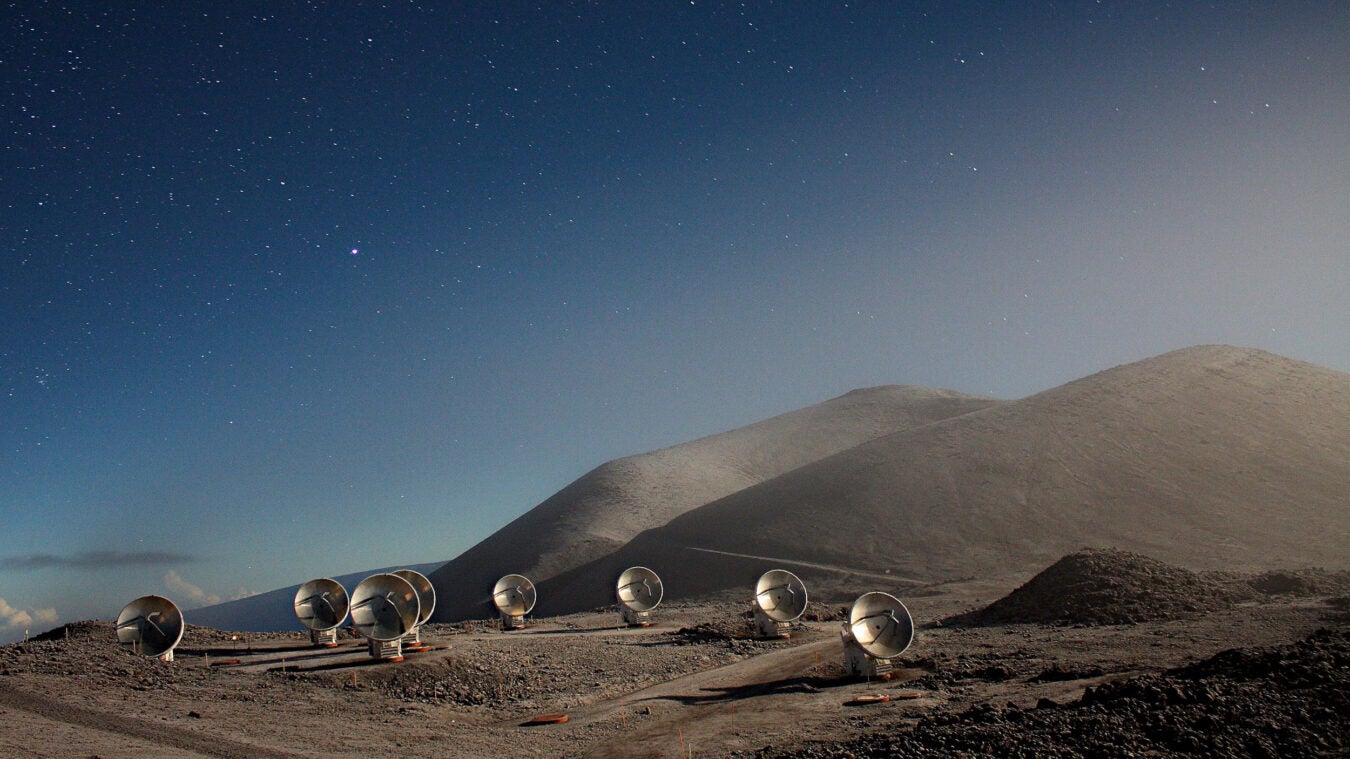
Event Horizon Telescope array in Hawaii.

The black hole images were captured with the Event Horizon Telescope, a worldwide network, including this array from Hilo, Hawaii, that link together to form a single Earth-sized virtual instrument.

Center for Astrophysics | Harvard & Smithsonian

The researchers produced the picture with observations from the Event Horizon Telescope, a worldwide network of radio telescopes that link together to form a single Earth-sized virtual instrument. In April 2017, eight radio observatories on six mountains on four continents stared on and off at a pair of black holes for 10 days — Sgr A* and a second that lies at the heart of the elliptical galaxy M87.

From that observation data, which was then crunched by supercomputer algorithms, came the image of the M87 black hole as well as the one just released.

The two images can now be compared to gain valuable insight on the inner workings of these supermassive giants and how they interact with their surroundings, a process thought to play a key role in shaping the formation and evolution of galaxies.

M87 is 55 million light-years away in the Virgo Galaxy cluster and has a mass about 6.5 billion times that of our sun. The bright circle of gas and dust that collects and swirls around it is known as an accretion disk. It takes many days to orbit around this gargantuan object. That means that when the EHT team shines their telescopes on it for hours — using a technique called very long baseline interferometry that works like taking a long exposure image on a camera — any change appears very gradually.

Sgr A*, on the other hand, is on the small side. If it was the size of a doughnut, M87 would be the size of a football stadium, Issaoun said at the press conference in Germany. This means superheated gas, which travels at near-light speed and takes days to orbit M87, only takes minutes to orbit Sgr A*, which is why there is so much motion blur in the image.

“The analogy would be if you have an adult getting their portrait taken with a long exposure, and they’re just sitting still. That’s M87,” Issaoun said. “For Sgr A*, you have a toddler running around and you’re trying to get their portrait with the long-exposure camera. You’re just going to get a bunch of blur everywhere.”

In addition, there is a giant cloud of ionized gas between Earth and the Galactic Center, which distorts the images the EHT takes of Sgr A,* which sits in central region of the Milky Way.

“We’re looking at our own Galactic Center through an interstellar soup of all the dust and gas between us,” said Daniel Palumbo, a Harvard graduate student at the CfA who worked on the data analysis. “This material scatters the light that we observe from Sgr A*. It’s like looking at something through frosted glass.”

Seeing all these difficulties, the Event Horizon team first focused on the M87 data before turning their full attention to that of Sgr A*.

In the end, the researchers were able to produce their final image, which isn’t just one picture but the average of thousands of images created using different computational methods to account for the movement of the gas.

The individual images showed many different structures that highlighted the uncertainty in the computational methods from the rapidly changing appearance of Sgr A*, including all the movement and plasma flares that go with it. The averaged image retains features more commonly seen in the varied images and suppresses features that appeared less frequently.

“We wanted to know how to measure the structure of the ring from all these possible images,” said Razieh Emami, a postdoctoral researcher at the CfA who made precise measurements of the ring and worked to combine data from multiple nights of observations into the single final image released Thursday.

That there now exist images of two black holes of very different sizes is particularly exciting to the astronomers, and they have already begun to use the new data to test theories and models of how gas behaves around supermassive black holes. It also marks a monumental collaborative achievement for the EHT, made up of more than 300 researchers from 80 institutes around the globe and 11 observatories.

Much of the work is based on the Harvard campus with dozens of astronomers, postdoctoral fellows, graduate students, and undergraduates at the Black Hole Initiative and CfA.

“With the interdisciplinary expertise at the Smithsonian, Harvard, and the Center for Astrophysics, our large group here has become the center of gravity for this visionary project, and an incubator for discoveries over the next decade,” said CfA scientist Sheperd Doeleman, founding director of the EHT and co-director of the Black Hole Initiative.

The work of studying these giants is far from finished. The members of the group say they are now looking at a next-generation EHT (ngEHT) project: capturing video of a black hole. The project will involve designing new ultra-high-speed instrumentation and a plan to double the number of radio dishes in the EHT array that will allow scientists “to create an Earth-sized motion picture camera” that “will bring black holes to vibrant life,” said Doeleman, who also leads the ngEHT project.

“We know that there’s more to see here,” Johnson said. “We know that there are sharp features that are that are tight predictions from general relativity. This is how we can push our theories further. We’re hoping to add these new telescopes around the world and be able to really dig into those sharp features and to be able to see these high-resolution movies.”

 A separate panel of CfA scientists will participate in a public Q&A panel at 3 p.m. EDT today which will be livestreamed on the CfA’s Facebook and YouTube pages. On Monday at 5:15 p.m. in the Harvard Science Center, Hall C, there will be a special public event with members of Harvard’s EHT team discussing the results.


This is a coming-of-age story — involving your brain.

That’s how W.A. Harris opened his virtual Harvard Science Book Talk on Monday. The talk, presented by the University’s Division of Science, Cabot Science Library, and Harvard Book Store, brought Harris together with old friend Joshua Sanes, the Jeff C. Tarr Professor of Molecular and Cellular Biology at Harvard and director of the Center for Brain Science. The neuroscientists discussed Harris’ new book, “Zero to Birth: How the Human Brain Is Built,” which elucidates how one cell develops into the complex operational centers that not only make us human, but also individuals, with entirely unique traits, behaviors, and, yes, malfunctions.

Harris presented the relevant evolutionary history, crediting the many pioneering neuroscientists who uncovered how the “Adams and Eves of our brains” were born. One, Santiago Ramón y Cajal, created the first drawings of intricate neuron trees, which are still widely studied. Another, Conrad Hal Waddington, likened the development of different neuron types to a ball rolling down an uneven hill.

“The neural stem cells are a bit unpredictable,” Harris explained. “We can’t predict exactly where they’ll land, but they will create the right amount of neuron types.”

Other 20th-century neuroscientists, including Roger Sperry, took a more hands-on approach, Harris said. Sperry removed, flipped, and reinserted a frog’s eye, leaving the amphibian with an upside-down world. And while the neurons adapted, rewiring to restore vision, the eye was not so nimble. To look up, the frog looked down — for the rest of its life.

Moving from amphibian to mammal, David Hubel and Torsten Wiesel deprived a kitten of vision in one eye to see how the limitation might affect a growing brain. When they restored vision after the kitten reached 3 months old, the duo discovered that the animal never gained sight in the closed eye.

Adult neurons survive for a lifetime and remain malleable for several years. This is one reason kids are especially adept at learning new languages, explained W.A. Harris (left), who was joined by Joshua Sanes, director of the Center for Brain Science at Harvard.

Jon Chase/Harvard Staff Photographer

As a brain develops, young neurons strike out, seeking to form synaptic connections across brain regions, Harris said. If they fail to make those connections, they “commit suicide by consuming themselves.” And even if they survive this first cutthroat wave, they can “get pruned, like plants.”

In the first trimester of pregnancy, neural growth is exponential: about 15 to 20 million cells are born every hour, Harris said. Only about 50 percent of these original cells survive. If, for example, there are too many of one type, causing an imbalance, the excess will die off. Or, if some seem to be serving a pointless task, like those attending a shut eye, they’ll move on. Why waste precious neurons?

After the early period of growth, suicide, and pruning comes to an end, adult neurons survive for a lifetime. And unlike those of a cat, they remain malleable for several years. This is one reason kids are especially adept at learning new languages, and why procedures to correct neurological dysfunctions, like a lazy eye, have higher chances of success early in life.

“Adult neurons seem to have lost some of the mojo of their youth,” Harris said. They get damaged, weaker, and a little less flexible over time. Plus, unlike those of fish, amphibians, and reptiles, human brains don’t regenerate much after injury because only a small number of neurons are born during adulthood.

“Fixing broken brains is one of the hardest challenges of medicine,” Harris said.

“This is a very good time to be a mouse with autism or Alzheimer’s because we can cure you,” Sanes said during the question-and-answer portion of the talk. But those cures don’t translate from mouse to human. Even though brains look remarkably similar across invertebrate species, “there are deep developmental differences between the brains of mice and humans,” Sanes said.

Today, scientists are growing mini-brains — or rather, collections of neural clusters formed in a Petri dish — to study neurological diseases, including opportunities for treatments and cures, and to inform the development of artificial intelligence. Of course, building a brain in the lab raises some ethical questions. Are they processing their world? Suffering? Human?

“We have to keep our eyes and ears and ethical antennae open to this,” Sanes said. And yet, he continued, there’s a moral imperative to seek treatments for brain disorders, which cause more suffering than any other class of disease.

“To understand human brains, you have to study human brains,” Harris added, “and that’s not easy.”


Soyeon Yi beat out 36,000 contestants to become South Korea’s first — and so far only — astronaut to fly into space. In 2008, she lifted off with a crew of Russia cosmonauts on a nine-day mission to the International Space Station (ISS), where she conducted 18 experiments and medical tests for the Korea Aerospace Research Institute.

Yi, who has a doctorate in biosystems, recently attended Space Week, an event hosted by the Space Consortium at Harvard & MIT and started by Alissa Haddaji, a lecturer in space law, policy, and ethics. This year’s event is dedicated to sustainability in space, including mission debris and national security.

Yi spoke with the Gazette about what the war in Ukraine could mean for American and Russian astronauts at the ISS. After the interview the head of Russia’s space agency announced the nation would pull out of the ISS due to economic sanctions over the war but did not set a date for the action. The interview was edited for clarity and length.

Q&A

Soyeon Yi

GAZETTE: There’s been growing tension between Russia and the West, especially regarding the International Space Station. How important is the war in Ukraine to the continuation of the ISS?

YI: The first idea that comes to my mind is how awkward the relationship is in the space station between Russian and U.S. astronauts because they cannot go anywhere. Maybe they might not have a strong opinion on the war or maybe they would love to avoid talking about that also, because they are not the person who can control or change something. Maybe some of them don’t agree with their own government. If I were either a Russian cosmonaut or American astronaut, I might do my best to not ruin our relationship as a friend or “comrade” because of this uncomfortable situation.

GAZETTE: You were at the International Space Station for about nine days. Could you provide some insight of the relationships between American and Russian astronauts?

YI: All those astronauts are selected from their countries after careful and sincere consideration. They are representatives of their own countries and not as politicians, but as heroes. We know what causes diplomatic problems with huge consequences, so we always do our best not to make a conflict among us. We can hate some country, but we know it doesn’t mean we hate every single citizen of that country. As astronauts, we are always doing our best to distinguish between those two. That’s the kind of essence of the collaboration at the ISS.

GAZETTE: As South Korea’s first and only astronaut, how important is it for you to be an inspiration for other Koreans who want to reach space?

YI: When I came to the U.S. for the very first time as an exchange student in 2003, it was a huge culture shock. A lot of my friends and colleagues, especially in the STEM field, were either “Star Trek” fans or “Star Wars” fans. I didn’t have any resources to think about sci-fi or STEM. When I came here, I felt a little bit jealous, because many friends of mine in the U.S. during their childhood daydreamed about space, watched crazy sci-fi movies, and dreamed about being an astronaut. During my childhood, I didn’t even know the vocabulary attributed to all that. Those movies and then real-life astronauts and space activities work together to inspire kids. Hopefully, I can inspire them to look up to the night sky and to dream about their future in space.

GAZETTE: Why is it so important to you to help nurture the next generation of women in STEM?

YI:  When I looked down to the Earth from space, it made me wonder: “Why on earth I was born in Korea?” There’s no specific reason, and there’s no specific effort I made to be born in that country and in that timeline. I was the first kid in my family to go to college full time, and until I went to the Space Station, I thought life was unfair because some kids had a much better situation than me. But once I got on the ISS, I realized that maybe someone feels jealous of me. Because I was lucky to be born in Korea. I think it’s really important to consider our next generation’s future. It’s in our hands; it’s our responsibility. I’m so honored to be the first, but I don’t want to be the last.

GAZETTE: What are some important conversations we should be having about space sustainability?

YI: ISS is the best test site to practice sustainability and a great example of how we can make sustainability work on Earth. Sometimes sustainability happens not because we really want to do it, but because of the situation. If you don’t have any clean water, you might be forced to recycle your urine. We definitely don’t want to make a situation like that on our Earth; we should be prepared before. We should preserve everything before we run out.


MKRdezign

Contact Form

Name

Email *

Message *

Powered by Blogger.
Javascript DisablePlease Enable Javascript To See All Widget