Latest Post

If you’ve ever talked to a baby, you’ve likely raised your pitch, made silly sounds, or used a sing-song voice. You’re not alone.

In a landmark study spanning six continents, researchers affiliated with the Music Lab found striking consistencies in the ways adults spoke and sang to infants. The findings, published this week in Nature Human Behaviour, point to possible common functions of certain kinds of speech and song patterns for infant development and parent-child bonding.

Over a period of three years, researchers coordinated the collection of 1,615 recordings from 21 cultures with varying degrees of connectedness to the rest of the world. From an urban English-speaking environment in San Diego to a Hadza hunter-gatherer society in East Africa, adults changed their speech patterns when interacting with infants. No previous study has compared infant-directed vocalizations across such a wide range of cultures.

“For about as long as people have been studying parents and babies, psychologists have theorized that there are special kinds of vocalizations for babies, but it’s difficult to study that trend in diverse groups of people all over the world,” said Samuel Mehr, who led the project as director of the Music Lab and a Harvard research associate before taking a new role as a senior scientist at Yale’s Haskins Laboratories. “Because of this big international collaboration, we were able to test this question rigorously in many different sites around the world.” 

Who's listening? Adult or infant?

In one of the clips, the speaker from Tanzania is speaking to an infant. Can you guess which one based on voice acoustics alone? Answer below. (Clips courtesy of The Music Lab)

First clip is adult-directed; second, infant-directed speech.

Listen to more recordings at The Music Lab.


Global consistencies in infant-directed speech included higher pitch and increased pitch range. Other features that appeared many times in the recordings were contrasting vowels (like emphasizing a long “e” and a short “e” in the same word) and pulse clarity (using a musical voice). When the researchers analyzed singing, they noticed consistent changes in tempo and timbre.

The group trained a machine-learning model to use features like pitch and loudness to guess whether a recording was infant-directed or adult-directed. The model was largely accurate in its determination across the 21 societies and strengthened the case for global consistencies, according to Courtney Hilton, a postdoctoral fellow in the Department of Psychology and a co-first author on the paper.

“Our study provides the strongest test yet of whether there are acoustic regularities in infant-directed vocalizations across cultures,” Hilton said. “It is also really the first to convincingly address this question in both speech and song simultaneously. The consistencies in vocal features offer a really tantalizing clue for a link between infant-care practices and distinctive aspects of our human psychology relating to music and sociality.”

This research builds on earlier studies showing that lullabies and altered speech patterns can have a soothing effect on infants, as well as animal findings demonstrating the clear function of vocalizations such as sounding the alarm for an approaching predator or signaling friendliness and approachability.

“When we were selecting the features with which to look at infant-directed song and speech, we specifically appealed to some baseline bioacoustic principles that can be held constant not only in humans, but across different animals,” said Cody J. Moser, a co-first author on the paper, doctoral candidate at the University of California Merced, and a visiting student in Harvard’s Graduate School of Arts and Sciences. “Things about the way that we alter our pitch toward our infants might have their roots in ways that other animals communicate with each other.”

A secondary part of the study involved members of the public trying to identify whether a vocalization was infant-directed or adult-directed. More than 50,000 English speakers with fluency in 199 languages hailing from 187 countries participated in that portion of the study. Most were accurate in their assessments regardless of their native language or culture. This aspect of the research confirmed that people can pick up on the acoustic markers of infant-directed speech and song, even if they don’t understand the words or cultural references.

How people alter their voices when speaking to infants
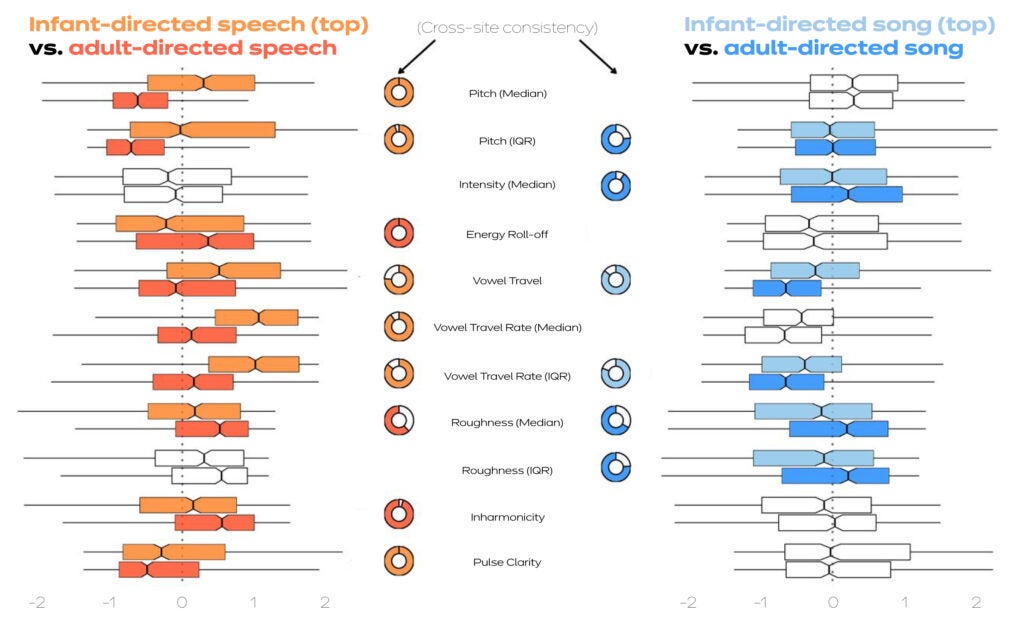
Visualization comparing voice pitch tends to be higher when adults are speaking to babies.

The researchers trained a machine learning model to analyze the extent to which adults altered their voices when speaking or singing to infants. The figure shows that adult median pitch was heightened when they spoke to infants as compared to adults (left column, top measurement), but remained largely the same during song (right column).

Read the full study.


Mehr said this “citizen science” approach was invaluable to the researchers.

“The method we used for this paper — that allowed us to get 50,000 people to tell us if they thought a certain song was for a baby or for an adult — is the same method that we could use to understand the trajectory of music perception ability across a person’s lifespan, or whether people hear structure in music the same way depending on the type of language they speak,” he said. “The citizen science method is an innovation that many psychologists are excited about.”

The findings show striking parallels among cultures when it comes to talking and singing to infants, but Moser warned that the similarities shouldn’t be understood as truly universal features.

“We’re not trying to claim that all societies have infant-directed song or infant-directed speech, but we do now know that when people do tend to sing to their infants or speak to their infants, they tend to do it in the same way,” around the world, he said. “That is very interesting and a new finding.”

“There is, of course, a lot of variation and cultural influence in this practice, but we were also finding commonalities hinting at roots in our shared biology,” added Hilton. “In this study, we were trying to uncover these hidden parts of our minds that shape our everyday behavior and experiences.”

New genetic research from remote islands in the Pacific offers fresh insights into the ancestry and culture of the world’s earliest transoceanic seafarers, including family structure, social customs, and the ancestral populations of the people living there today.

The work, described in the journal Science, reveals five previously undocumented migrations into a subregion of this area and suggests that about 2,500 to 3,500 years ago early inhabitants of these Pacific islands — including Guam in the northern region and Vanuatu in the southwest — had matrilocal population structures, ones in which women almost typically remained in their communities after marriage while men more often moved out of theirs to join them.

The practice is opposite of patrilocal societies, in which women typically relocate. These findings support the idea that these early seafarers were from cultures organized through female lineages.

The results come from a genome-wide analysis on 164 individuals from 2,800 to 300 years ago, as well 112 modern individuals. It was published by a team of researchers co-led by Harvard geneticists David Reich and Yue-Chen Liu, Ron Pinhasi at the University of Vienna, and Rosalind Hunter-Anderson, an independent researcher working in Albuquerque, New Mexico.

“It’s an unexpected gift to be able to learn about cultural patterns from genetic data,” said Reich, a professor in the Department of Human Evolutionary Biology and a professor of genetics at Harvard Medical School. “Today, traditional communities in the Pacific have both patrilocal and matrilocal population structures, and there was a debate about what the common practice was in the ancestral populations. These results suggest that in the earliest seafarers, matrilocality was the rule.”

The genetic analysis compared mitochondrial DNA sequences — which are inherited only from biological mothers — of the first seafarers from Guam to those of the first seafarers from the southwest islands of Vanuatu, and Tonga who lived 2,500-3,000 years ago. It revealed that the two lineages of the first Remote Oceanians derived from two distinctly different maternal lineages but that kind of stark differentiation didn’t exist in terms of the rest of their DNA.

Map of migration routes.

Map of migration routes.

Credit: David Reich, Yue-Chen Liu, and Rosalind Hunter-Anderson

Researchers ran these results through mathematical simulations, which showed that this kind of genetic drift in the two groups could not have happened randomly and lead them to the conclusion that the cause was most likely the result of women not moving around to different islands as much as men.

“Females certainly moved to new islands, but when they did so they were part of joint movements of both females and males” said Reich. “This pattern of leaving the community must have been nearly unique to males in order to explain why genetic differentiation is so much higher in mitochondrial DNA than in the rest of the genome.”

The new study from an interdisciplinary team of geneticists and archaeologists quintuples the body of ancient DNA data from the vast Pacific region called Remote Oceania, the last habitable place on earth to be peopled. It also provides surprising insights into the extraordinarily complex peopling of one of Remote Oceania’s major subregions.

Humans arrived and spread through Australia, New Guinea, the Bismarck Archipelago, and the Solomon Islands beginning 50,000 years ago, but it wasn’t until after 3,500 years ago that they began living in Remote Oceania for the first time after developing the technology to cross open water in long-distance canoes.

This expansion included the region called Micronesia — about 2,000 small islands north of the equator, including Guam, the Marshall Islands, the Caroline Islands, Palau, and the Northern Mariana Islands.

It’s long been a mystery what routes people took to arrive in the region. The discovery that there were five streams of migration into Micronesia helps bring clarity to this mystery and the origins of the people there today.

“These migrations we document with ancient DNA are the key events shaping this region’s unique history,” said Liu, a postdoctoral fellow in Reich’s lab and the study’s lead author. “Some of the findings were very surprising.”

Of the five migrations, three were from East Asia, one from Polynesia, and one involved Papuans from the northern fringes of mainland New Guinea. This represented a new wrinkle for researchers because a prior stream of migration to the southwest Pacific and Central Micronesia came not from the mainland but New Britain, an island chain to the east of it.

The researchers also found that present-day Indigenous people of the Mariana Islands in Micronesia, including Guam and Saipan, derive nearly all their pre-European-contact ancestry from two of the East Asian-associated migrations the researchers detected. It makes them the “only people of the open Pacific who lack ancestry from the New Guinea region,” Liu said.

The researchers consulted with several Indigenous communities in Micronesia for the study. This is the Reich group’s fourth publication of original ancient DNA data from remote Pacific islands.

“It’s important that when we do ancient DNA work, we don’t just write a paper about the population history of a region and then move on,” Reich said. “Each paper raises as many new questions as it answers, and this requires long-term commitment to follow up the initial findings. In the Pacific islands there are so many open questions, so many surprises still to be discovered.”

Supporters for this study included the National Institutes of Health, the John Templeton Foundation, the Allen Discovery Center, and the Howard Hughes Medical Institute.


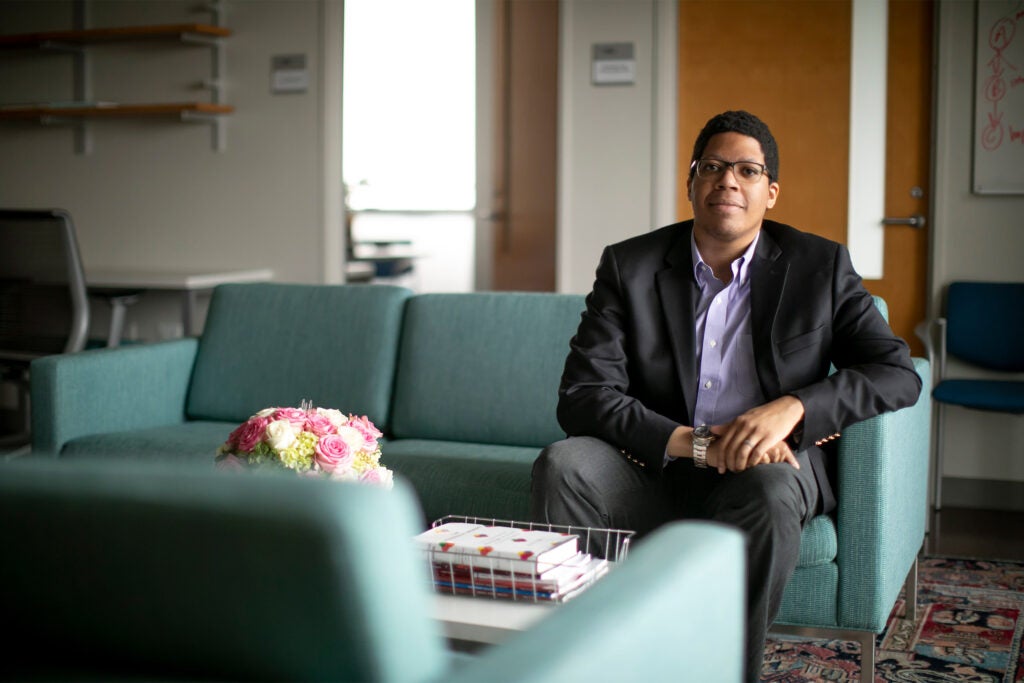
When Ellis Monk’s wife became pregnant in 2019, the couple became curious about what skin tone their child might have. The subject was of more than passing interest to the sociology professor, some of whose work involves the role lighter and darker skin tones play in society. Monk’s wife noted that a comprehensive scale would be useful and urged him to develop one.

So he did, and last month Google adopted Monk’s namesake 10-shade scale as a standard in its digital products to make them more inclusive and diverse and to promote wider awareness of the problems and unintended bias associated with technologies that fail to recognize a wider range of skin tones.

Monk’s scale is already making an impact. It has been incorporated in Google’s online image searches and photo filters. The innovation will be particularly important for training artificial intelligence and machine learning applications, such as facial recognition and self-driving vehicle systems, which often have not performed as well with people with darker skin tones. And it could help reduce or eliminate some unintended algorithm bias in search engines and other products.

“She encouraged me to keep it going,” Monk said, crediting his wife. “Eventually, I delved in and put together the Monk Skin Tone Scale, taking the baton [and] building on what she had started.”

Monk’s scale is a rethinking of the Fitzpatrick Scale, which has been considered the online standard. Created by dermatologist Thomas B. Fitzpatrick at Harvard Medical School in 1975, the Fitzpatrick Scale was developed to classify six tones based on skin pigmentation and response to sun exposure. It was not created with diverse populations in mind but as a gauge of tolerance for ultraviolet light, Monk explained.

Ellis Monk

Sociology Professor Ellis Monk chose 10 color points to better represent the range of skin tones. Google recently adopted Monk’s namesake 10-shade scale.

File photo by Rose Lincoln/Harvard Staff Photographer

The Fitzpatrick Scale has been in the open domain for decades and was adopted by the tech industry primarily for use in machine learning and artificial intelligence. Humans must annotate images or videos to train machine-learning algorithms for things like face detections.

“Instead of using this Fitzpatrick Scale, which wasn’t designed to classify diverse skin tones among different groups of people, you would use the Monk Skin Tone Scale, which gives you a more granular understanding,” Monk said. He chose 10 color points to better represent the range of skin tones, opting out of wider range as a larger numbers would begin to create problems with annotation. Extensive fieldwork on skin tone and colorism in the U.S. and Brazil informed the final color selection.

Monk’s collaboration with Google began a few years ago when he was contacted by its Research Responsible AI team, and over time, the work turned to finding an alternative to the Fitzpatrick Scale, the sociologist said. That is when the team learned that Monk had developed a scale of his own.

Google is already using the Monk Skin Tone Scale in its image search. When users search makeup looks, for example, they can refine those searches by skin tone to find more relevant matches. The tech giant also used the scale to update its own Real Tone filters (an initiative it had already launched to deal with the skin-tone problem) on its Pixel cameras so that they can capture a wider, more realistic palette of shades.

“There’ve also been some refinements to search where people have complained that in the past, if you search for certain images, you only get back certain types of people,” Monk said. “One example is if you search for ‘cute babies,’ you might get a completely homogenous set of babies that basically all look white. That’s not a very inclusive experience for people at all.”

Google says the scale will be useful in checking the diversity of results for problems with algorithms. “This has been a longstanding issue, not just at Google, but across the tech industry,” Monk said.

Monk plans to publish research, testing the scale on a diverse group of people. He and the Google team conducted research together to validate the scale in the U.S., which was an extension of his own work.

Developers who do not intentionally design their products to work well across the continuum of skin tones will have products that do not work as well, Monk added. The new scale is open-source so that all companies around the world can make their products more inclusive.

“My hope is that other companies, not just Google, take on the work of auditing and making sure that their products are designed to work equally well across the entire range of skin tones, whether that’s using the Monk Skin Tone Scale or not,” Monk said. “I hope they do that work.”


As food costs continue to rise and a global food crisis looms on the horizon, it’s staggering to think that some 30-40 percent of America’s food supply ends up in landfills, mostly due to spoilage. At the same time, the World Health Organization estimates that foodborne illness from microbial contamination causes about 420,000 deaths per year worldwide.

What if there were a way to package fresh foods that could extend their shelf life and eliminate microbial contamination?

Now, researchers from the Harvard John A. Paulson School of Engineering and Applied Sciences and the Harvard T.H. Chan School of Public Health have developed a biodegradable, antimicrobial food packaging system that does both.

“One of the biggest challenges in the food supply is the distribution and viability of the food items themselves,” said Kit Parker, the Tarr Family Professor of Bioengineering and Applied Physics at SEAS and senior author of the paper. “We are harnessing advances in materials science and materials processing to increase both the longevity and freshness of the food items and doing so in a sustainable model.”

The research was published in Nature Food.

From the battlefield to the farm

Surprisingly, the new food packing system has its roots in battlefield medicine. For more than a decade, Parker and his Disease Biophysics Group have been developing antimicrobial fibers for wound dressings. Their fiber manufacturing platform, known as Rotary Jet-Spinning (RJS), was designed specifically for the purpose.

RJS works likes a cotton candy machine — a liquid polymer solution is loaded into a reservoir and pushed out through a tiny opening by centrifugal force as the device spins. As the solution leaves the reservoir, the solvent evaporates, and the polymers solidify to form fibers, with controlled diameters ranging from microscale to nanoscale.

Rotary Jet-Spinning coats the avocado in thin fibers of pullulan.

Credit: Disease Biophysics Group/Harvard SEAS

The idea to translate the research from wound dressing to food packing was born of a collaboration with Philip Demokritou, the former co-Director of the Center for Nanotechnology and Nanotoxicology (NanoCenter) at the Harvard’s Chan School. The NanoCenter is a joint initiative between Harvard and Nanyang Technological University of Singapore.

“As it turned out, wound dressings have the same purpose, in some ways, as food packaging — sustaining tissues, protecting them against bacteria and fungi, and controlling moisture,” said Huibin Chang, a postdoctoral fellow at SEAS and first author of the paper.

To make the fibers food-safe, the team turned to a polymer known as pullulan. Pullulan is an edible, tasteless and naturally occurring polysaccharide commonly used in breath fresheners and mints.

The researchers dissolved the pullulan polymer in water and mixed it with range of naturally derived antimicrobial agents, including thyme oil, nisin, and citric acid. The solution is then spun in an RJS system and the fibers are deposited directly on a food item. The researchers demonstrated the technique by wrapping an avocado with pullulan fibers. The result resembles a fruit wrapped in spiderweb.

The research team compared their RJS wrapping to standard aluminum foil and found a substantial reduction of contamination by microorganisms, including E.coli, L. innocua (which causes listeria), and A. fumigatus (which can cause disease in people who are immunocompromised).

“The high surface-to-volume ratio of the coating makes it much easier to kill dangerous bacteria because more bacteria are coming into contact with the antimicrobial agents than in traditional packaging,” said John Zimmerman, a postdoctoral fellow at SEAS and co-author of the paper.

The team also demonstrated that their fiber wrapping increased the shelf life of avocado, a notoriously finnicky fruit that can turn from ripe to rotten in a matter of hours. After seven days on a lab bench, 90 percent of unwrapped avocados were rotten while only 50 percent of avocados wrapped in antimicrobial pullulan fibers rotted.

The wrapping is also water soluble and biodegradable, rinsing off without any residue on the avocado surface.

Making food more sustainable

This antimicrobial, biodegradable food packing system is not the Disease Biophysics Group’s first foray into making our food supply system more sustainable.

Parker’s group has used their RJS system to grow animal cells on edible gelatin scaffolds that mimic the texture and consistency of meat. That technology was licensed by Tender Food, a Boston-based startup that aims to combat the enormous environmental impact of the meat industry by developing a new generation of plant-based alternative meat products that have the same texture, taste, and consistency as real meat.

The lab’s latest innovations in food packaging may also soon enter commercial development. Harvard Office of Technology Development has protected the intellectual property relating to this project and is now exploring commercialization opportunities with Parker’s lab.

“One of my research group’s the long-range goals is reducing the environmental footprint of food,” said Parker. “We’ve done that by building more sustainable food to now packaging the food in a sustainable way that can reduce food waste.”

This research was co-authored by Jie Xu, Luke A. Macqueen, Zeynep Aytac, Michael M. Peters, Tao Xu and Philip Demokritou.

It was supported by the Nanyang Technological University–Harvard T. H. Chan School of Public Health Initiative for Sustainable Nanotechnology, under project number NTUHSPH 18003; the Harvard Center for Nanoscale Systems (CNS), a member of the National Nanotechnology Coordinated Infrastructure Network (NNCI), which is supported by the National Science Foundation under NSF award number 1541959; and Harvard Materials Research Science and Engineering Center, under grant numbers DMR-1420570 and DMR-2011754.


A summer dilemma worthy of Solomon: how to stay cool in days of high heat and humidity without turning to traditional air conditioning, which consumes vast amounts of electricity and emits potent climate-changing greenhouse gases.

The answer potentially involves a new class of solid-state refrigerants that could enable energy-efficient and emission-free cooling. And now researchers from the Department of Chemistry and Chemical Biology have developed an environmentally friendly mechanism to enable solid-state cooling with two-dimensional perovskites. Their findings are described in a new study in Nature Communications.

“Shifting away from the vapor compression systems that have been in use for a really long time is a crucial part of the overall push toward a more sustainable future,” said Jarad Mason, the paper’s senior author and assistant professor of chemistry and chemical biology. “Our focus is looking deeply at the intrinsic properties of these materials to see what is possible in terms of solid-state cooling as a sustainable alternative.”

Also known as barocaloric materials, the two-dimensional perovskites release and absorb heat in response to pressure changes as they expand and contract. The effect is based on a phenomenon you may be familiar with if you’ve ever stretched a balloon and felt it warm up against your lips. Similarly, these materials release heat when pressurized or stressed. Without releasing any harmful emissions, this mechanism can remove heat in the solid state using low driving pressures.

The work was led by members of Mason’s lab, including Jinyoung Seo, Ryan D. McGillicuddy, Adam H. Slavney, Selena Zhang ’22, Rahil Ukani, and Shao-Liang Zheng, director of the X-ray Laboratory. Advanced tests were also performed in collaboration with scientists at the Argonne National Laboratory in Lemont, Illinois.

This new mechanism for solid-state cooling has the potential to overcome the limitations of traditional vapor-compression cooling technology, which has remained largely unchanged since the early 20th century.

Any kind of refrigeration system runs in a cycle from a low-entropy state when a material can absorb heat, thereby cooling a space, to a high-entropy state when that energy can be released in a heat sink, where it dissipates. Vapor-compression air conditioners circulate a volatile fluid refrigerant that evaporates and condenses under varying pressure through metal coils to cool an enclosed space and eject heat outside. Running vapor-compression cycles is energy-intensive, responsible currently for almost 20 percent of electricity use in buildings around the world. In addition, leaking refrigerants are more than 1,000 times more potent greenhouse gases than carbon dioxide.

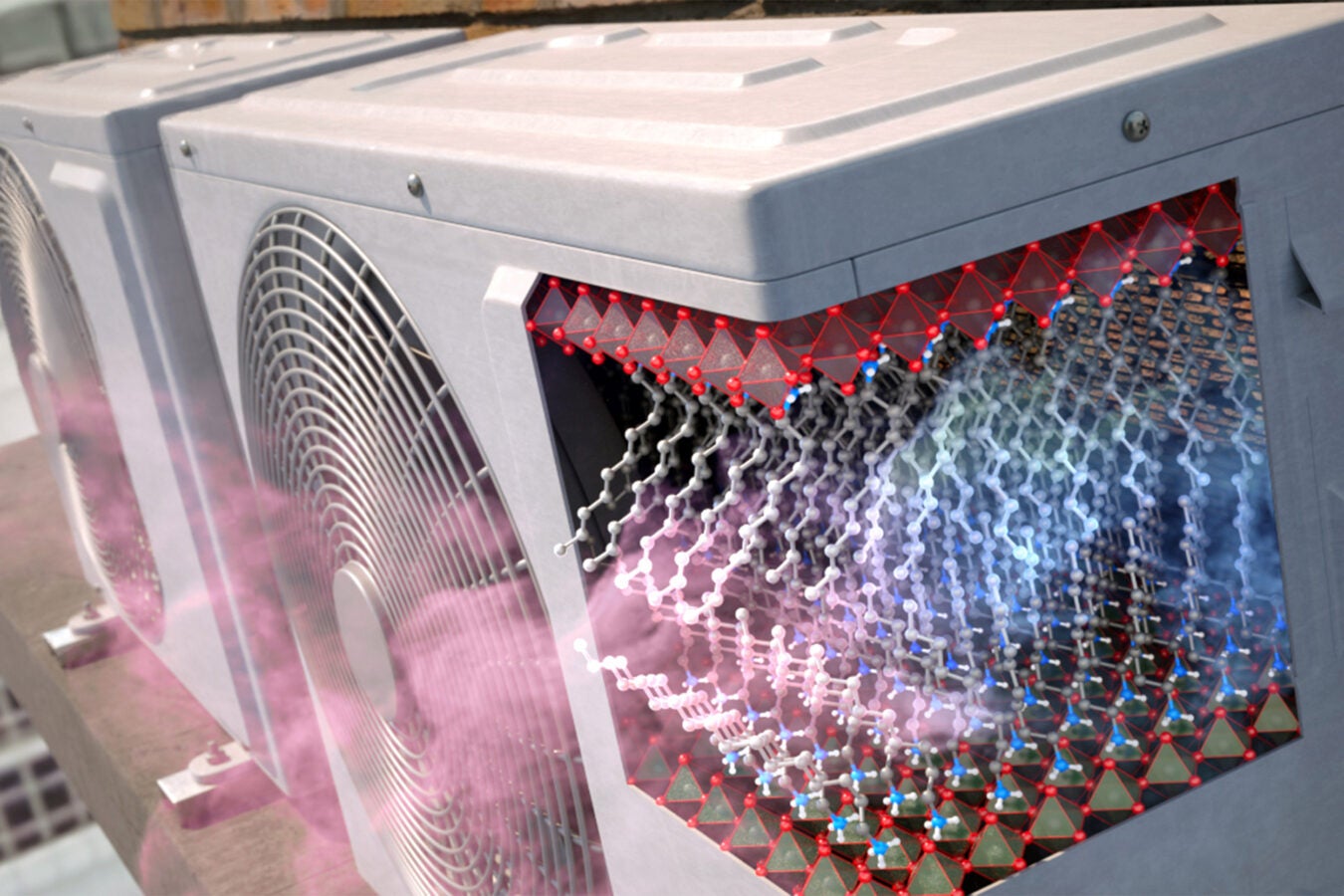
Air conditioner

The new mechanism (pictured) could replace traditional vapor-compression cooling technology, which has remained largely unchanged since the early 20th century.

The team identified two-dimensional perovskites as ideal substitutes because they undergo phase transitions that can be driven reversibly under minimal pressure, all while remaining in a solid state; the more a material can change its entropy, the more effective it can be for running cooling cycles. With organic bi-layers capable of undergoing large changes in entropy when their hydrocarbon chains switch between ordered and disordered states, the team anticipated that two-dimensional perovskites could serve as a highly tunable solid-state cooling material that could operate at lower pressures than thought possible.

The team synthesized the materials in their lab and tested them in a high-pressure calorimeter to measure changes in heat flow in the material under varying pressures and temperatures. These experiments reveal how much heat can be removed in a potential refrigeration cycle, and how much pressure is needed to drive the cycle reversibly.

“As soon as we began testing the material, we realized that we could remove a very large amount of heat with a very small pressure change,” Mason said. “From that point on, we knew that there was going to be something interesting here.”

The researchers also conducted high-pressure powder X-ray diffraction experiments at Argonne to understand phase changes at the molecular level. With the X-ray synchrotron, the teams were able to characterize how the structures of each material changes at varying temperatures and pressures.

“These materials are worth studying beyond their promising performance,” Seo said, “They can also be useful for chemists to understand the fundamental properties that are critical to realizing this technology at scale.”

The Mason Lab next plans to craft prototype barocaloric cooling devices while continuing to explore the potential use of different materials.

“We will likely use next-generation materials for the prototype device,” Seo said. “We are trying to come up with new technologies to address the cooling challenge.”


Why do we sleep? Scientists have debated this question for millennia, but a new study adds fresh clues for solving this mystery.

The findings, published in the Journal of Neuroscience, may help explain how humans form memories and learn, and could eventually aid the development of assistive tools for people affected by neurologic disease or injury. The study was conducted by Massachusetts General Hospital in collaboration with colleagues at Brown University, the Department of Veterans Affairs, and several other institutions.

Scientists studying laboratory animals long ago discovered a phenomenon known as “replay” that occurs during sleep, explains neurologist Daniel Rubin of the MGH Center for Neurotechnology and Neurorecovery, the lead author of the study. Replay is theorized to be a strategy the brain uses to remember new information. If a mouse is trained to find its way through a maze, monitoring devices can show that a specific pattern of brain cells, or neurons, will light up as it traverses the correct route. “Then, later on while the animal is sleeping, you can see that those neurons will fire again in that same order,” says Rubin.

Scientists believe that this replay of neuronal firing during sleep is how the brain practices newly learned information, which allows a memory to be consolidated — that is, converted from a short-term memory to a long-term one.

However, replay has only been convincingly shown in lab animals. “There’s been an open question in the neuroscience community: To what extent is this model for how we learn things true in humans? And is it true for different kinds of learning?” asks neurologist Sydney S. Cash, co-director of the Center for Neurotechnology and Neurorecovery at MGH and co-senior author of the study. Importantly, says Cash, understanding whether replay occurs with the learning of motor skills could help guide the development of new therapies and tools for people with neurologic diseases and injuries.

To study whether replay occurs in the human motor cortex — the brain region that governs movement — Rubin, Cash, and their colleagues enlisted a 36-year-old man with tetraplegia (also called quadriplegia), meaning he is unable to move his upper and lower limbs, in his case due to a spinal cord injury. The man, identified in the study as T11, is a participant in a clinical trial of a brain-computer interface device that allows him to use a computer cursor and keyboard on a screen. The investigational device is being developed by the BrainGate consortium, a collaborative effort involving clinicians, neuroscientists, and engineers at several institutions with the goal of creating technologies to restore communication, mobility, and independence for people with neurologic disease, injury, or limb loss. The consortium is directed by Leigh R. Hochberg of MGH, Brown University, and the Department of Veterans Affairs.

In the study, T11 was asked to perform a memory task similar to the electronic game Simon, in which a player observes a pattern of flashing colored lights, then has to recall and reproduce that sequence. He controlled the cursor on the computer screen simply by thinking about the movement of his own hand. Sensors implanted in T11’s motor cortex measured patterns of neuronal firing, which reflected his intended hand movement, allowing him to move the cursor around on the screen and click it at his desired locations. These brain signals were recorded and wirelessly transmitted to a computer.

That night, while T11 slept at home, activity in his motor cortex was recorded and wirelessly transmitted to a computer. “What we found was pretty incredible,” says Rubin. “He was basically playing the game overnight in his sleep.” On several occasions, says Rubin, T11’s patterns of neuronal firing during sleep exactly matched patterns that occurred while he performed the memory-matching game earlier that day.

“This is the most direct evidence of replay from motor cortex that’s ever been seen during sleep in humans,” says Rubin. Most of the replay detected in the study occurred during slow-wave sleep, a phase of deep slumber. Interestingly, replay was much less likely to be detected while T11 was in REM sleep, the phase most commonly associated with dreaming. Rubin and Cash see this work as a foundation for learning more about replay and its role in learning and memory in humans.

“Our hope is that we can leverage this information to help build better brain-computer interfaces and come up with paradigms that help people learn more quickly and efficiently in order to regain control after an injury,” says Cash, noting the significance of moving this line of inquiry from animals to human subjects. “This kind of research benefits enormously from the close interaction we have with our participants,” he adds, with gratitude to T11 and other participants in the BrainGate clinical trial.

Hochberg concurs. “Our incredible BrainGate participants provide not only helpful feedback toward the creation of a system to restore communication and mobility, but they also give us the rare opportunity to advance fundamental human neuroscience — to understand how the human brain works at the level of circuits of individual neurons,” he says, “and to use that information to build next-generation restorative neurotechnologies.”

Rubin is also an instructor in neurology at Harvard Medical School. Cash is an associate professor of neurology at HMS. Hochberg is a senior lecturer on neurology at HMS and professor of engineering at Brown University.

This work was supported by the Department of Veterans Affairs, the National Institute of Neurologic Disease and Stroke, the National Institute of Mental Health, Conquer Paralysis Now, the MGH-Deane Institute, the American Academy of Neurology, and the Howard Hughes Medical Institute at Stanford University.  


In the 1970s, as Evelynn Hammonds walked the halls of MIT’s physics department on her way to a Ph.D., faculty, students, and staff kept asking her the same question:

“Hi, Shirley, how’s your work going?”

Her name, of course, was Evelynn, not Shirley. A few years before, Shirley Jackson, the second African American woman to receive a Ph.D. in physics in the United States, had been the only Black woman in the department. But she was gone by the time Hammonds, also the only Black woman in MIT physics, arrived.

“As an African American woman, I carried the double burden,” Hammonds, the chair and professor of the history of science at Harvard, recalled in a recent interview with the Harvard Museums of Science and Culture. “The first two years, I just felt like I was constantly fighting to have people take me seriously.”

After she earned her degree, Hammonds took a leave of absence to grapple with questions physics couldn’t answer: “Where are the women? What’s going on?”

Today, on the 50th anniversary of Title IX, which prohibits sex-based discrimination at educational institutions that receive federal funding, she’s still asking why there aren’t more women in science, technology, engineering, and mathematics. “The attitudes and the culture haven’t changed as much as they absolutely have to,” she said.

Most people associate Title IX with anti-discrimination initiatives in athletics and efforts to reduce sexual harassment. But it was also intended to increase women’s access to higher education. This “big hammer,” as the chemist Debra Rolison calls it, could be used to put universities on alert: Fail to increase the representation of women in STEM, and the government might take away your federal funding.

“No money from the feds is death at the door,” said Rolison, who has been fighting for women’s equality since her male cousins excluded her from a baseball game when she was 5 years old. “I have never, ever appreciated that double standard,” she said. “And every time I can say or do something about it, I do.”

For decades, Rolison, who is head of the Advanced Electrochemical Materials section at the Naval Research Laboratory, has given talks to raise awareness about gender inequities in STEM. When words haven’t been enough, she has sought to force change by using the “big hammer” Title IX represents.

Since the law’s enactment, women have made some gains in science and engineering — they’ve gone from representing just 8 percent of STEM workers in 1970 to 27 percent in 2019. But men still dominate, making up half of all U.S. employees but 73 percent of the STEM workforce. A report published in 2018 made clear that sexual harassment was still an everyday reality for many women in science. Two years later, the American Association of University Women (AAUW) found that women in science earned about $15,000 less than their male colleagues.

“The gender gap that exists in the STEM workforce cannot be blamed on differences in academic preparation,” the National Coalition for Women and Girls in Education wrote in a report released this month. Research has shown that women are no less capable than men in science and mathematics. But, according to the AAUW, external factors, like a lack of role models, cultures that tend to exclude women, and persistent stereotypes about women’s intellectual abilities, reinforce a wide gender gap. Even today, teachers and parents underestimate girls’ STEM abilities from a young age. From a historical perspective, at least in certain fields, we seem to have regressed.

“In 1700, 14 percent of German astronomers were women,” said Londa Schiebinger, who earned her Ph.D. in history from Harvard and is now the John L. Hinds Professor of History of Science at Stanford University. As a student, she couldn’t stop wondering: “What happened to all the women?”

The were pushed out, she found, and men brandished biased science to justify keeping them out. Take the Harvard-trained physician Edward Hammond Clarke, who practiced in the late 1800s.

Clarke, Schiebinger noted, claimed that as a woman’s brain grows, her ovaries shrink — clear-cut evidence, he said, that a woman’s rightful place was in the home, bearing children. The first drawings of the female skeleton, also from the 19th century, depicted (inaccurately) small skulls and large pelvises — more evidence, male scientists thought, that a woman’s body was made for procreation. In the 1920s, men blamed female hormones for their inferior minds. A century later, when Schiebinger was a graduate student at Harvard, she still heard men argue that women were intellectually deficient and ill-suited for science.

The gender gap isn’t just about percentages or fairness; a lack of women (and other minorities) in a field affects the quality of the science, as Schiebinger has discovered.

Women are 47 percent more likely to be injured in a car crash, she said, because crash test dummies are just smaller versions of the male anatomy. “It’s a shrink-it and pink-it sort of thing,” Schiebinger said. Medical devices fail more often for women. Pulse oximeters, for example, which measure blood oxygen levels, tend to miscalculate these levels in women and people of color, putting them at risk of not receiving emergency care (an especially pernicious threat during the pandemic). Large datasets don’t have equal representation of women or different ethnic groups. Search algorithms, for example, show more high-paying jobs to men because that’s what their underlying data tells them: men earn more.

“It’s not like Title IX changed anything,” Schiebinger said. “It’s been the women’s movement, right? It’s the people who have been working nonstop on institutional reform. Some law doesn’t really change anything.”

A male-dominated culture — along with its unconscious biases and rewards for cutthroat pursuit of money and prestige — is still considered one of the biggest and most stubborn barriers women face in STEM, said Schiebinger.

Hammonds would agree.

“You’re in a culture where, on any given day, somebody might think you were a secretary, or a janitor, or anything but a graduate student in physics, so you had to live with that,” she said. “It was made very clear to us by some people that we didn’t fit, that we didn’t belong, that we were only there because of affirmative action, that we could never be successful. We were constantly finding those attitudes.”

Some people argue that women choose to avoid STEM careers because of long hours that can intrude on family responsibilities. It’s true, Rolison noted, that child care and parental leave are critical benefits that ensure women can have a family without sacrificing career ambitions.
But, she said, the particular demands and realities of a life in science are not the primary problem. “There’s plenty of work done to show that, no, it’s the culture. It’s always the culture. It’s not the low pay; it’s not the long hours; it’s the culture.”

To fix the culture, Schiebinger argues for a coordinated approach. Courses should teach awareness of social issues; journals and funding agencies shouldn’t accept research that doesn’t consider gender and sex; big hammers like Title IX should be used as levers to force stubborn institutions to do better.

“These have to be structural solutions. It’s not just getting this woman or that woman,” Schiebinger said. “You gotta do it everywhere. Start in the womb, I always say.”


MKRdezign

Contact Form

Name

Email *

Message *

Powered by Blogger.
Javascript DisablePlease Enable Javascript To See All Widget