Latest Post

The Milky Way is often depicted as a flat, spinning disk of dust, gas, and stars. But if you could zoom out and take an edge-on photo, it actually has a distinctive warp — as if you tried to twist and bend a vinyl LP.

Though scientists have long known through observational data that the Milky Way is warped and its edges are flared like a skirt, no one could explain why.

Now, Harvard astronomers at the Center for Astrophysics | Harvard and Smithsonian (CfA) have performed the first calculations that fully explain this phenomenon, with compelling evidence pointing to the Milky Way’s envelopment in an off-kilter halo of dark matter. The work also bolsters current thinking about how the galaxy evolved and may offer clues into some of the mysteries of dark matter.

The new calculations were led by Jiwon Jesse Han, a Griffin Graduate School of Arts and Sciences student affiliated with the CfA. Published in Nature Astronomy, the work includes co-authors Charlie Conroy and Lars Hernquist, both faculty members at the CfA and in the Department of Astronomy.

Our galaxy is located inside a diffuse cloud called the stellar halo, which extends much farther out into the universe. In groundbreaking work published last year, the Harvard team deduced that the stellar halo is tilted and elliptical in shape, like a zeppelin or football.

Building on that, the team assumed the same shape for the dark matter halo, the larger entity that encompasses everything in and around the Milky Way. Dark matter makes up 80 percent of the galaxy’s mass but is invisible because it doesn’t interact with light, so the shape of that halo must be inferred. Using models to calculate the orbits of stars within a tilted, oblong dark matter halo, the team found a near-perfect match to existing observations of a warped, flared galaxy.

“A tilted dark halo is actually fairly common in simulations, but no one had explored its effect on the Milky Way,” Conroy said. “It turns out that the tilt is an elegant way to explain both the magnitude and direction of our galaxy’s wobbly disk.”

Scientists had long surmised that the Milky Way formed due to a galactic collision; the astronomers’ work further underscores that hypothesis.

“If the galaxy was just evolving on its own, it would have had this nice, spherical halo, this nice, flat disk,” Han said. “So the fact that the halo is tilted and has a football-like shape suggests that our galaxy experienced a merger event, where two galaxies collide.”

Their calculation of the dark matter halo’s probable shape may also provide clues as to the properties and particle nature of dark matter itself, which remain unsolved mysteries in physics. “The fact that the galaxy is not spherical in our data implies that there is some limit to which dark matter can interact with itself,” Han explained.

Confidence in these findings might lead to better ways to cleverly study the unobservable dark matter that makes up most of the universe. This includes new ways to pick up on kinematic signatures of dark sub-halos, which are miniature dark matter halos zipping around the galaxy.


The human brain is a tangled highway of wires emanating from nearly 100 billion neurons, all of which communicate across trillions of junctions called synapses. “Depressingly complex,” Harvard neuroscientist Jeff Lichtman calls it. The only way to understand this highway, says Lichtman, is to create a map.

Lichtman, the Jeremy R. Knowles Professor of Molecular and Cellular Biology, has spent several decades generating such maps, and in doing so has pioneered a field known as “connectomics.” His ultimate goal is a whole-mammalian brain map accounting for every neural connection, a so-called “connectome.”

Now, Lichtman and colleagues are embarking on a critical new step of that journey by seeking to capture synapse-level connectome data from a mouse brain at unprecedented clarity and resolution.

Lichtman and partners including Princeton University, MIT, Cambridge University and Johns Hopkins have received $30 million from the National Institutes of Health and an additional $3 million from Harvard and Princeton toward the goal of reconstructing, for the first time, all the neural wiring inside a mouse brain. They’ll prove the feat possible by first imaging a 10 cubic-millimeter region in the mouse hippocampal formation, the portion of the brain responsible for memory consolidation, spatial navigation, and other complex tasks.

Like the Human Genome Project cataloged every human gene and its unique DNA sequence, Lichtman’s connectome, which he has worked on since arriving at Harvard in 2004, would be a comprehensive diagram of every neural connection in the brain.

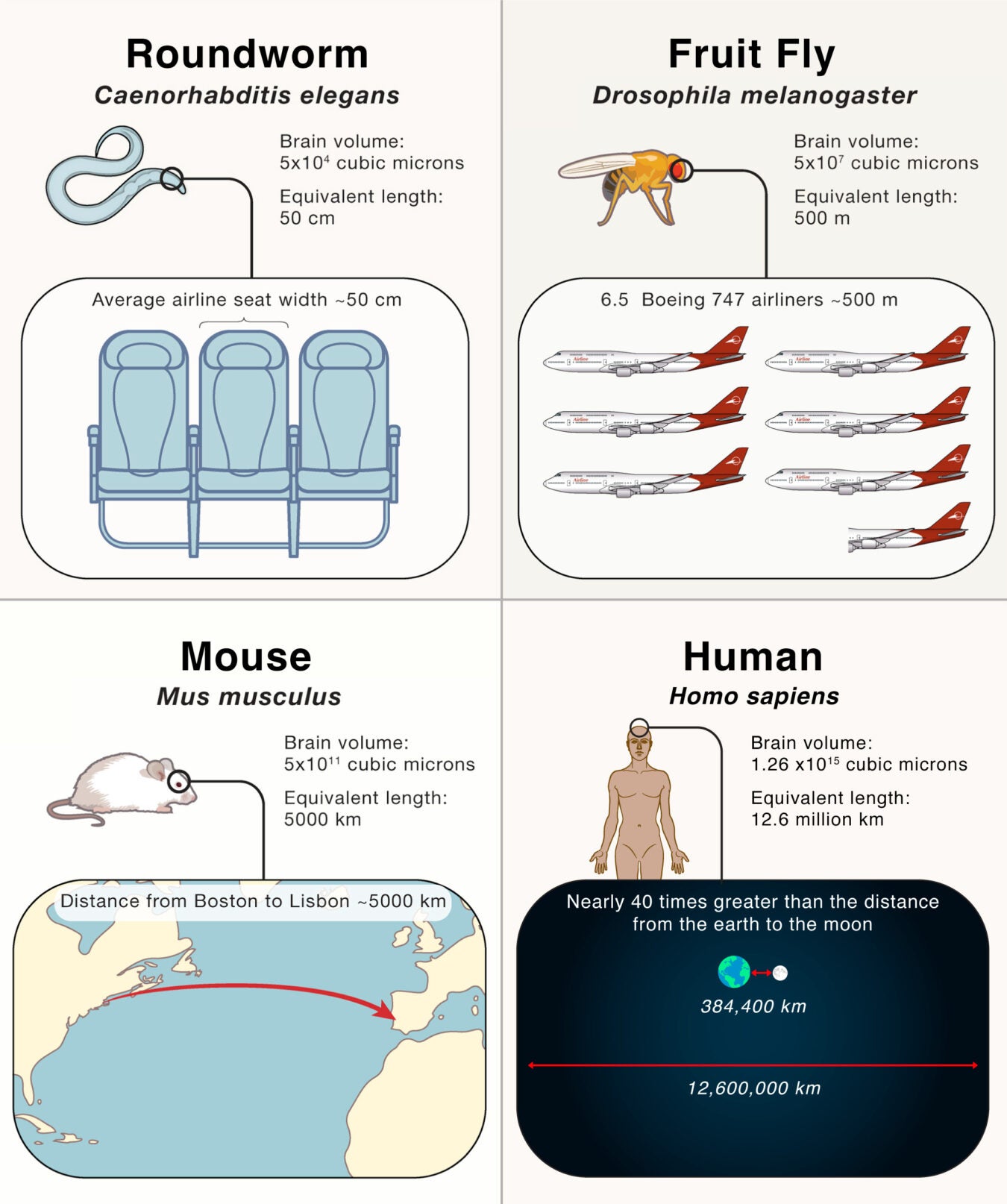
Comparing brain volume from worm to human

Each 1,000 cubic microns of brain volume is schematically represented by a 1 cm. linear distance.

Source: "The Mind of a Mouse," Cell; Jeff W. Lichtman and Viren Jain

Creating a connectome of the human brain could lead to new approaches in diagnosing and treating disorders of the brain, from autism to schizophrenia. Scientists suspect these diseases are “connectopathies” — subtle miswirings that no currently available brain scans can detect.

“Connectomics is the only pathway,” said Lichtman, an affiliate of Harvard’s Center for Brain Science. “If we get to a point where doing a whole mouse brain becomes routine, you could think about doing it in say, animal models of autism. There is this level of understanding about brains that presently doesn’t exist. We know about the outward manifestations of behavior. We know about some of the molecules that are perturbed. But in between, the wiring diagrams, until now, there was no way to see them. Now, there is a way.”

The National Institutes of Health awarded new recipients of the Brain Research Through Advancing Innovative Neurotechnologies® Initiative, or BRAIN Initiative, funding in early September. The Harvard team is being funded through the BRAIN Initiative Connectivity Across Scales network, aimed at developing research capacity and technical capabilities for creating wiring diagrams of whole brains.

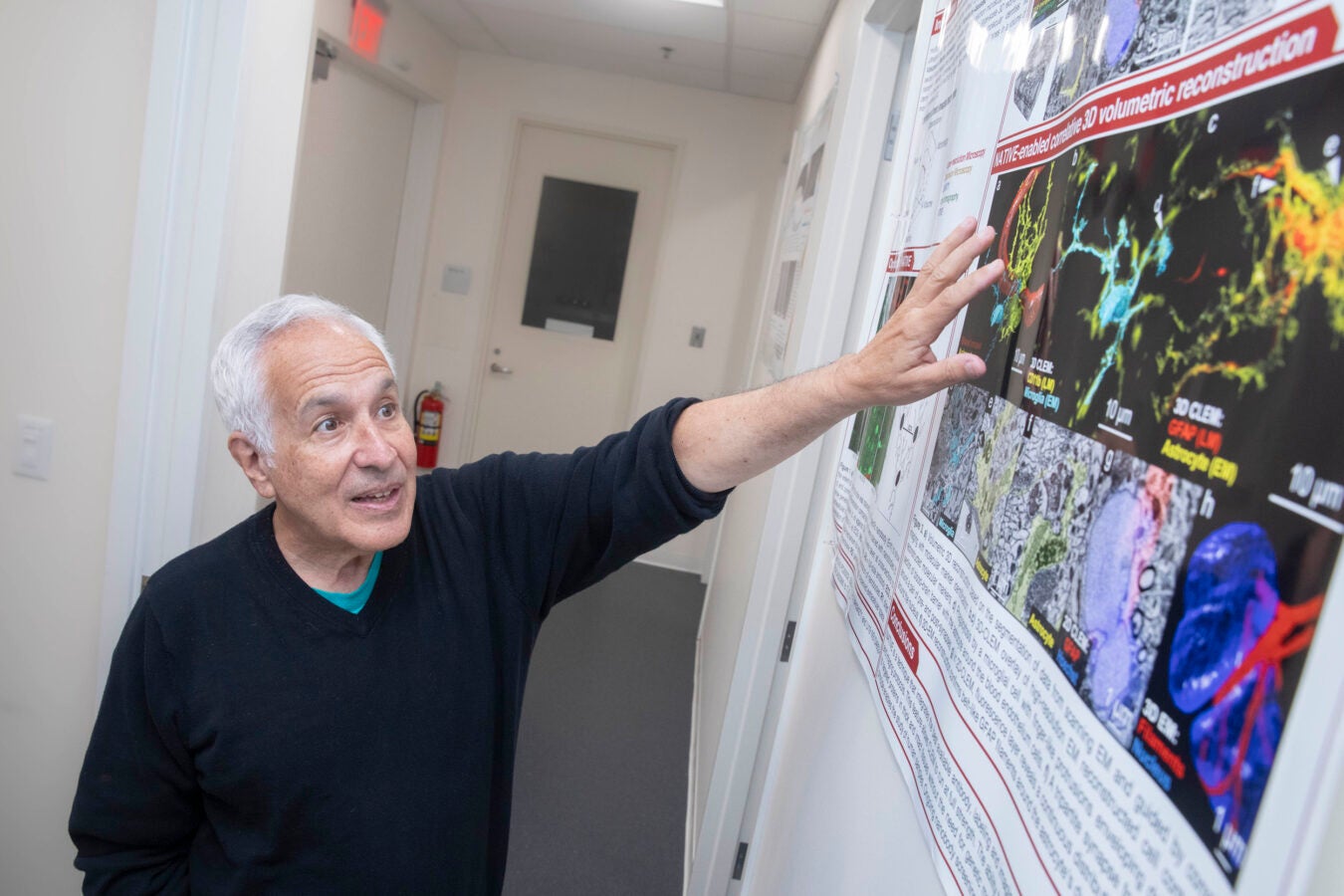
Jeff Lichtman.

The only way to understand the "depressingly complex" human brain is to create a map, says Jeff Lichtman, who has spent decades pioneering work in "connectomics."

Kris Snibbe/Harvard Staff Photographer

“Current techniques lack either the resolution or the ability to scale across and map out large regions of the entire brain, information that is essential for unraveling the mysteries of this incredible organ,” said John Ngai, director of the BRAIN Initiative. “Following years of careful planning and input from the scientific community, BRAIN CONNECTS — which represents our third, large-scale transformative project — aims to develop the tools needed to obtain brain-wide connectivity maps at unprecedented levels of detail and scale.”

The mouse brain is, of course, much smaller than a human’s, but when looking at individual neurons, synaptic vesicles and glial cells, “you can’t tell the difference,” Lichtman said. “At the level of cells and synapses, all mammalian brains are basically the same.”

Given recent advances in computing and data processing, and prior work by Lichtman and others — including Professor Florian Engert in molecular and cell biology —­ on the brains of zebrafish and fruit flies, achieving a mouse brain map has become more feasible and would serve as an early proving ground for imaging the human brain. Lichtman and colleagues urged collective efforts toward the lofty goal of a mouse brain connectome in a 2020 opinion piece titled “The Mind of a Mouse.”

The researchers will apply biological imaging techniques Lichtman and colleagues have invented over the course of several decades to achieve their goals. For the NIH project, they will employ a two-tiered system. First, two 91-beam scanning electron microscopes, one at Harvard and one at Princeton, will capture images of thin sections of the mouse hippocampal formation. The surface of each section will then be etched away with an ion beam just a few nanometers at a time, and the imaging process will be repeated until the entire volume is viewed. A team at Google Research will computationally extract the resulting wiring diagram with machine learning.

The team expects to generate about 10,000 terabytes of data for their 10-square-millimeter mouse brain section; 50 times that amount of data would be generated for a whole mouse brain. Over the first half of their five-year project, the team expects to generate up to 50 terabytes of data per day.

Lichtman’s team has worked with Google over the last several years on image processing techniques that allow them to make sense of large amounts of data quickly. Engineers led by grant co-investigator Viren Jain will apply artificial intelligence algorithms to these brain images to categorize and color-code nerve cells and synapses. Google will also help publicly share this enormous brain map.

“We plan on using our experience with computational reconstruction and analysis of large-scale electron microscopy data, along with Google’s highly scalable data processing infrastructure, in order to enable mouse connectomics at an unprecedented scale,” said Google’s Jain. “We have worked closely with Jeff’s lab over five years, and this collaboration has been highly successful in pushing the frontiers of data-intensive neuroscience.”

The research is supported by the NIH BRAIN Initiative under award number 1UM1NS132250-01. Lichtman is involved with another BRAIN CONNECTS grant awarded by the NIH, which is led by Professor of Physics Aravinthan D.T. Samuel and is aimed at developing a rapid-imaging strategy for connectomics. More information on other awardees.


It was the perfect way to kick off her work at the Salata Institute for Climate and Sustainability.

Elaine Buckberg, former chief economist for General Motors, drove from Michigan to her new home state of Massachusetts this summer in her EV and found one aspect of the journey particularly challenging.

“If you’re going through a part of America that doesn’t have a lot of chargers, you really need to be researching,” said Buckberg, who made the trip a second time in another EV she owns with her husband. “Is that charger going to work when we get there? What’s our fallback option? Do we need to charge sooner?”

That scarcity of public chargers, with unreliable coverage for long-distance trips, remains a major obstacle to widespread EV adoption. As head of the new Driving Toward Seamless Public EV Charging initiative, Buckberg, a new senior fellow at the Salata Institute, will lead a team of researchers from Harvard and the MIT Center for Energy and Environmental Policy Research in pursuit of improvements. Key collaborators include Christopher R. Knittel, an MIT applied economics professor who also directs the MIT Center for Energy and Environmental Policy Research, and Harvard’s Vice President for Climate and Sustainability James H. Stock, who also directs the Salata Institute.

Buckberg previewed some of the team’s ideas for the Gazette while also offering tips for EV drivers. The interview was edited for length and clarity.

Q&A

Elaine Buckberg

GAZETTE: Why is the EV transition so important?

BUCKBERG: Transportation accounts for 28 percent of U.S. greenhouse gas emissions. Light-duty vehicles, like passenger vehicles, account for 17 percent. Transitioning to EVs is tremendously important for reducing greenhouse gas emissions and continuing to drive emissions lower to ultimately net zero.

GAZETTE: How do problems with public charging hold back EV adoption?

BUCKBERG: The fact is, EVs are becoming increasingly good substitutes for internal combustion engine vehicles. They have longer ranges. Their price point has come down. They are becoming available in different shapes and sizes. But the thing that’s not getting solved is access to ubiquitous and easy charging. It’s a piece that won’t be resolved by the automakers alone.

A lot of early EV adopters have homes where they can install charging, but to actually achieve the EV transition we need two things. One, we need communities and workplaces to provide EV charging options for people who can’t plug in at home. Second, we need DC fast charging along highway corridors so every EV owner feels like they can do a road trip.

That’s important because market research shows that auto buyers buy cars for their extreme use case. Even if there are two cars in the household and they do very few road trips, they still don’t want a car that will not do that road trip.

BUCKBERG: The first project we’re looking at is real-time sharing of public charger data. So you could go on the likes of Apple or Google Maps, just like you already do when planning your trip, and find chargers along the way, know whether they’re operating, know whether there’s a queue, and know what the price is in advance.

Another thing we’re thinking about is zoning that would drive investment in community charging locations. That might include developing zoning best practices and using the resources of Harvard — like the Taubman Center for State and Local Government and Bloomberg Center for Cities — to roll these out to municipalities. For example, you need a charger for every X spaces in your parking lot if that lot is for public, employee, customer, or resident parking.

One more important consideration with EVs is maximizing climate benefits. You actually want to drive charging toward the daytime, when more renewables are involved in producing the electricity to charge vehicles, meaning lower emissions. We have to think about how electricity rate structures are designed.

GAZETTE: How did you make it work during your own cross-country trips?

BUCKBERG: It turned into my husband driving while I feverishly researched. The app native to my Chevy Bolt EV allows you to read your level of charge when you start the trip. But then it’ll say, “Stop at this charger” in some smaller town in upstate New York.

I then needed to try to find information on the internet about whether that charger was working. Does this type of charger have a website? Can I cross-reference that with another site that has user reporting on whether chargers are working or not, like Plugshare?

Do one of these sites tell me when someone last used it? If it worked during the last 12 to 24 hours, I feel pretty good. But if I can’t find a report of it working in the last few days, I’m going to be much more cautious. On our second trip, we stopped at a charger that had worked for us two weeks earlier. And this time it didn’t work.

GAZETTE: Where do you see progress on EV charging?

BUCKBERG: A consortium of seven automakers just announced a joint investment in 30,000 chargers in North America. And they want them in places with restaurants and bathrooms. Other companies are making moves to install chargers in places where it wouldn’t be so bad to charge for 20 or 30 minutes, like truck stops and the parking lots of big box stores. You could plan your lunch or errands around them.

But, despite this progress, we need the EV charging experience to get much better. We need lots of chargers at each station. We need vehicles to have built-in software that plans your route. Your EV should send you to the charger and precondition the battery without your asking. We need every EV owner to have this kind of experience. For that to happen, EV charging infrastructure needs to get much better much faster. That’s why this collaboration with MIT is really important.


COVID-19 patients are often prescribed antiviral drugs that work by reducing the number of viral particles circulating in the body. One such drug, molnupiravir, tricks the virus into generating mutations, some of which are lethal to the virus itself. The mutations eventually overwhelm and destroy the body’s SARS-CoV-2 population.

Since molnupiravir causes the virus to die by inducing mutations, some have raised concerns about the possibility of inadvertently creating new, treatment-resistant versions of the virus. Coronaviruses like SARS-CoV-2 are good at mutating into newer strains like Delta, Omicron, and EG.5. The idea of a drug that helps the virus mutate, even for the purpose of killing it, has some people worried.

A research team that includes Martin Nowak, Harvard professor of mathematics and biology, took a math-based dive into the question of whether molnupiravir could lead to harmful mutations of the virus that causes COVID-19. Nowak’s collaborators were Gabriela Lobinska and Yitzhak Pilpel, both of Israel’s Weizmann Institute of Science, and their work appears this month in the journal PLOS Biology.

They conclude with potential good news: Molnupiravir appears to be “marginally evolutionarily safe.” That is, if used correctly, the treatment reduces the ability of the virus to create surviving mutants.

“We are introducing the concept of evolutionary safety — the idea that giving the drug will leave less mutants than not giving the drug,” said Nowak, who is a leading authority on the mathematics of virus dynamics.

To draw their conclusions, the team constructed a set of mathematical rules that describes the increase and decrease of viral load after infection, and they compared the total amount of original and mutant viruses produced by someone during an infection.

They found that a patient who receives the drug actually makes fewer mutants over time than a patient who does not. Using molnupiravir triggers what scientists refer to as the virus’s error threshold, or the point at which mutations make its survival impossible. Death by mutation is called lethal mutagenesis.

“We propose that, in the future, these types of drugs should be pursued, and their evolutionary safety should be carefully evaluated,” Nowak said. Molnupiravir belongs to a class of drugs called nucleoside analogs, which include drugs that treat HIV.

The researchers propose that a drug with even better ability to cause lethal mutagenesis might be more evolutionarily safe than molnupiravir is now.

Their work also finds that molnupiravir appears to be more effective for those with difficulty clearing the virus on their own. It may be less evolutionarily safe to give it to people who can clear the virus quickly. But for those healthier patients, the total number of mutants stays low in any case.


The Salata Institute Seed Grant Program, launched in April to enable new interdisciplinary research in climate and sustainability, has announced its first cohort of awards. The program will support 19 faculty members working across seven Harvard Schools with funding for projects ranging from exploring a new, algae-based building insulation material to researching the carbon footprint of AI-driven computing.

Harvard faculty members interested in applying to the program, which is supported by a gift from the Troper Wojcicki Foundation, can access the current call for proposals to learn more. The next deadline to apply is Sept. 8.

Here’s a look at the first 14 projects the program is funding, presented in alphabetical order by lead researcher’s name.

1.

Using sensors buried in arctic ice to better predict sea-level rise
Principal investigator Carlos Argüelles-Delgado
Co-principal investigator David R. Clarke

Just how much — and how fast — sea levels will rise is one of the most pressing questions raised by climate change. Understanding the dynamics of glacial melting is crucial to producing accurate sea level forecasts, which in turn help decision-makers and stakeholders mitigate and adapt to shifting risks. The team will use readings collected over 10 years from sensors buried in a cubic kilometer of Antarctic ice to better understand how glacial melting will fuel sea level rise.

2.

Insulating buildings with algae foam
Principal investigator, Martin Bechthold
Co-principal investigator Jennifer Lewis

Most homes in the U.S. are still heated and cooled with fossil fuels, contributing significantly to climate change. Thermal insulation remains the most impactful and cost-effective way to reduce buildings’ energy consumption and emissions — but insulation materials remain too carbon-intensive. Faculty from the Graduate School of Design and John A. Paulson School of Engineering and Applied Sciences will work to develop a proof of concept for a carbon-negative insulation material made from microalgae.

3.

Communicating benefits of climate action
Principal investigator Joe Blatt
Co-principal investigators Mina Cikara, Dustin Tingley, and K. “Vish” Viswanath

An effective response to climate change in the U.S. will require broad support. The key to overcoming resistance to green energy and sustainability solutions may lie in communicating their benefits — from new, high-paying jobs to better public health and fewer catastrophic weather events. Faculty from the Graduate School of Education, the Departments of Government and Psychology in the Faculty of Arts and Sciences, and the T.H. Chan School of Public Health will design and test content.

4.

Studying electricity subsidies, consumption in developing world
Principal investigator Rema Hanna
Co-principal investigators Ben Olken, Elan Satriawan, and Sudarno Sumarto

Indonesia has made great strides in providing electricity access to its citizens, jumping from about 53 percent coverage in 2000 to nearly 100 percent today. Yet Indonesia’s grid is carbon-intensive. A team from the Kennedy School, MIT Economics, and the National Team for the Acceleration of Poverty Reduction in Indonesia will examine the relationship between electricity subsidies and consumption in Indonesia. The results may help policymakers tailor subsidy programs to reduce climate impacts in low- and middle-income countries.

5.

Quantifying the carbon footprint of future technologies
Principal investigator Gage Hills
Co-principal investigators David Brooks and Gu-Yeon Wei

Recent estimates suggest that the information and communication technology sector drives 2.1 to 3.9 percent of global carbon emissions. That number is expected to increase as demand for computing driven by artificial intelligence, metaverse, blockchain, and Internet of Things devices accelerates. At the same time, advanced silicon technologies and beyond-silicon nanotechnologies are being explored for improving energy efficiency of computing systems. Faculty from SEAS will develop a framework to study how these future technologies impact climate change and energy efficiency.

6.

Blending wildfire observations with numerical modeling
Principal investigator Frank Keutsch
Co-principal investigator Loretta J. Mickley

In the coming decades, wildfires in the western U.S. are projected to increase dramatically. Gaps in understanding about the links between climate change and wildfire activity present challenges for policymakers. Harvard faculty will launch a pilot study examining two critical but poorly understood dimensions of wildfire risk: the potential of plumes from the most intense blazes to penetrate into the stratosphere and the consequences to our atmosphere and regional climate. The team hopes to demonstrate a practical path to combining state-of-the-art observing systems with numerical modeling.

Recognizing Indigenous claims for environmental justice
Principal investigator Michèle Lamont

Lamont is an expert on the power of recognition — rendering others as visible and valued — in driving social and cultural change. She will expand her work to examine recognition in a global context with a special focus on claims for environmental justice by Indigenous people. Through in-depth interviews, Lamont and her team will explore the environmental and climate justice-related views of Indigenous people living in Canada and the Northern Mariana Islands of the South Pacific.

8.

Building climate-resilient health systems
Principal investigator Megan Murray

As climate change deepens health risks worldwide, there is a need for climate-resilient health systems. This need is especially urgent in low- and middle-income countries, where rising temperatures, changing precipitation patterns, and rising sea levels increasingly compromise air quality, water availability, and access to nutritious foods. Faculty from the Department of Global Health and Social Medicine at Harvard Medical School will launch a workshop, bringing together experts from across disciplines to chart a shared research agenda focused on the role of community health workers.

9.

Enhancing campus sustainability
Principal investigator Vijay Janapa Reddi

A project at Harvard’s Science & Engineering Complex, led by an applied-machine-learning-systems expert, will deploy tiny machine-learning sensors throughout the SEC to explore resource consumption and waste generation. It will enable real-time monitoring and analysis, fostering discussions and learning among STEM students on climate change and sustainability. The collected data will empower students to make informed choices, inspiring eco-friendly practices and potential solutions.

10.

Rethinking window glass requirements
Principal investigator Holly Samuelson

With window glass selection in mixed climates, architects can prioritize saving heating or cooling energy. The optimal glass properties depend on not only building type and window orientation — variables already lumped together in today’s broad-brush building codes — but also properties of evolving heating systems and electricity generation. Since windows built today will be in place for decades, Samuelson, an associate professor at the Graduate School of Design, will study the potential benefits of revising glass requirements.

11.

Who’s suffering? Studying toll on mental health.
Principal investigator Karen Thornber

In June 2022, the World Health Organization released a policy brief underscoring the lack of research on the toll of climate change on mental health, impacts that are distributed unequally. Thornber will analyze how the impacts of climate change on mental health intersect with class, race, ethnicity, gender, and other factors. Thornber will draw on case studies — from Inuit, Sámi, Indigenous Taiwanese, and Polynesian stories to bestsellers and blockbusters from Asia, Africa, the Americas, and Europe.

Decarbonizing healthcare systems
Principal investigator Stéphane Verguet

Healthcare is not only at risk from climate change, it is also a major polluter, representing 4 to 5 percent of global carbon emissions. The World Health Organization is urging countries to reduce pollution while reinforcing health systems. Since November 2021, 65 countries have committed to developing low-carbon health systems. This team will provide evidence for governments to use in equitably and efficiently decarbonizing their healthcare systems.

13.

Calculating computing’s footprint
Principal investigator Gu-Yeon Wei
Co-principal investigator David Brooks

A commonly ignored consequence of the computer age is the carbon footprint of making and running computers. As an explosion in services relying on vast amounts of computing continues, the carbon impacts will continue to mount. SEAS researchers will launch an effort to develop a practical and accurate measure of carbon emissions associated with the fabrication and operation of computers and electronic devices.

14.

Toward a national agroforest
Principal investigator Amy Whitesides

As carbon sinks, forests play a key role in mitigating climate change. Historically and today they are lost to urban and agricultural expansion. Agroforestry may offer means to diversify and protect lands that face encroachment and climate threats and often support lower-income communities. Whitesides of the Graduate School of Design will explore the formation of a National Agro-forest. This work will bring together landscape architects, planners, foresters, farmers, municipalities, and specialists in land management.


Summer headlines have screamed of climate extremes: Record temperatures, an ocean heat wave, and rampant wildfires, including Canadian blazes that have funneled dense smoke into major U.S. cities.

For Loretta Mickley, a Harvard wildfire expert, the fires present a dual problem: Not only are they a symptom of climate change — becoming bigger, hotter, and more common in regions where they can affect large population centers — but they also make the crisis worse. By burning vast layers of partially decomposed vegetable matter called peat, fires like those in Canada release even more greenhouse gases into the atmosphere.

The Gazette spoke with Mickley, who will chair a National Academies workshop next month on wildfires as a driver of greenhouse gases, about the science behind the threat. The interview has been edited for clarity and length.

Q&A

Loretta Mickley

GAZETTE: How do we expect wildfires to change in the decades to come?

MICKLEY: The consensus is that wildfires will increase in what we call boreal regions —Siberia, northern Canada, and Alaska. With climate change, these regions are warming more rapidly than elsewhere on the globe, and the warmer temperatures will dry out the fuel, leading to increased fire activity. Fire is also predicted to increase in the western U.S. The climate in the western U.S. is historically very variable, prone to dryness, and climate models suggest that we’ll have more frequent droughts and more fire activity there.

In Australia as well as the Mediterranean, there’s also a strong view that fires will increase, again because of warmer or drier conditions under climate change. The fires in Australia in 2019-2020 and in Greece this summer are consistent with these projections.

GAZETTE: So the general sense is more fires and shifting locations?

MICKLEY: Yes, but with a caveat: human activity. While human activity can ignite fires, human changes to the landscape — like roads, cities, even cropland — can impede the spread of wildfires because there’s less fuel. Efforts to suppress fires in populated regions such as the western U.S. have also played a role in this decline. In fact, in the early 2000s, observations showed that fire was decreasing over much of the globe. But there are also these emerging, climate-driven trends, and there is a consensus that out-of-control, intense wildfires will increase in some regions of the globe, imperiling people, animals, and vegetation.

GAZETTE: And the fires we’ve seen in the U.S. and around the world this summer are consistent with that consensus?

MICKLEY: For the most part. The fires in Quebec and the fires in the western parts of Canada are totally consistent with climate change. The drivers of the terrible fires in Maui are complex and include recent drought as well as a change in vegetation from native species to more flammable invasive grasses.

GAZETTE: The September workshop will focus on greenhouse gas emissions from these fires. Why is that a concern?

MICKLEY: In the natural world fires are ignited by lightning. With no humans around, fires release greenhouse gases — mainly carbon dioxide — into the atmosphere, which over time are taken up again by the regrowth of very similar vegetation. The natural world has a neutral carbon balance.

But with a changing climate, two things can happen to disrupt that balance. First, the fires in boreal regions become more intense, and, because of the tremendous heat being generated, peat, which has stored carbon for thousands of years, can start to burn and contribute massive amounts of carbon to the air. That carbon will take at least another 1,000 years to go back into the peat. Second, in boreal regions, fires can thaw permafrost, beginning a cascade of microbial processes that may also generate greenhouse gases.

GAZETTE: So there’s little debate that burning peat will release large amounts of carbon?

MICKLEY: No question. There’s also peat in Indonesia, where human activity has really perturbed land cover. The government there made a big attempt to grow rice in the 1990s, which failed but left lots of peatland drained, making it much more vulnerable to fire. More recently, fire in Indonesia has been used to clear land to plant different crops, including timber and palm oil, leading to the drainage and exposure of still more peat. When an El Niño brings dry weather to the region, fires in the region can go out of control for several weeks or more, with lots of peat burning. For example, there was a big El Niño in 2015 and the amount of carbon released by fires in Indonesia that year was equivalent to the amount emitted by the European Union. These are sizable amounts.

GAZETTE: The concern with peat, specifically, is that you’re taking it from long-term storage and releasing it into the atmosphere. And it takes a long, long time to rebuild that storage. Is there an analogy here to fossil fuels?

MICKLEY: It’s very much like that. The timescales are shorter for generation of peat compared with, say, oil, but it’s similar. So burning peat is a big problem for the carbon budget.

Then there’s the problem of climate change affecting the succession of vegetation in an ecosystem. This is a very new area of research and we’ve done a little work on it. If you burn, for example, the conifers in Sierra Nevada, you may not get conifers back. It’s too dry and too warm during certain times of the year. That could be another source of carbon into the atmosphere. There is some concern that after the recent very large fires in the western U.S., like the Camp Fire and some of the fires in the Columbia River Gorge in Oregon, given the changing climate, we won’t see the same dense vegetation return.

GAZETTE: What are some of your goals for the workshop?

MICKLEY: It’s a public workshop and the goal is to assess the problem of greenhouse gases being emitted by wildfires. We don’t have to come to consensus or have a list of recommendations, but there will be a strong emphasis on what we can do besides stop emitting carbon dioxide.

In Australia, there has been a successful program that has empowered Indigenous people to recreate their traditional fire practices and has led to big changes in fire activity. Our former graduate student Tianjia Liu has investigated the effect of Indigenous controlled burning in northern Australia early in the fire season, when fuels are less dry. This initiative has reduced available fuel and decreased fire activity later in the season, when fires are typically more intense and harder to control. The area burned there has decreased by about 30 percent since 2003.

But it’s a very hard problem. Typically fires in remote regions in Canada and Alaska are just allowed to burn, but now we’re thinking, “This isn’t working. There’s all this smoke. Carbon dioxide is being released. Peat is burning. We need to do something.” But there’s a fine line between wise fire management and fire suppression. In the western U.S. during the 20th century, there was a huge effort to limit the size of fires. That approach got us into trouble because now, when fires do occur, the accumulated fuel can lead to large, out-of-control burning. I’m hoping that this workshop will illuminate prudent ways to manage these and other remote regions. The fires are a terrible calamity, an outcome of climate change that can’t easily be controlled. It’s akin to hurricanes and sea-level rise. You can prepare for sea-level rise, but then along comes a Hurricane Irene. It’s frightening.


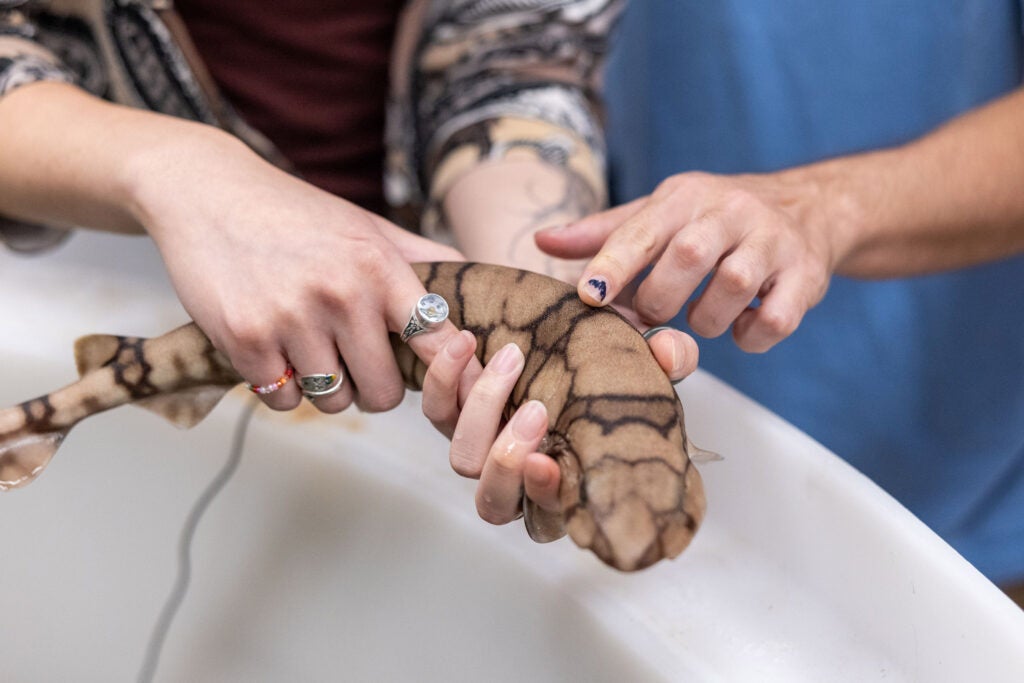
Dakota Law cradled a small shark as two fellow student researchers leaned in to touch it. Before this summer, Law had never worked in a lab or held a shark. Now she’s done both, thanks to an undergraduate research program geared to students with disabilities.

The rising senior in engineering sciences at Smith College is one of three students studying sharks for eight weeks this summer through the Research Experience for Undergraduates program Accessible Sharks, funded by the National Science Foundation. She worked in the lab of Harvard’s George Lauder. Scientists from Woods Hole Oceanographic Institution and the University of Florida also took part.

Law, who has an invisible disability, talked about what the experience has meant for her. “I have been very hesitant and, honestly, kind of nervous about both going into the industry or continuing my journey through academia and how my disability might hinder my experience.”

None of that hesitation was evident in late July when Law’s peers in the program visited her in Lauder’s lab, and she showed off that chain catshark — and its denticles. The flat V-shaped shark scales, also known as “skin teeth,” have an enamel coating, dentin layer, pulp cavity, and blood vessels. They are of particular interest to researchers, Lauder included, because they help sharks swim more efficiently by reducing the drag around their bodies.

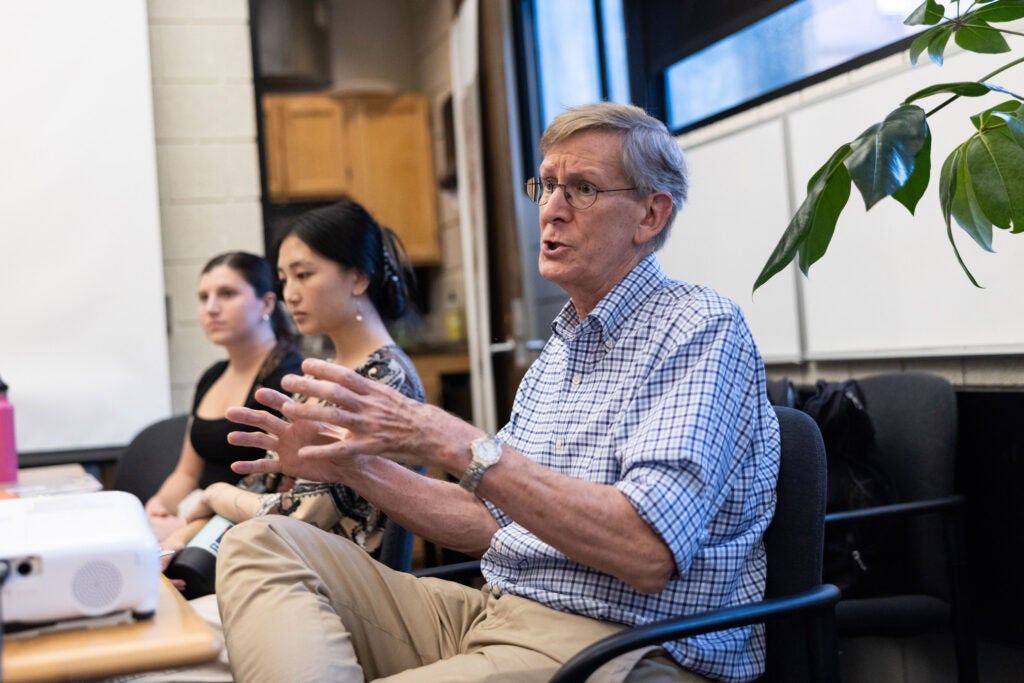
George Lauder.

George Lauder studies hydrodynamics of shark skin.

Law has spent much of the summer probing how denticles influence the flow of water over a swimming shark. She learned how to use different kinds of technology to analyze skin samples and collect data on movement.

“I think lots of us, especially these days, are trying to diversify access to science and the scientific experience,” said Lauder, Henry Bryant Bigelow Professor of Ichthyology and Harvard College Professor in the Department of Organismic and Evolutionary Biology. “That has many dimensions to it. It has dimensions of race, dimensions of economic accessibility, emotional accessibility, mental health accessibility. We’re all trying to diversify science for the future, and this is just a part of that.”

University of Florida rising senior Nick Wallis-Mauro worked in Elizabeth Sibert’s lab at the Woods Hole Oceanographic Institution as part of the program. His focus was microfossils. Sibert said that the goal of the research experience was to ground it in the science, not in disability.

“All of us are here for science,” she said. “As a scientist with a disability, I have felt very much alone and really appreciated any opportunities that I had to get to meet other people who also happen to be scientists and happen to be disabled in different ways.”

“I just really like sharks,” said Wallis-Mauro. “I saw this program and was like, ‘That’s crazy! Shark program for disabilities? That’s me!’”

This is the second year of the National Science Foundation grant for Lauder, Sibert, and Gareth Fraser of University of Florida to study sharks, but is the first year of the REU program. Researchers have discussed a plan to request additional funds to double the number of students next year. They also hope to inspire professors and researchers in other fields to lead similar opportunities for students with disabilities.

“It’s not hard to do … faculty just need to focus their efforts,” Lauder said.


MKRdezign

Contact Form

Name

Email *

Message *

Powered by Blogger.
Javascript DisablePlease Enable Javascript To See All Widget